The flamboyant tree, a fiery red species, is stunningly beautiful
The flamboyant tree has excellent ornamental value. When its flowering season arrives, the tree bursts into blazing red, eye-catching flamboyant flowers, as if a phoenix had truly landed on it, captivating anyone at first glance with a love-at-first-sight charm. Let us now take a look at how to cultivate this tree.
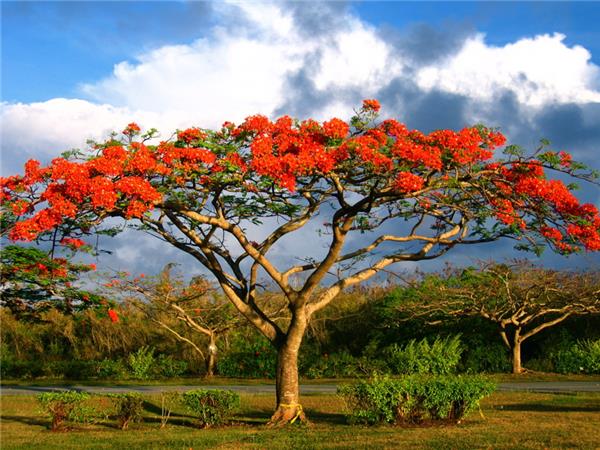
I. Cultivation and management techniques for the flamboyant tree
Soil conditions: Choose loose, fertile, well-drained loam or sandy loam. Such soil is suitable for the germination, growth and development of seedling seeds, and produces strong seedlings with few pests and diseases. Never choose clay, waterlogged low-lying land, saline-alkali land, vegetable garden plots or places with thin soil as a nursery site.
Seed treatment: The seed coat of the flamboyant tree is hard and thick, does not easily absorb water, and germinates slowly and unevenly, so seed treatment and germination acceleration are required before sowing. The conventional method is: 1 month before sowing, soak the seeds in water, changing the water every 3-5 days, so that the seeds fully absorb water and the seed coat softens; sow after the seed coat cracks open and shows white.
Correct sowing: Drill sowing is generally used for propagation. The sowing time is generally from late February to mid-April. The row spacing is 20-25cm, each furrow is 3-4 cm deep, and the furrow length equals the bed width (1m). Evenly sow 10-15 seeds per sowing furrow by dibbling, cover with 2.5-3cm of soil after sowing, cover with pine needles or rice straw, and water after sowing to keep the soil moist without becoming compacted, keeping the seedbed moist and preventing weed growth.
II. Control of root rot in the flamboyant tree
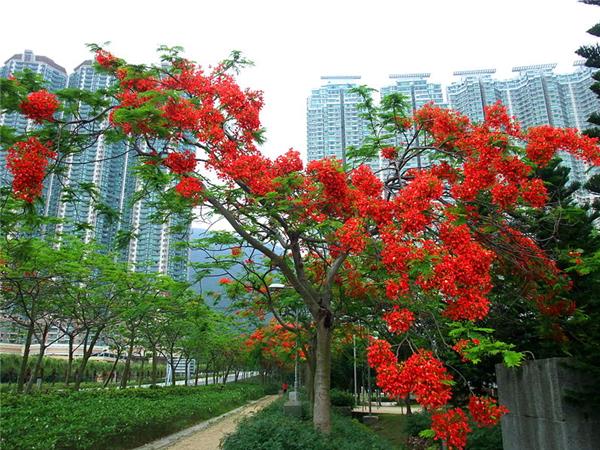
Symptoms: Because of its beautiful tree form and brilliant flower color, the flamboyant tree has become an important urban landscape greening tree species. This disease attacks the roots of the flamboyant tree, causing the roots to rot and the tree to die. In the early stage of the disease, the tree grows slowly, and the crown is sparse and shows yellowing. By the disease stage, the growth of the standing tree almost stops, and leaf fall makes the crown even sparser. At this time, white mycelium or reddish-brown fruiting bodies are commonly seen at the base of the diseased tree or on roots exposed above the ground. The surface of diseased roots, from fine roots to thick roots, is covered with mycelium in spider-web, fan-shaped or felt-like forms, and their tissues rot, with mycelium also growing in the wood tissues. In the final stage of the disease, the standing tree withers and dies, and many fruiting bodies grow from the roots at the base. This disease causes serious damage to flamboyant tree street trees and Acacia confusa stands in the central and southern regions, with trees over 10 years old being most susceptible.
Cause: The pathogen of this disease is Ganoderma lucidum. The spores of Ganoderma lucidum are spread by water or wind, and can also spread through tree roots in the soil.
Control methods:
1. Cut down diseased trees, dig out the roots and fruiting bodies, burn them in a centralized manner, and disinfect the soil.
2. Dig trenches to block the disease and spray a 750-fold dilution of 75% quintozene wettable powder to prevent the disease from spreading.
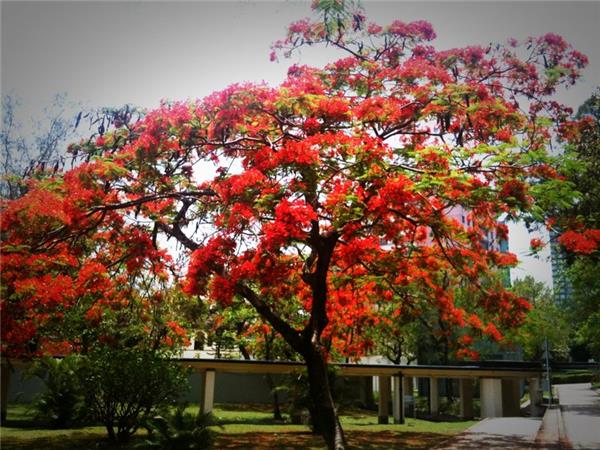
III. How to distinguish the flamboyant tree from the silk tree
1. The flamboyant tree has alternate bipinnate compound leaves, 2060cm long, with 1520 pairs of pinnae; the opposite pinnae are 510cm long and have 2040 pairs of leaflets; the leaflets are densely arranged, small, long elliptical, entire, with obtuse rounded tips and oblique bases, 48mm long and 2.53mm wide, thin papery, with smooth and thin leaf surfaces, blue-green, with only the midrib obvious among the veins, and silky hairs on both sides.
2. The silk tree is a deciduous tree with even-pinnate compound leaves, 412 pairs of pinnae, 10-30 pairs of leaflets, and leaflets oblong to linear, extremely oblique on both sides, 612mm long and 14mm wide, opening by day and closing at night.
3. The biggest difference between the flamboyant tree and the silk tree based on leaves alone is that the flamboyant tree has 1520 pairs of pinnae, while the silk tree has only 412 pairs of pinnae.
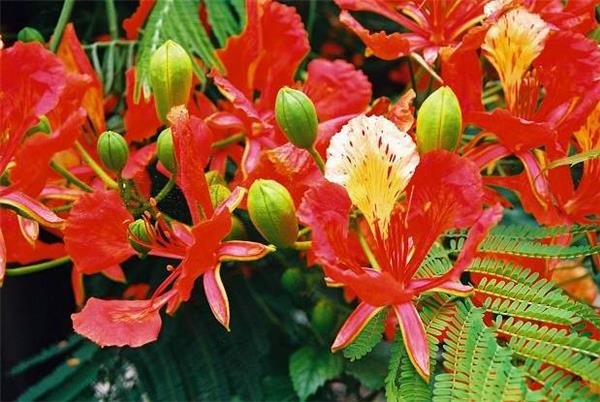
If you have a courtyard at home, choosing to plant a flamboyant tree in the courtyard will definitely give you abundant rewards, because with its magnificent beauty and fiery red color, it will make your courtyard deeply attract others' attention and win their admiration and envy.