Grafting and seedling propagation techniques and planting methods for the golden locust
The golden locust can be planted in various ways, including sowing, cuttings and grafting. Generally speaking, grafting has a higher survival rate and is the most economically beneficial method of propagation.
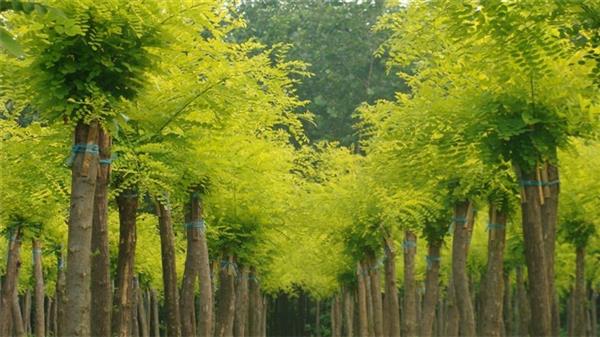
Grafting and seedling propagation techniques for the golden locust
Grafting time: in early to mid-April, before the rootstock seedlings have sprouted and when the sap is about to start flowing, is the most suitable time.
Grafting principles: cut one-year-old branches of the golden locust to use as scions, and remove the compound leaves before use. Because of hot weather and other reasons, it is best to take the scions as you graft, so as to avoid the scions being cut for too long and losing too much water, which would reduce the survival rate.
Grafting method: make the cut 1 to 1.5 cm above the bud on the scion branch, slicing straight downward and flat with a little wood, down to 1.5 to 2 cm below the base of the bud, then make a horizontal diagonal cut to remove the bud piece. Then choose a rootstock with a ground diameter of more than 0.5 cm, and on the smooth windward side about 5 cm above the ground on the rootstock, cut a face from top to bottom equal in both length and width to the bud piece; make a horizontal diagonal cut at the lower end to remove the sliced piece, then immediately insert the bud piece into the rootstock cut. Align the cut face with the cambium and press it tightly against the rootstock cut face. Bind it with a plastic film strip about 0.03 cm thick and 1.2 cm wide, wrapping the wound completely tight.
Training the trunk: for grafted seedlings, after they sprout in summer, remove sprouts promptly to promote the growth of new shoots. When the seedling reaches 60 cm in height, to train a straight trunk, tie the new shoot to a bamboo pole or wooden stick until it reaches the desired height. Root-collar budded seedlings can reach 3 cm in height and 2 cm in diameter at breast height in the same year, and can be lifted for nursery use in landscaping projects in 2 to 3 years.
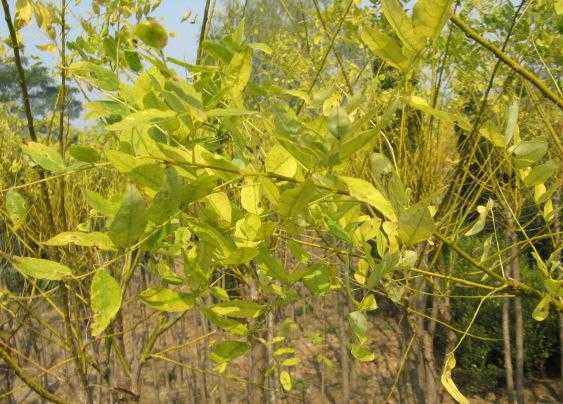
Cutting the rootstock and removing buds: cut the rootstock 1.5 cm above the grafted bud; the rootstock tends to sprout, so remove the sprouts promptly.
Topping and pinching: when the grafted bud grows to 6 cm to 8 cm, begin topping (that is, pinch off the tip). After topping, several side branches will grow; when they reach 6 cm to 8 cm, pinch again a second time. After two pinchings, one grafted bud can generally produce 12 to 16 side branches. It can be lifted and planted in winter of the same year or spring of the following year.
Pest and disease control: the golden locust is prone to damage by aphids and inchworms, and especially young seedlings suffer damage that weakens the tree's vigor and affects growth, so control must be timely.
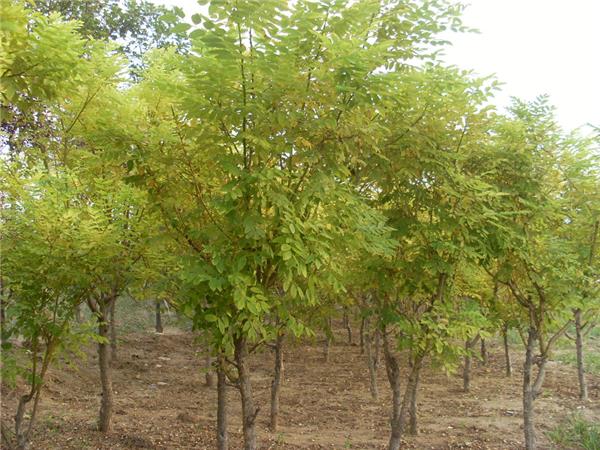
Differences between the golden locust and the golden-branch locust
[Color difference]: The most obvious time to see the golden-branch locust is winter, because it is a deciduous tree; after the leaves fall in winter, only the branches remain, and the branches are golden yellow. In spring, summer and autumn, the golden locust has golden yellow leaves and green branches.
[Price difference]: In the nursery stock market, there is great demand for colored-leaf trees. The parent of both the golden locust and the golden-branch locust is the Chinese scholar tree (Sophora japonica). Because the Chinese scholar tree has a short growth period and grows very slowly, its price is higher than that of the Chinese scholar tree. Relatively speaking, the price difference between the golden locust and the golden-branch locust is not great.
[Survival rate difference]: Verified by practice, grafting the golden-branch locust onto the Chinese scholar tree has a low survival rate, while grafting the golden locust has a high survival rate.
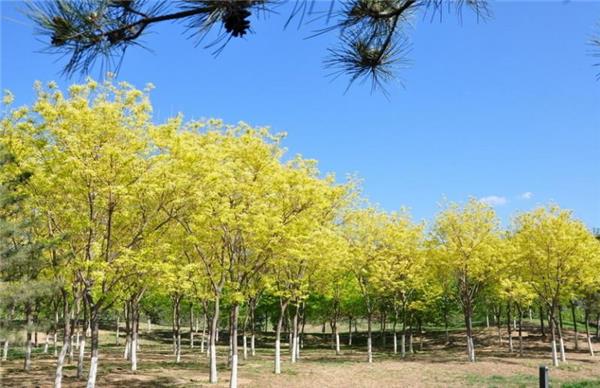
In landscape arrangement, the golden locust can be used both as a main tree species and as a mixed tree species, and is suitable for landscape arrangements with various planting effects such as solitary planting, clump planting and group planting. On lakeside embankments, paired with flowering and ornamental trees such as weeping willow, Chinese bishopwood, Chinese tallow tree, camphor tree, maple and peach, it makes the lake reflections even more brilliant and beautiful.