The Harm and Control Methods of the Firmiana Psyllid
The Firmiana psyllid, also known as the Firmiana psyllid, belongs to the order Homoptera, family Psyllidae. It is distributed in North China, East China, Central China and the Northwest, and is one of the most easily contracted insect pests of the Firmiana simplex tree, so it is very necessary to master some methods of controlling it.
I. Morphological Characteristics of the Firmiana Psyllid
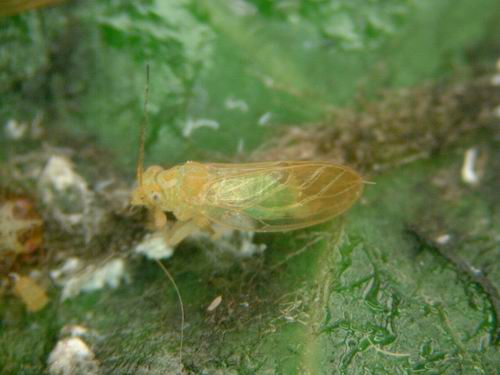
Adult: body length 4 mm to 5 mm, wingspan 12 mm to 13 mm, body yellow-green, head apex distinctly depressed, compound eyes hemispherical and protruding, three ocelli arranged in an inverted "" shape. Antennae yellow, 10 segments, the last two segments black, with two bristles at the tip. Pronotum arched, anterior and posterior margins dark brown. Mesonotum with two longitudinal brown lines, prescutum with a band-shaped groove, scutum with 6 longitudinal striae. Legs pale yellow, claws black, hind coxae with a pair of conical protrusions. Wings transparent, veins light brown. Abdominal tergites pale yellow, each segment with a brown transverse band at the anterior end. Male adult body length 4 mm to 4.5 mm, with 7 visible abdominal tergites and 6 visible sternites. The abdomen and abdominal tergites of the female each have one more segment than those of the male.
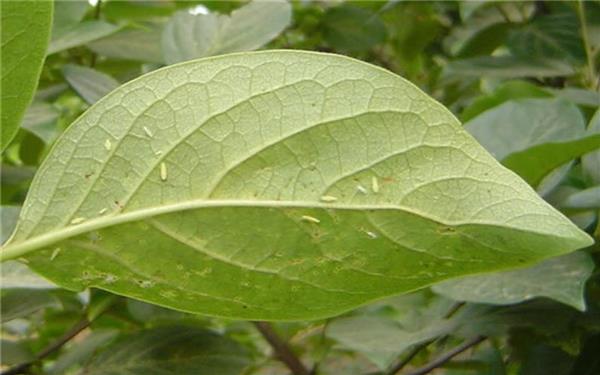
Egg: elongate-oval, slightly pointed at one end, length 0.7 mm, pale yellow or yellow-brown when newly laid, red-yellow near hatching, with red eye spots visible.
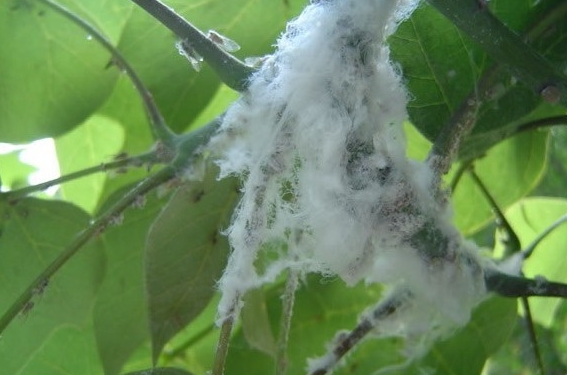
Nymph: five instars in total. The 1st to 2nd instar nymphs have a flattened body, slightly rectangular, yellow or green. The final instar nymph has a nearly cylindrical body, tea-yellow often tinged with green, with well-developed wax glands on the abdomen, so the body is covered with white flocculent material. Antennae 10 segments, wing pads well developed, veins visible, with a pair of black spots between the wing pads.
II. Occurrence Symptoms of the Firmiana Psyllid
In the central-southern part of North China, the Firmiana psyllid has 3 generations per year, overwintering as eggs on branches and trunks. From late April to early May of the following year, the overwintering eggs hatch successively, and the 1st generation nymphs cause damage, with a nymph duration of about 30 days. In late June the 2nd generation nymphs begin to appear, with mid-July being the peak activity period. In early to mid-September the 3rd generation nymphs cause damage, and in late October the adults gradually lay eggs to overwinter. The development of this insect is very uneven, with severe overlapping of generations.
The Firmiana psyllid is an important pest of Firmiana simplex. Both adults and nymphs cause damage by piercing and sucking, and the nymphs can also secrete large amounts of waxy floc, affecting the tree's photosynthesis and respiration. In May to June the waxy floc falls in profusion, seriously polluting the surrounding environment. The nymphs secrete waxy floc, and honeydew leads to the occurrence of sooty mold, thus causing the Firmiana simplex to suffer double damage. In severe cases the leaves fall early, the twigs and tips dry up, the bark becomes rough, and the tree is prone to wind breakage, seriously affecting the growth and development of the tree.
III. Control Methods of the Firmiana Psyllid
1. Chemical control: in mid to late May, spray 10% imidacloprid powder at 2000-2500 times dilution, 2.5% imidacloprid at 1000 times dilution, or 1.8% abamectin at 2500-3000 times dilution.
2. Pay attention to protecting and utilizing natural enemy insects such as parasitic wasps, ladybugs and lacewings.
3. Root application of pesticides has a good effect on controlling the Firmiana psyllid. This method overcomes the shortcomings of spray application, requires no equipment, is simple to operate and safe to use. For the pesticide, it is best to choose insecticides with systemic action, such as imidacloprid, omethoate and acephate. In addition, some non-systemic insecticides can also be used for root-zone application, such as beta-cypermethrin. For the use of pesticides on Firmiana simplex in urban landscaping, pay attention to choosing low-toxicity pesticides.
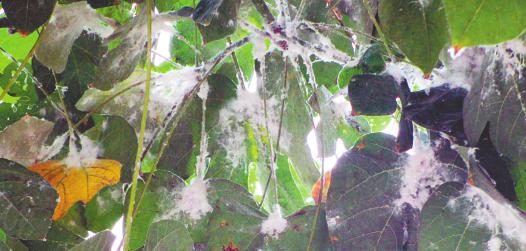
Besides the Firmiana psyllid, the cotton leaf roller can also cause the same damage to Firmiana simplex trees, and its control can also adopt the two control methods of chemical pesticide control and natural enemy protection.