What are the key points to note when growing hawthorn trees?
The hawthorn tree is a tree species with relatively high economic value, so more and more people are growing hawthorn trees now. So what should be noted when growing hawthorn trees to help them grow healthily and vigorously?
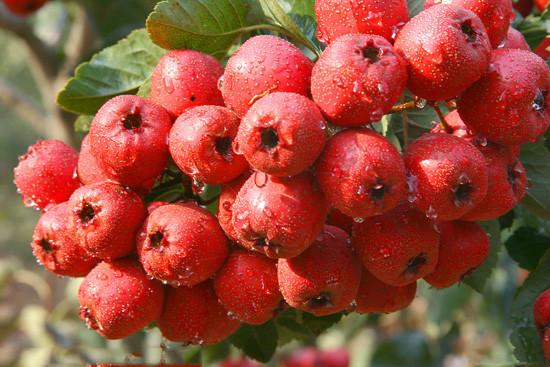
I. Key points for fertilizing hawthorn trees
Base fertilizer: It is best to apply it promptly in late autumn after the fruit is harvested, as this can promote the tree's absorption and accumulation of nutrients and is beneficial for flower bud differentiation. The base fertilizer should preferably be mainly organic fertilizer, combined with a certain amount of chemical fertilizer. The amounts of chemical fertilizer are as follows: nitrogen fertilizer used as base fertilizer generally accounts for about half of the annual application rate, equivalent to applying 0.25 kg to 1.0 kg of urea or 0.7 kg to 5.0 kg of ammonium bicarbonate; phosphorus fertilizer is generally mainly used as base fertilizer, accounting for about 80% of the annual application rate, equivalent to applying 1.0 kg to 5.0 kg of superphosphate containing 16% phosphorus pentoxide.
Topdressing at flowering stage: Mainly nitrogen fertilizer, generally about 25% of the annual application rate, equivalent to applying 0.1 kg to 0.5 kg of urea or 0.3 kg to 1.3 kg of ammonium bicarbonate per tree. According to actual conditions, an appropriate amount of phosphorus and potassium fertilizer can also be applied as needed. Apply it in small furrows combined with irrigation.
Topdressing at fruit swelling stage: Mainly potassium fertilizer, combined with a certain amount of nitrogen and phosphorus fertilizer, mainly to promote fruit growth, increase the carbohydrate content of hawthorn, increase yield and improve quality.
Note: Hawthorn has a relatively low demand for trace element fertilizers and mainly relies on organic fertilizer and soil to provide them. If more organic fertilizer is applied, trace element fertilizers may not be applied or only a small amount may be applied; if less organic fertilizer is applied, trace element fertilizers may be applied appropriately.
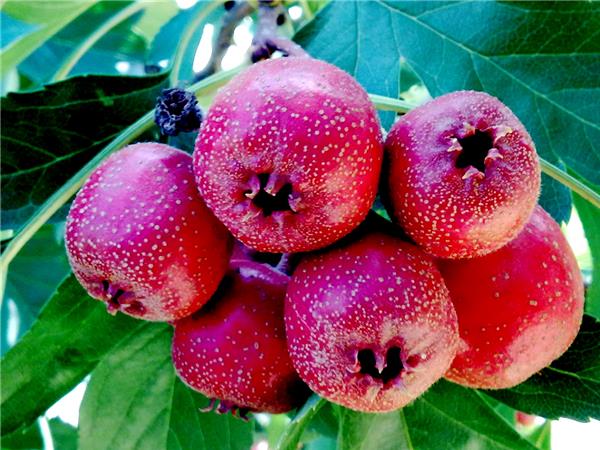
II. Key points for pruning hawthorn trees
When shaping young hawthorn trees, the trunk should be low and the opening angle of the scaffold branches should be large, so as to make full use of light, heat resources and space; rationally use auxiliary nurturing branches to maintain a moderate and vigorous tree vigor and good ventilation and light conditions within the canopy.
When young hawthorn trees grow too vigorously, they form fewer flower buds and have a low fruit-setting rate; when the tree vigor is strong, there are more flower buds, but the quality is poorer, the fruit-setting rate is low, and flower and fruit drop is severe; only by maintaining moderate tree vigor can continuous high yields be obtained year after year.
The alternate bearing of hawthorn trees is not obvious, but if pruning is too heavy, vegetative growth is too vigorous, stored nutrients are very few, or the number of fruits is too large, alternate bearing may also occur.
The vegetative growth of young hawthorn trees is generally more vigorous than that of apple trees and pear trees. If the tree shape is forced during pruning and the pruning amount is too heavy, it is very easy to cause excessive vegetative growth, inhibit flower bud formation, and delay the years to fruiting. When shaping young trees, using the method of leaving long branches unpruned to cultivate fruiting branch groups is also often inappropriate. After long branches are left unpruned, due to the low sprouting rate and the weak conversion ability of medium and short branches, the branch axis is prone to becoming bare, and if too many long branches are left unpruned and too densely arranged, due to poor ventilation and light transmission, the self-thinning of medium and short branches and the outward movement of fruiting positions become very serious.
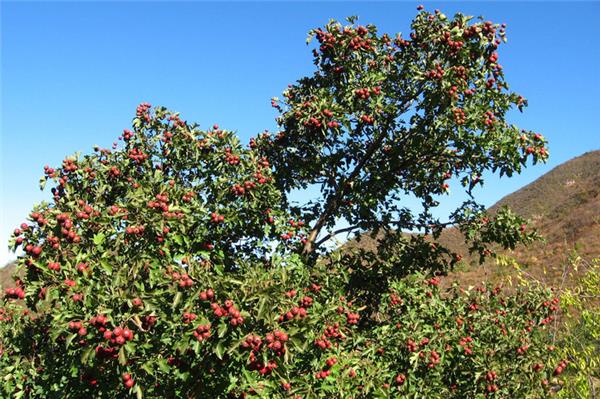
III. Key points for pest and disease control in hawthorn trees
Leaf yellow mottle virus disease: Infected plants show yellow mottling or variegation on the leaves, generally yellow. The mottling has different forms; sometimes the chlorosis is very slight, and sometimes there are irregular blotches or spots. Flowers sometimes also show mottling or marbling. According to experiments, grafting can transmit hawthorn leaf yellow mottle virus disease. If a diseased plant is used as rootstock, this disease is likely to appear on the scion. The control method is to avoid using scions from diseased trees for cuttings, and do not use diseased plants as rootstock.
Spot disease: Infected leaves first show small round dots, and after a period of time form round or oval spots, 2 mm to 7 mm in size. The lesions are dark brown to smoky gray, with slightly raised edges. Sometimes there is a dark brown band between the necrotic area and the healthy part. Later, small black dots grow on the surface of the lesions. The control method is to remove diseased leaves and spray 75% chlorothalonil 600 times dilution, or 0.15% potassium permanganate solution.
Hawthorn powdery mildew: Mainly harms leaves, new shoots and fruits. When leaves are affected, the diseased parts are covered with white powder in a blanket-like form, namely conidiophores and conidia. When new shoots are affected, in addition to the appearance of white powder, growth is weak. Internodes shorten, leaves become slender, curled and distorted, and in severe cases they dry up and die. The control method can be to clean the orchard, clear away diseased branches, diseased leaves and diseased fruits, and burn them in a centralized manner. Or use chemical control. Before germination, spray 5-degree lime sulfur mixture; during the flower bud stage, when airborne spores increase, spray 5-degree lime sulfur mixture; after flower drop to the young fruit stage, depending on the incidence, spray 1 to 2 times of 0.3-degree lime sulfur mixture or 25% triadimefon 1000 to 1500 times dilution.
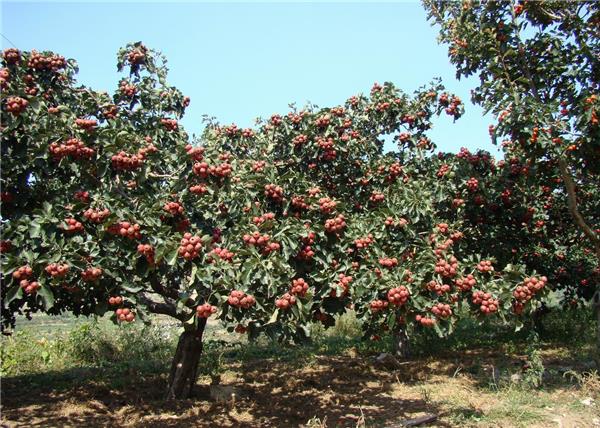
The hawthorn tree not only has fruits that can be used as medicine and food, but is also a relatively typical ornamental fruit tree species. Planting it in a courtyard can play a good role in decorating and beautifying the courtyard, so it is an excellent choice for tree planting.
It is also a relatively typical ornamental fruit tree species. Planting it in a courtyard can play a good role in decorating and beautifying the courtyard, so it is an excellent choice for tree planting.