What are the propagation and cultivation methods for the marigold?
The marigold is a typical flowering ornamental plant. Its blooms are elegant and luxurious, its colors bright and eye-catching, and its symbolism auspicious and beautiful. It is a flower that is both suitable for growing at home and for giving as a gift to relatives and friends.
I. Introduction to the marigold
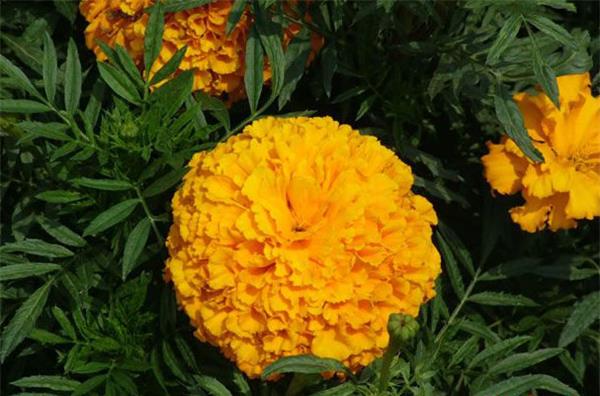
Annual herb, 50-150 cm tall. Stem erect, stout, with longitudinal fine ridges, branches spreading upward and flat. Leaves pinnately divided, segments oblong or lanceolate, margins sharply serrate, the tooth tips of the upper leaf segments bearing long fine awns; a few glands along the leaf margins. Capitulum solitary, the peduncle apex club-shaped and swollen; involucre apex with toothed tips; ligulate florets yellow or dark orange, the ligule obovate, base contracted into a long claw, apex slightly emarginate; tubular florets with yellow corolla, apex with 5 tooth-like lobes. Achene linear, base narrowed, black or brown, covered with short fine hairs; pappus with short, blunt scales.
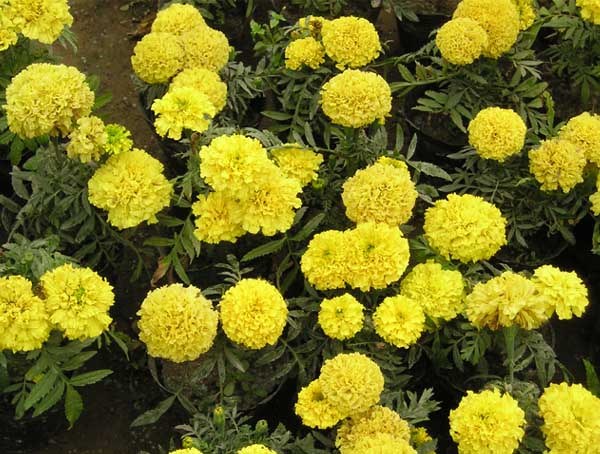
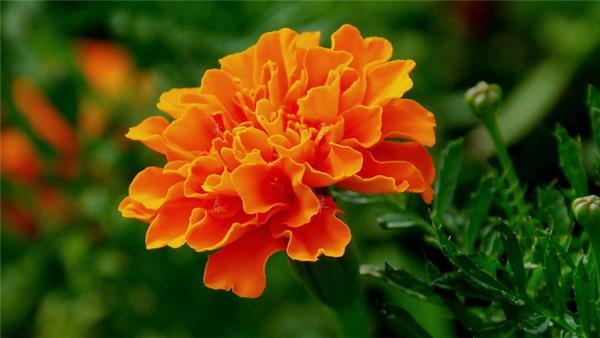
The marigold's flowering period is from July to September. When the marigold blooms, the hemispherical flowers are golden and yellow-orange, the plump petals overlapping layer upon layer; the flowers are large and beautiful in color, the leaves green and the flowers vivid, yellow and green complementing each other, exceptionally dazzling and delightful to the eye.
Flower language: friendship, health, sweet love, health and longevity, the sorrow of parting.
II. Propagation methods of the marigold
Sowing propagation: sow in spring, the temperature must be suitable, be careful to avoid light
It is best to sow the marigold in spring, when the sunlight is not strong and the temperature is fairly suitable. Because the marigold's seeds are rather sensitive to light, after sowing them into the soil, be careful to cover the soil surface slightly with vermiculite, so that light does not penetrate into the soil and affect the seeds' germination and growth. Generally speaking, after the soil in which the seeds are growing has spent a week at room temperature, they will germinate, and flowering will take about three more months.
Cuttage propagation: take cuttings in summer, roots form quickly, survival rate is high
Cut a young shoot about ten cm long from a robust main branch of the marigold to use as a cutting. Remove the lower leaves of the marigold cutting, cut the base at an angle, and insert it into the potting soil. After appropriate watering and shading, it will generally take root in about half a month. The marigold's cuttage survival rate is relatively high, and it also flowers fairly quickly; roughly one more month after rooting, it will bloom.
III. Cultivation methods of the marigold
Light: The marigold is a light-loving plant and is not shade-tolerant, so it must be planted in a flowerbed or other plot with ample light; for potted marigolds, they must also be placed in conditions with light for care and management.
Watering: It likes a warm, moist soil environment and is drought-tolerant. Avoid excessive moisture and waterlogging; when the potting soil is too wet, the roots easily rot, so watering should follow the principle of "alternating dry and wet." After rain during the plum rain season, check and promptly pour off any accumulated water in the pot.
Fertilizing: Because the marigold's flowering period is relatively long, additional fertilizer is needed to supply nutrients, but it must not be applied too much; nitrogen fertilizer must be controlled, otherwise the branches and leaves will grow excessively and not flower. Generally apply 1 time per month a fully decomposed, thin organic liquid fertilizer or a nitrogen, phosphorus, and potassium compound liquid fertilizer.
Pruning: To make the flowers large, promptly thin out or heavily pinch back leggy branches, dead branches, weak branches, and post-bloom branches. For overly dense branches, thin them out to improve light and retain strong branches, but they must not be pinched back, so that the flower buds at the top develop fully. In windy seasons, pruning and pinching should also be used to control plant height to prevent lodging. Otherwise, stakes must be set up to prevent the wind from blowing the plant over.
Pests: In dry weather with high temperatures, red spider mites are prone to harming the leaves; it is advisable to spray a 1000-1500 times dilution of Jingyebao.
Overall, the marigold's cultivation methods are relatively simple and easy to pick up, so even if you are new to flower growing, it does not matter; the marigold can help you train your flower-growing skills.