How wonderful is the sky-blue mushroom? Learn to tell poisonous mushrooms from non-poisonous ones
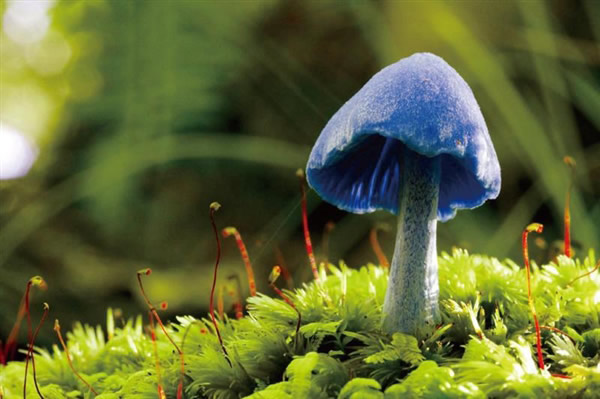
The sky-blue mushroom is known as one of the "ten most wonderful mushrooms in the world." Along with it are others such as turkey tail mushroom; these are all inedible mushrooms with distinctive looks and very high recognizability.
I. What are the sky-blue mushroom and the turkey tail mushroom
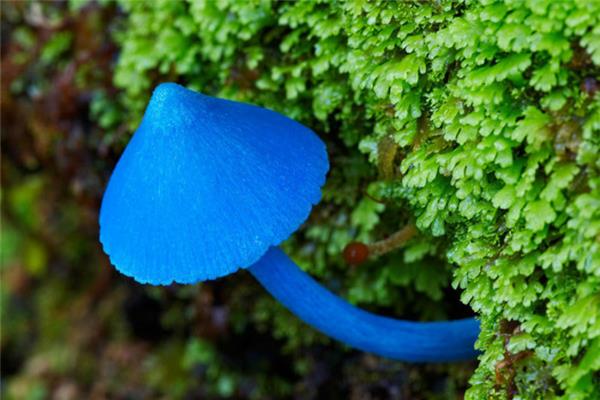
The sky-blue mushroom's scientific name is "Entoloma hochstetteri," and it lives in woodland in the western parts of New Zealand's North and South Islands and in parts of India. This small mushroom is very delicate, mainly blue, with only the spore-bearing gills tinged with red. Its blue outer coat is caused by 3 kinds of pigments. In 2002, New Zealand issued a set of stamps covering 6 native fungal species, among which was the sky-blue mushroom. In addition, this mushroom also appeared on the back of the 50-yuan banknote issued by the Reserve Bank of New Zealand in 1990. The sky-blue mushroom is inedible, and whether it is poisonous is still unknown.
The turkey tail mushroom's scientific name is "Trametes versicolor," and it is distributed all over the world, usually growing in groups on the trunks of dead trees. The name "turkey tail" comes from their appearance, which resembles the fan-shaped tail of a wild turkey. Sometimes, because algae "colonize" on them, turkey tail mushrooms develop green stripes. Although inedible, in the field of traditional Chinese medicine this mushroom has also found its own place. Recently, scientists extracted polysaccharide-K (PSK) from the turkey tail mushroom, an immune system booster. At present, Japan has approved the use of polysaccharide-K as an adjuvant for cancer treatment.
II. Methods for identifying poisonous and non-poisonous mushrooms
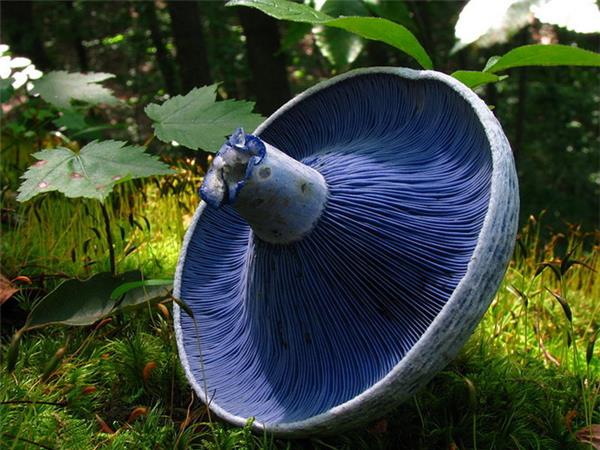
1. In terms of color, poisonous mushrooms are brightly colored, often red, green or yellow, with a raised center.
2. The cap often bears mottled spots, and the surface has filaments or small bits of debris or scales. Non-poisonous mushrooms are generally not brightly colored, with a flatter cap and a smooth surface.
3. In terms of secretions, the cap or injured parts of poisonous mushrooms often secrete a sticky, thick liquid, with a reddish-brown color and a pungent or other off odor, and the cap easily changes color after being torn. Non-poisonous mushrooms are generally drier, and the liquid secreted after breaking is white, with a distinctive fragrance, and the cap generally does not change color after being torn.
4. Poisonous mushrooms have a ring on the stem, and it breaks easily; the lower part has a volva, and the base of the root has cysts, and the stem is very hard to tear open by hand. Non-poisonous mushrooms have no ring on the stem and no volva at the lower part, and the stem tears open easily by hand.
5. For chemical identification, squeeze out the juice of a poisonous mushroom, spread it on paper, and after it dries, drop one drop of concentrated hydrochloric acid on it; after 20 minutes it turns blue or immediately turns red, and after 30 minutes it turns blue.
III. How to fertilize potted mushrooms
Mushroom foot water: Take 5 kg of fresh mushroom roots, wash them, add 15-20 kg of water, boil for 15 minutes, take the clear liquid and add 40 kg of water, dilute evenly, then spray. This can extend the peak fruiting period and make the fruiting bodies plump.
Soy milk water: Use 1 kg of soybeans that are not moldy or spoiled, soak them, grind them into soy milk, add 50 kg of water, filter out the residue, then spray. It can thicken and whiten the mushroom surface, make the mushroom feet sturdy, and increase yield by about 10%, but do not use it when the temperature is high, to prevent infection by stray microbes.
Carrot juice: Chop 5 kg of fresh carrots, add 10 kg of water, boil for 30 minutes, filter out the residue and take the juice, add 50 kg of water, then spray. It can promote mushroom growth.
Compost soak liquid: Take 5 kg of dry compost, add 50 kg of boiling water, cover tightly and let it steep, then after cooling remove the residue and spray. This solution can extend the peak fruiting period and make the fruiting bodies plump.
Sugar liquid: 1 kg of sucrose (0.5 kg of glucose powder), add 50 kg of water, dissolve and then spray. Use with caution when the temperature is high, to avoid infection by stray microbes, and pay attention to preventing ants after spraying. If 0.5 kg of calcium carbonate is added, the effect is even better.
Judging whether a mushroom is poisonous from its appearance is the most commonly used method for ordinary people. Although they cannot be eaten, it does not hurt to try growing them, but during the planting process, be sure to take protective measures to avoid dangers such as accidental ingestion.