Detailed Guide to Grape Cultivation Techniques: Planting Methods and Management Essentials
Grape growing has a very long history, but nowadays fewer and fewer families have a yard, and potted grapes are something many flower enthusiasts want to try. However, since the grapevine is a relatively large climbing plant, many enthusiasts who grow grapes in pots are not very confident about it. What are the cultivation techniques for potted grapes? How many methods are there for propagating grape seedlings?
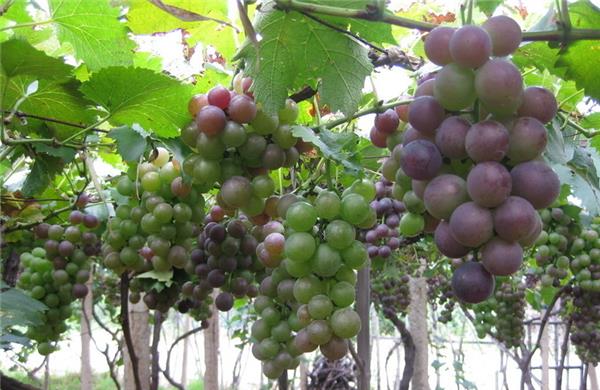
How many methods are there for propagating grape seedlings?
There are usually two methods for propagating grape seedlings: one is asexual propagation, namely vegetative propagation; the other is sexual propagation, namely seed propagation.
Vegetative propagation is a method of propagating and cultivating seedlings using a part of the organs of the grape plant, mainly the stem. Its advantages are that the new plant varies little, can maintain the variety characteristics of the mother plant, and can be propagated multiple times in a year. Plants propagated by this method take shape early, grow quickly, and enter the fruiting stage early, so it is widely used in production. Asexual propagation methods include hardwood cuttings, green cuttings, layering, grafting, and tissue culture of stem tips and stem segments, among which hardwood cuttings and grafting are the most widely used, and are also relatively traditional methods. Tissue culture seedling propagation is a modern propagation method with relatively large investment and higher requirements for facilities and technology.
Sexual propagation is a method of producing new plants using seeds, and is the result of sexual hybridization and genetic recombination. The new plants obtained have great genetic variation and it is difficult to maintain the characteristics of the original variety, so this method is not used for propagating superior varieties. Traditional conventional grape breeding usually adopts seed propagation, obtaining hybrid seeds through hybridization, and then selecting new varieties with superior traits from a large number of seedlings. This method is often used for breeding new grape varieties but is labor-intensive, time-consuming, and has a long breeding cycle, so it is generally not suitable for seedling propagation.
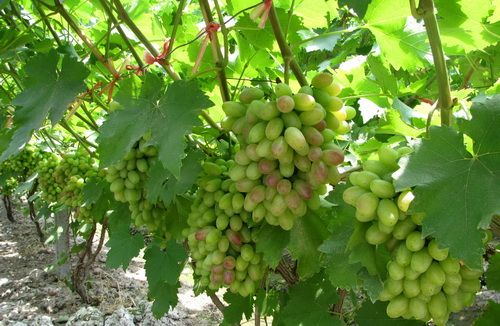
Grape trellising (double-cross V-shaped trellis)
The main pole, top tension wire, stake wire, and ground anchor stones of the double-cross V-shaped trellis are all set up the same as for a single hedge trellis. In the first year, a wire (single strand) is stretched lengthwise on the concrete post at 80 cm above the ground to facilitate tying small bamboo. In the second year, before the grapes bud, on the other side of the concrete post, another single strand is stretched parallel to the wire from the first year. At the same time, two beams are mounted on the concrete post. The first crossbeam is fixed with a hoop at 120 cm above the ground, and the crossbeam length is 40-50 cm. The second crossbeam is mounted at 160 cm above the ground, and the crossbeam length is 80-100 cm. The crossbeams are made of 3×3 angle steel. On one side of the horizontal angle steel, two holes are drilled at equal intervals in the middle for fixing the hoop, and one small hole is drilled at each end; the size of the small hole should be just enough for the wire to pass through, and should not be too large. After the horizontal angle steel is made, it is painted with anti-rust paint and then fixed to the concrete post to prevent corrosion; galvanized anti-rust treatment is even better. After the crossbeams are fixed, a wire is stretched through the middle of the holes at both ends; after one end is fixed, the other end is tightened with a wire tensioner and then fixed. When tightening, two wire tensioners should be used at both ends of the crossbeam to tighten simultaneously so that the force is balanced. In this way, a total of seven wires are stretched on a row of concrete posts. In the future, each grapevine will keep four fruiting mother branches, two on each side, tied horizontally to the two wires at the bottom layer. After the fruiting branches emerge, they are gradually tied to the wires at both ends of the crossbeams, forming a 45-degree V shape, hence the name double-cross V-shaped trellis. This also forms a cultivation layout with a ventilation zone below, a fruiting zone in the middle, and a photosynthesis zone above.
Pest and damage prevention for potted grapes
Preventing bird damage (when the grapes are about to ripen, birds specially peck at the already ripe grapes): making newspaper bagging for grapes has a good effect, not only reducing sunburn, preventing pathogen infection, and preventing bird damage, but also making bagging convenient. Each large newspaper can be made into 4 paper bags, costing less than 1 fen, with a bag length of 27 cm and a width of 20 cm; prepare 6-8 cm thin wire for later use. Sew the side of the bag with a sewing machine, staple the middle of the lower opening with a stapler, and leave 6 cm ventilation holes on each side. If used in orchards with high summer temperature and high humidity, the lower opening may be left unsealed to enhance moisture drainage performance. Bag the fruit when the berries are the size of soybean grains. Before bagging, the cluster needs to be trimmed and berries thinned, and fungicides, insecticides, and quick-acting calcium should be sprayed. Bagging should be done after the morning dew has dried and before evening; when bagging at noon, try to avoid the period of highest temperature and places with direct sunlight. The time for removing bags should be determined according to the variety and the market time. For medium-early maturing varieties and varieties that color easily, it is suitable to remove the bags 7-10 days before harvest; for late-maturing varieties, it is suitable to remove the bags 10-15 days before harvest. After removing the bags, leaves should be removed and the fruit turned.
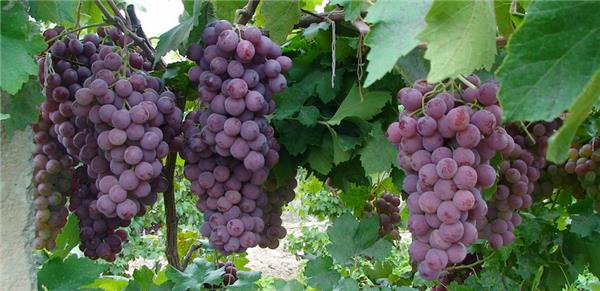
Disease control: Before the grape buds sprout, spray 50-100 times Solibar or spray 3-5 degrees Baumé lime sulfur mixture (adding 0.3% washing powder gives a better effect). For orchards where diseases such as rotten fruit disease occurred seriously in the previous year, lime should be spread on the ground before the disease occurs; or spray 50% carbendazim 500-600 times solution under the trellis to control the primary infection sources overwintering from the soil.
Focus on prevention and spray pesticides promptly: For pesticides with a residual effect period of 17-21 days, spray once every 15 days. If rain occurs in between, shorten the number of days until the next spraying as appropriate. If heavy rain occurs immediately after spraying, spray again after the weather clears. If two adjacent pesticides are respectively alkaline or acidic, strictly control the interval time to prevent the two pesticides from acid-base neutralization.
At the first sign of disease, treat promptly: Continuous rainy weather with high temperature and high humidity makes plants most susceptible to disease. Observe every day, and spray the appropriate pesticide as soon as disease first appears. Use 70% Kebo 600 times solution, 80% phosethyl aluminum 300 times solution, or 1:0.7:180 Bordeaux mixture to control downy mildew;
Use Bordeaux mixture as the main treatment, with other pesticides as appropriate: This method has a very good disease prevention effect. Spray 1:0.5:240 solution once before flowering, spray 1:0.7:220 solution once after flowering, spray 1:0.7:200 solution once during the grape swelling stage, spray 1:1:180 solution once after grape harvest, and spray 1:1:160 solution 1-2 times in autumn. If white rot or anthracnose occurs in between, spray the appropriate pesticide. These pesticides are mostly acidic and should have strictly controlled intervals from Bordeaux mixture.
Clear the orchard at the right time to curb the spread of disease sources: If disease occurs, because of high temperature and high humidity, disease spreads most easily. The orchard should be cleared at any time. Remove diseased leaves, diseased branches, and diseased fruits from the orchard and bury them deeply or burn them. Remove weeds from the orchard in time. When pruning diseased branches and diseased fruits, frequently clean the scissors and disinfect them to prevent cross-infection.
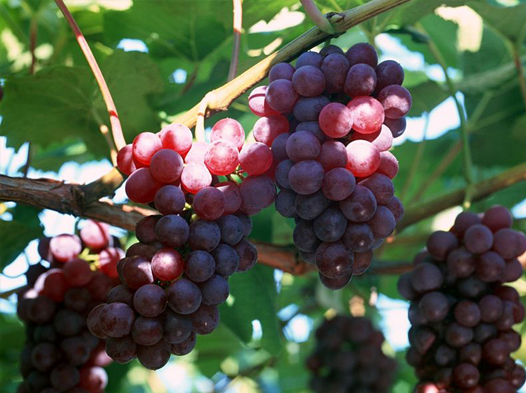
Relationship between grape root characteristics and fertilization
The main skeleton roots of grapes mainly transport nutrients and water, and are also an important place for nutrient storage; their storage amount can account for 70%-85% of all nutrients in the tree. Grape root growth has two peaks within a year. The first peak is in May-June, and the second peak is in September-October. In production, this characteristic is often used to apply base fertilizer deeply in late autumn to promote root growth and development.
The most suitable soil for grape root growth is still fertile, loose sandy loam, requiring a pH between 5-8, with pH 6-7 being most suitable. When the pH of red-yellow soil hilly wasteland in Jiangnan is 4-5.5, lime and organic fertilizer should be applied to improve it; on saline-alkali soil or calcareous soil with a pH of 8.3-8.7, yellow leaf disease occurs due to lack of trace elements, and gypsum and organic fertilizer should be applied for improvement. Grape roots also have certain requirements for soil moisture, with 60-70% of field water-holding capacity being most suitable. Too little or too much water affects grape yield, quality, and diseases.
Conventional fertilization methods for high-yield grapes
Based on the calculation that every 100 kg of fruit absorbs N: 0.3-0.55 kg, P2O5: 0.13-0.28 kg, K2O: 0.28-0.64 kg from the soil, for a yield of 1800-2000 kg of grapes per mu, apply 5000-6000 kg of barnyard manure per mu per year; N: 10-15 kg; P2O5: 8-10 kg; K2O: 15-20 kg. Apply 100-120 kg of barnyard manure or 25-40 kg of poultry manure per plant per year. Quick-acting fertilizer 1-2 kg.
Application method of Tianyun fertilizer
1. For full-bearing trees, apply 400-600 kg of Tianyun fertilizer 7.5% powder per mu per year, or 10-12 kg per plant per year. For young trees, the amount is halved.
2. Base fertilizer amount in September-October: use 4-5 kg of powder per plant. The first topdressing in April, 10-15 days before flowering, is 1-2 kg per plant; the second topdressing in May-June, during the fruit swelling stage, is 4-6 kg per plant.
3. Application method: Dig a disc-shaped trench or square hole 40-60 cm deep, apply fertilizer according to the amount, then water thoroughly, and afterward cover with soil to retain moisture. Note: do not mix with bactericidal pesticides.
Apply more organic fertilizer, fertilize and improve the soil, improve the soil conditions for grapevine growth, and lay a foundation for sustained high yield and high quality.
Focus on prevention and spray pesticides promptly: For pesticides with a residual effect period of 17-21 days, spray once every 15 days. If rain occurs in between, shorten the number of days until the next spraying as appropriate. If heavy rain occurs immediately after spraying, spray again after the weather clears. If two adjacent pesticides are respectively alkaline or acidic, strictly control the interval time to prevent the two pesticides from acid-base neutralization.
At the first sign of disease, treat promptly: Continuous rainy weather with high temperature and high humidity makes plants most susceptible to disease. Observe every day, and spray the appropriate pesticide as soon as disease first appears. Use 70% Kebo 600 times solution, 80% phosethyl aluminum 300 times solution, or 1:0.7:180 Bordeaux mixture to control downy mildew;
Use Bordeaux mixture as the main treatment, with other pesticides as appropriate: This method has a very good disease prevention effect. Spray 1:0.5:240 solution once before flowering, spray 1:0.7:220 solution once after flowering, spray 1:0.7:200 solution once during the grape swelling stage, spray 1:1:180 solution once after grape harvest, and spray 1:1:160 solution 1-2 times in autumn. If white rot or anthracnose occurs in between, spray the appropriate pesticide. These pesticides are mostly acidic and should have strictly controlled intervals from Bordeaux mixture.
Clear the orchard at the right time to curb the spread of disease sources: If disease occurs, because of high temperature and high humidity, disease spreads most easily. The orchard should be cleared at any time. Remove diseased leaves, diseased branches, and diseased fruits from the orchard and bury them deeply or burn them. Remove weeds from the orchard in time. When pruning diseased branches and diseased fruits, frequently clean the scissors and disinfect them to prevent cross-infection.
Relationship between grape root characteristics and fertilization
The main skeleton roots of grapes mainly transport nutrients and water, and are also an important place for nutrient storage; their storage amount can account for 70%-85% of all nutrients in the tree. Grape root growth has two peaks within a year. The first peak is in May-June, and the second peak is in September-October. In production, this characteristic is often used to apply base fertilizer deeply in late autumn to promote root growth and development.
The most suitable soil for grape root growth is still fertile, loose sandy loam, requiring a pH between 5-8, with pH 6-7 being most suitable. When the pH of red-yellow soil hilly wasteland in Jiangnan is 4-5.5, lime and organic fertilizer should be applied to improve it; on saline-alkali soil or calcareous soil with a pH of 8.3-8.7, yellow leaf disease occurs due to lack of trace elements, and gypsum and organic fertilizer should be applied for improvement. Grape roots also have certain requirements for soil moisture, with 60-70% of field water-holding capacity being most suitable. Too little or too much water affects grape yield, quality, and diseases.
Conventional fertilization methods for high-yield grapes
Based on the calculation that every 100 kg of fruit absorbs N: 0.3-0.55 kg, P2O5: 0.13-0.28 kg, K2O: 0.28-0.64 kg from the soil, for a yield of 1800-2000 kg of grapes per mu, apply 5000-6000 kg of barnyard manure per mu per year; N: 10-15 kg; P2O5: 8-10 kg; K2O: 15-20 kg. Apply 100-120 kg of barnyard manure or 25-40 kg of poultry manure per plant per year. Quick-acting fertilizer 1-2 kg.
Application method of Tianyun fertilizer
1. For full-bearing trees, apply 400-600 kg of Tianyun fertilizer 7.5% powder per mu per year, or 10-12 kg per plant per year. For young trees, the amount is halved.
2. Base fertilizer amount in September-October: use 4-5 kg of powder per plant. The first topdressing in April, 10-15 days before flowering, is 1-2 kg per plant; the second topdressing in May-June, during the fruit swelling stage, is 4-6 kg per plant.
3. Application method: Dig a disc-shaped trench or square hole 40-60 cm deep, apply fertilizer according to the amount, then water thoroughly, and afterward cover with soil to retain moisture. Note: do not mix with bactericidal pesticides.
Apply more organic fertilizer, fertilize and improve the soil, improve the soil conditions for grapevine growth, and lay a foundation for sustained high yield and high quality.