A Detailed Guide to the Planting Techniques and Landscape Applications of Euonymus japonicus 'Aureo-marginatus'
Euonymus japonicus 'Aureo-marginatus' is relatively easy to grow; you just need to select the right seedlings or cuttings, and it will readily establish. However, in routine care, you still need to pay attention to preventing and controlling pests and diseases.
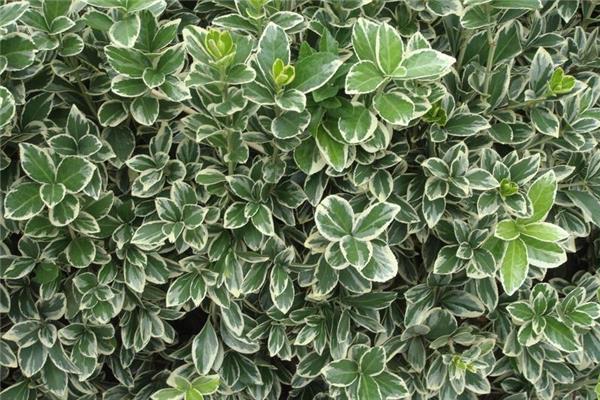
I. Planting Techniques for Euonymus japonicus 'Aureo-marginatus'
1. Cuttage is the most common method for Euonymus japonicus 'Aureo-marginatus'. During the cutting process, appropriate temperature and humidity must be maintained. Watering should be based on temperature and humidity. Follow the principle of watering when dry to keep the leaves moist, but avoid waterlogging, which can cause root rot and prolong rooting time. After the seedlings root, watering can be reduced appropriately. After cutting, the seedlings generally root in about 30 days.
2. When taking cuttings, do not choose shoots that are too tender. Choose ones with a high degree of lignification, as they root and sprout more easily. When pruning, keep the main stem and cut the side branches. After cutting, leave at least one bud as the "base" to facilitate the next cut. Remove the lower leaves from the cuttings and keep 2 to 3 leaves at the top. After the cuttings are prepared, soak them in rooting water. Then dig a furrow in the nursery. Place the cuttings at 5 to 10 cm intervals. After placing them, cover with soil and firm it down; a row spacing of 10 to 20 cm is sufficient.
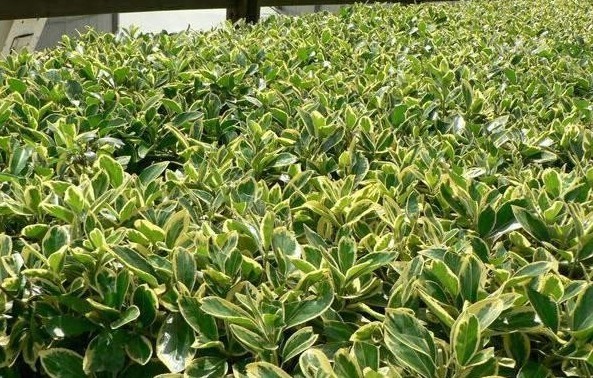
II. Control of Leaf Spot Disease in Euonymus japonicus 'Aureo-marginatus'
Harm: Leaf spot disease of Euonymus japonicus 'Aureo-marginatus' occurs on new leaves, producing small yellow spots that gradually expand into irregular yellowish-brown large spots. The diameter of the diseased spots is 2 mm to 10 mm. The edges of the spots are raised, with a relatively wide brown margin. Outside the raised edge there is an extending yellow halo; the center is yellowish-brown or grayish-brown, densely covered with small black dots. In severe cases, the spots merge into one mass, and the leaves turn yellow and fall off.
Control methods:
1. Select healthy, disease-free seedlings for planting.
2. In combination with pruning, remove and burn infected leaves as much as possible.
3. After pruning, spray Xiansheng at 800 times dilution or diniconazole at 2000 times dilution to eliminate residual pathogens. From early June to July, spray 50% carbendazim at 500 times dilution or 75% chlorothalonil at 500 times dilution, or 50% wettable powder of thiram at 800 to 1000 times dilution for prevention to reduce the incidence rate, spraying once every 10 to 15 days for 3 consecutive sprays.
4. In winter, clear fallen leaves and burn them in a centralized manner.
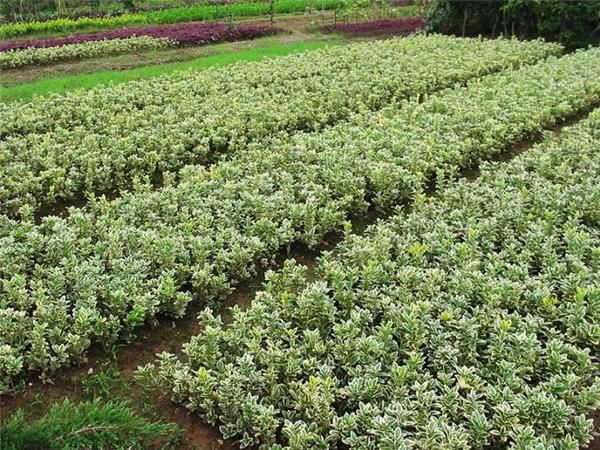
III. Landscape Applications of Euonymus japonicus 'Aureo-marginatus'
In landscape construction, the use of color is indispensable, and we often use three color blocks formed by red, yellow, and green shrubs to enrich the color composition of the landscape. Among the yellow small shrubs, the one we most often use is Euonymus japonicus 'Aureo-marginatus', but it also has its own shortcomings. Under poor conditions, its yellow color will be very inconspicuous, even indistinguishable from other green plants. This will fail to meet our needs for color composition, and in autumn and winter it will shed its leaves, which is also very discordant for color. However, Euonymus japonicus 'Aureo-marginatus' is a foliage plant; its leaf color is very glossy, and its young leaves are bright green. It is also very tolerant of pruning and is a common hedge tree species in courtyards, appearing especially beautiful in the center of flower beds.
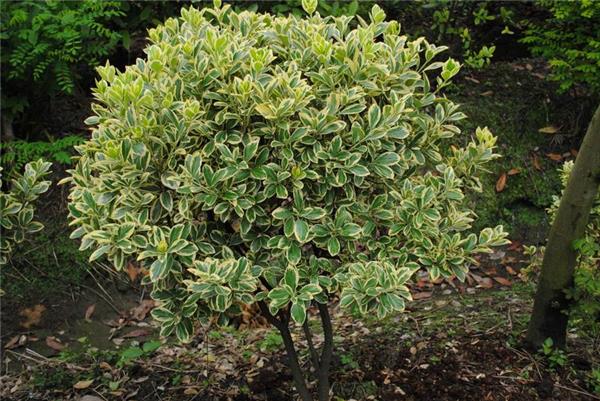
In addition to being used in landscape design, we can also use it to decorate our own courtyards, and smaller plants of Euonymus japonicus 'Aureo-marginatus' can also be grown as indoor potted plants, beautifying the room and purifying indoor air.