How to grow Abelia × grandiflora? A detailed guide to cultivation methods
For planting Abelia × grandiflora, the ground-planting method is more suitable. In landscaping projects, Abelia × grandiflora should be planted at a reasonable density to avoid leggy growth and distortion.
I. Introduction to Abelia × grandiflora
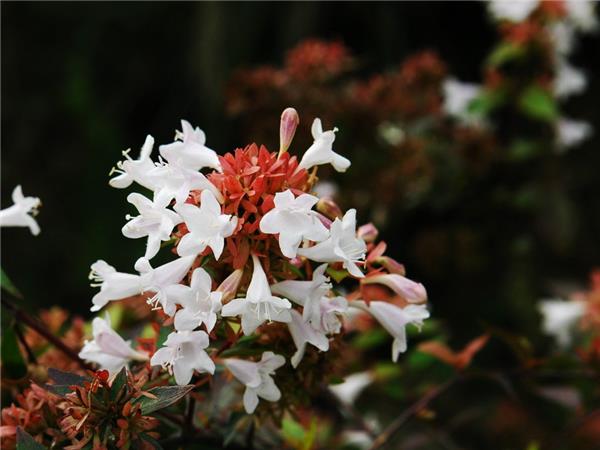
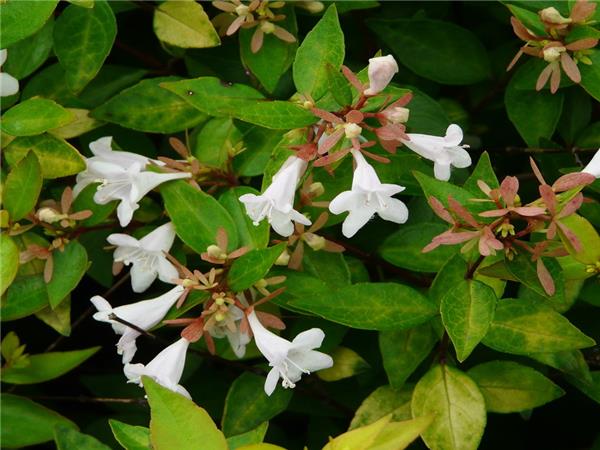
Morphological characteristics: An evergreen shrub, about 2 m tall. The branchlets are slender and round, purplish-red on the sunny side, arching. The leaves are small, ovate to oblong-lanceolate, with sparse shallow teeth on the margins, bright green on the upper surface and pale green on the underside. The inflorescence is a paniculate cyme; the flowers are small, white tinged with pink, abundant and fragrant. The flowering period is from June to October, sometimes extending to mid-November, blooming continuously.
Ecological habits: Native to Europe. It prefers light and is heat-tolerant and cold-tolerant. It has strong adaptability to soil and grows well in acidic, neutral or slightly alkaline soil, and it also has a certain tolerance to drought and poor soil. It branches strongly and tolerates pruning.
Garden uses: Abelia × grandiflora has pinkish-white flowers in great profusion and is very attractive. After the flowers fade, the pink sepals persist until winter, which is very beautiful. Its flowering period lasts as long as half a year, making it an excellent summer and autumn shrub for viewing flowers and foliage.
Varieties: Its variant includes the golden-leaf Abelia × grandiflora, an evergreen dwarf shrub. The leaves have golden margins and a glossy color.
II. Points to note when planting Abelia × grandiflora
Substrate preparation: The cutting substrate is mainly perlite and yellow sand with strong air permeability and good water filtration. To make the roots combine tightly with the substrate after rooting and improve the survival rate after repotting, a certain proportion of peat and plant ash can be added to the substrate. Put the mixed seedling substrate into a 128-cell tray ready for cuttings.
Collection and treatment of cuttings: Abelia × grandiflora can be propagated by cuttings all year round. In winter or early spring, mature branches can be used for cuttings, and they can bloom in the same year; in spring, summer and autumn, semi-mature branches or softwood branches are used for cuttings. After treating the cuttings with rooting powder, insert them into the cell tray. With this method, rooting is fast; generally roots begin to form in 3-5 days, the root system is well developed, and the rooting survival rate reaches more than 98%.
Seedbed management: Before the cuttings root, keep the substrate moisture content at 70-80%. From just after cutting until the roots form, pay attention to maintaining leaf moisture. After rooting, reduce the substrate moisture to 60% and reduce the frequency of misting to promote root growth. After cutting, thiophanate-methyl (or carbendazim) can be sprayed once a week for control; to promote root growth, 0.2-0.3% urea and potassium dihydrogen phosphate can be used for foliar topdressing during this period, generally once a week, and can be mixed with fungicides.
III. Methods to prevent leggy growth in Abelia × grandiflora
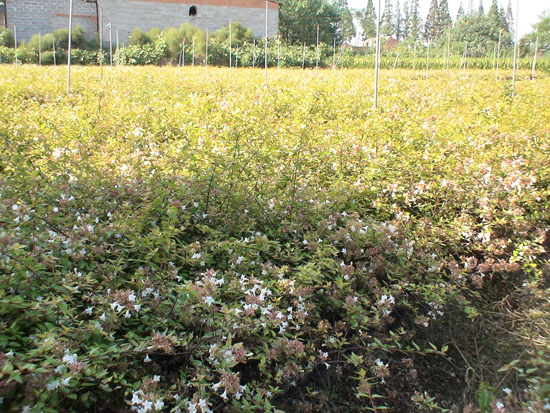
In landscaping projects, reasonable dense planting and careful management to ensure the survival rate are the keys to avoiding messy growth in Abelia × grandiflora. When Abelia × grandiflora is used as a hedge, it must be pruned reasonably to prevent leggy growth.
There are mainly three reasons for leggy growth in Abelia × grandiflora: the characteristics of the variety itself; during shaping of young trees, too few large branches are retained, or the plant is bushy with few side branches and nutrients are overly concentrated; or strong branches are cut back too heavily and too many small branches are pruned; improper fertilization during the cultivation period. During the young tree stage, excessive application of nitrogen fertilizer, chemical fertilizer, or heavy fertilizer and water with little organic fertilizer causes leggy branches.
To prevent leggy growth in Abelia × grandiflora, the following measures can be taken: when transplanting, cut off part of the main root and overly long roots to promote more side roots; plant at an appropriate density; when pruning and shaping, mainly pinch and top in summer, with winter pruning as a supplement; for seedlings that grow too vigorously, control leggy growth by cutting off overly long main branches, and retain appropriately more of the emerging branches, and also retain more side branches as flowering branches; for new shoots that grow in a leggy pattern, spray growth regulators such as B-9, paclobutrazol and chlormequat to inhibit leggy branch growth. In terms of fertilization, increase phosphorus and potassium fertilizer, and after new shoots reach a certain length, pay attention to controlling fertilizer and water. In seasons with a lot of rain, do a good job of drainage.
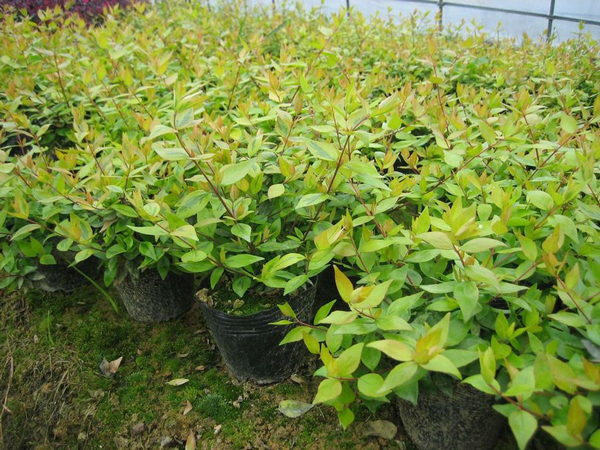
Because Abelia × grandiflora can be propagated by cuttings and survive throughout the year, it counts as an easy shrub to grow. If you have a courtyard at home, choosing Abelia × grandiflora to decorate the courtyard should leave you quite satisfied.