What to Do When Bromeliad Leaves Turn Yellow? Causes and Solutions
Nowadays indoor floral decoration is gradually becoming popular. Placing plants indoors not only helps freshen the air but also serves a decorative purpose. Some people even use indoor plants to change their feng shui fortune, but most people still choose plants with good meanings to decorate their interiors, such as the money tree and lucky bamboo. Today, however, I want to introduce the bromeliad and analyze how it should be grown.
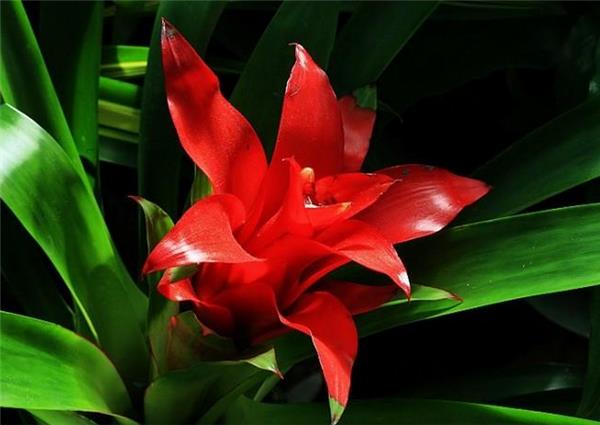
I. What to Do When Bromeliad Leaves Turn Yellow
1. Temperature too high or too low
The Guzmania (bromeliad) likes a warm and humid environment. Its suitable growing temperature is 21-28°C during the day and 18-21°C at night, and the maximum temperature must not exceed 35°C. High temperatures are unfavorable for growth, but being kept in a 10°C environment for a long time can also easily cause the plant to grow slowly, with leaves or bracts turning red or white and losing color. It should be sprayed with "Xin Gao Zhi Mo" suspension and other anti-freezing and cold-protection agents to prevent the temperature from continuing to drop and causing the plant to die.
2. Overwatering or underwatering
Overwatering causes the potting soil to remain too wet for a long time, resulting in a lack of oxygen in the soil, rotting some of the fibrous roots, hindering normal respiration and the absorption of water and nutrients, and causing the leaves to turn yellow and fall off. After being affected, the young leaves first turn pale yellow, and then the old leaves gradually turn yellow as well. Watering should be controlled immediately, fertilizing suspended, and the soil should be loosened frequently to give it good aeration.
However, if watering is missed or the plant is given only half-water (that is, wet on top and dry at the bottom) for a long time, nutrient absorption will be affected, and the leaves will easily become dull and lusterless, wilting and drooping. The lower old leaves age first and gradually wither, turn yellow, and fall off from bottom to top. At this point, a small amount of water should be given along with misting, so that the plant gradually recovers before returning to normal watering.
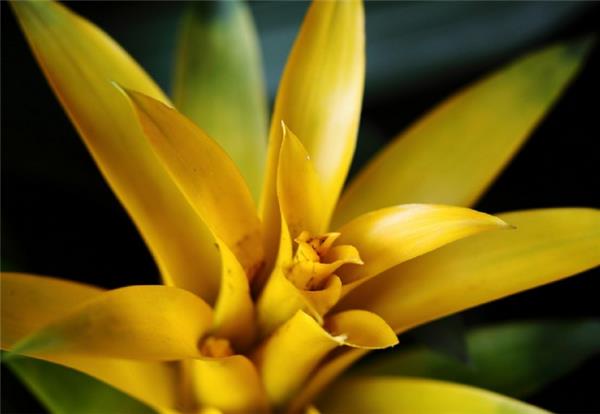
II. Growing Bromeliads
Catering to their preferences is key, because bromeliads originate from the tropical rainforest regions of the Americas and like a hot, humid climate. If grown indoors, attention must be paid to sunlight, water, and air conditions, and an indoor temperature of 15-20°C is most suitable for bromeliad growth. In terms of temperature, bromeliads are suited to indoor cultivation, and in terms of soil, moist conditions suit bromeliad growth during the peak growing season. Therefore, during the flowering period, water should be sprayed on the leaves and the surrounding area several times a day to increase air and soil humidity.
Because bromeliads have an underdeveloped root system and no main root, they easily end up with only a single offset surviving during propagation, which greatly limits the number of propagated plants. Therefore, methods such as repotting in spring and cutting the stem for cuttings or dividing and transplanting the offsets all help with their propagation!
Growing bromeliads is mainly about realizing their ornamental value, and there are particular ways to keep them growing vigorously during the flowering period. When in bloom, do not fill the pot with water, and place it in a shaded area, which helps to some extent in extending the flowering period!
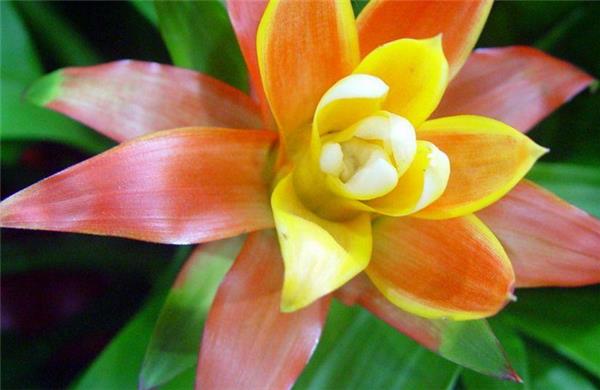
III. The Role of Bromeliads
The bromeliad is the most common type of flower in the Bromeliaceae family. Whether as a home-grown flower or in courtyard displays, it is a commonly seen ornamental flower. Because it has many varieties and each one is highly ornamental, it is called a horticultural treasure. Bromeliad actually refers to the Bromeliaceae family, just as the pineapple is a member of the Bromeliaceae family, being an edible bromeliad. Bromeliad flowers only bloom and do not bear fruit; their leaves are green and slender, with patterns on the leaf surface, and some flower leaves turn red near the flowering period. Flower colors vary by variety, and different varieties have different flower colors.
Bromeliads are mainly ornamental flowers. In many places, they represent perfection and good luck, and among them Guzmania is the most favored and most representative. The effect they can achieve in home decoration cannot be replaced by many plants, being both subtle and comfortable. For example, the well-known Neoregelia is most famous as a potted plant, with beautiful flower shapes and bright leaves, and is regarded as a fine specimen among bromeliads for its fresh and elegant look. Of course, common ones also include the red water tower flower and the "palace maid's tears."
Of course, as green plants, bromeliads also have a greening effect and purify the air. Many varieties with strong purifying functions are called air plants by some people. This is because they can reduce the formaldehyde content in a newly renovated house by 80%, making them not only practical but also beautiful.
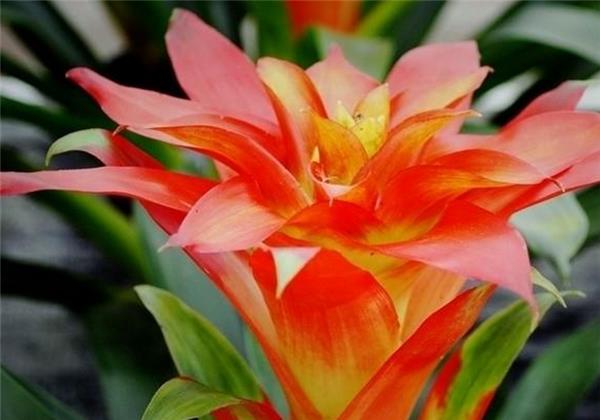
Overall, how to grow bromeliads still comes down to understanding their growth habits, adapting to and creating a suitable growing environment, and extending the bromeliad's flowering period according to its growth patterns, bringing more color indoors. In this way, the methods for growing bromeliads can be mastered with ease.