What are the uses and purposes of Mimosa pudica
Mimosa pudica originates from the tropical regions of South America. With international development, Mimosa pudica is now widely cultivated in China. Mimosa pudica has a very strong ability to adapt to the environment and likes to grow in warm and humid environments. It is relatively common on hillside thickets and in damp places beside roads. Now many families grow Mimosa pudica as a household ornamental plant.
I. The uses of Mimosa pudica
1. Ornamental
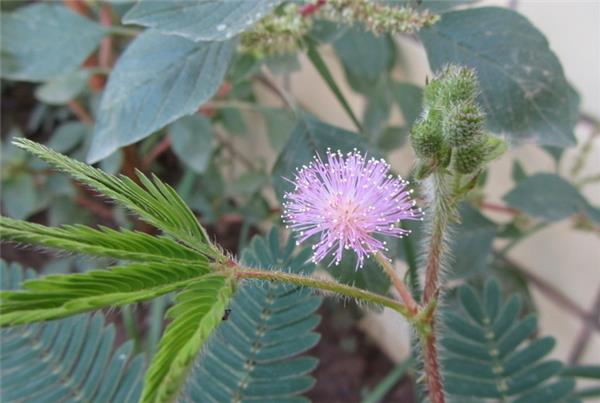
The Mimosa pudica plant has a loose form, and its pinnate leaves are slender and elegant; its leaves close as soon as they are touched. Mimosa pudica has many flowers and is delicate and lovely, giving people an impression of fragility and elegance. It can be planted in the ground at the corner of a courtyard, or grown in a pot on a windowsill or desk. When giving it as a flower gift, gently cover the pot with pink gauze and tie it with a pink decorative ribbon bow. If it can be further decorated with pink mohair pom-poms, it will be even more interesting.
2. Weather forecasting
Mimosa pudica is a wonderful plant that can foretell changes between sunny and rainy weather. If you touch it with your hand, its leaves close quickly, and when they open it is very slow, this indicates that the weather will turn clear; if when touching Mimosa pudica its leaves contract slowly and droop slowly, or even close slightly and then open again, this indicates that the weather will turn from clear to overcast or that it is about to rain.
3. Earthquake prediction
According to Turkish seismologist Erjiang, several hours before a strong earthquake occurs, the leaves of Mimosa pudica, which are sensitive to external touch, will suddenly wither, and then dry up. In earthquake-prone Japan, scientists have found through research that under normal circumstances, the leaves of Mimosa pudica open during the day and close at night. If the leaves of Mimosa pudica show the abnormal phenomenon of closing during the day and opening at night, then it is a precursor to an earthquake.
4. Medicinal use
It has the effects of clearing heat and promoting diuresis, resolving phlegm and relieving cough, calming the nerves and relieving pain, detoxifying, dispersing blood stasis, stopping bleeding, and astringing. It is used for colds, high fever in children, acute conjunctivitis, bronchitis, gastritis, enteritis, urinary tract stones, malaria, and neurasthenia; for external use it treats bruises and swelling pain, sores and swelling toxins, hemoptysis, and herpes zoster.
II. How to grow Mimosa pudica:
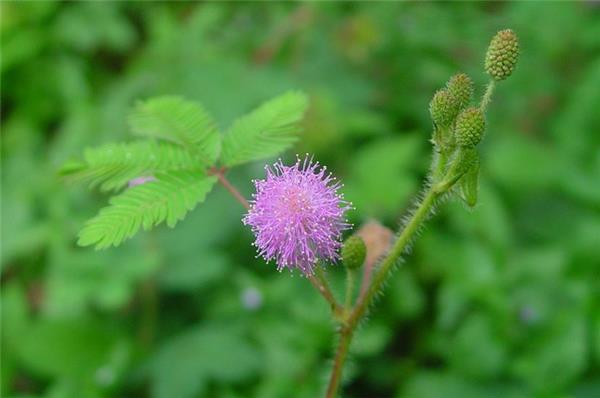
1. Watering: Mimosa pudica likes moisture. During the summer growing period, water once a day.
2. Soil: Mimosa pudica has strong adaptability and is not strict about soil requirements. It grows well in moist, fertile soil. Sow it in a culture soil prepared by sieving and mixing 2 parts leaf mold, 3 parts garden soil, and 5 parts fine yellow sand.
3. Sunlight: Mimosa pudica likes sufficient light and is slightly tolerant of semi-shade.
4. Temperature: As a potted ornamental flower, Mimosa pudica should be moved indoors to a sunny place in winter. Maintaining a room temperature of 10-12°C is enough for it to overwinter safely.
5. Fertilizing: Mimosa pudica does not need much fertilizer during the growing period. Applying dilute liquid fertilizer 2-3 times is enough. Do not let it grow leggy, because Mimosa pudica is mainly used as an interesting foliage plant, and smaller is better.
III. Propagation methods of Mimosa pudica
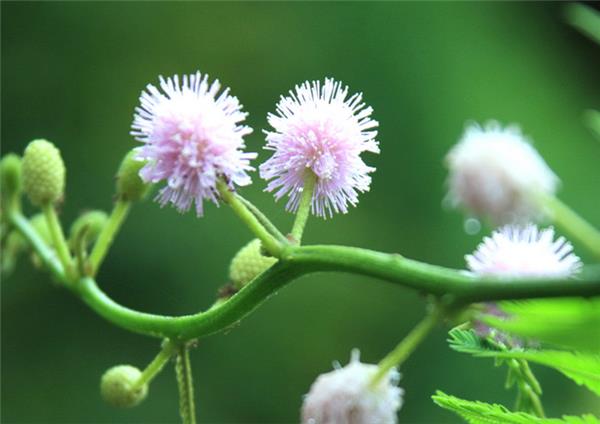
Propagate by sowing seeds
It can be sown in both spring and autumn. Before sowing, soak the seeds in 35°C warm water for 24 hours. Sow in shallow pots in holes, cover with 1-2 cm of soil, water by the pot-soaking method, and keep moist. Under conditions of 15-20°C, seedlings emerge after 7-10 days. When the seedlings are 5 cm tall, pot them up. When collecting seeds, select robust mother plants, strengthen management, and collect as they ripen during the fruiting period. The pods will split open automatically when mature.
Mimosa pudica is a taproot plant with very few fibrous roots. It is suitable for propagation by sowing, and it is best to use direct sowing to avoid damaging the roots during transplanting; if transplanting is necessary, it should be done at the seedling stage, otherwise it is not easy to survive. As an annual cultivation, Mimosa pudica is generally sown indoors in early spring.
Direct sowing in small pots
It can also be grown in shallow pots and divided for planting. The sowing soil is prepared by sieving and mixing 2 parts leaf mold, 3 parts garden soil, and 5 parts fine yellow sand. When sowing, first fill the pot with an appropriate amount of culture soil, spread it flat and press it firm, sprinkle thoroughly with a watering can, and sow immediately after the water has completely penetrated.

Mimosa pudica has ornamental and medicinal uses, and also has the unique functions of forecasting weather and predicting earthquakes. If you like Mimosa pudica, you might as well grow a few pots and place them in your home.