How to Place String of Pearls and Daily Care Tips
Don't those little round jade-green bead-like leaves of String of Pearls look incredibly dainty and adorable? When placing String of Pearls, however, you also need to pay attention to choosing the right space. Only by placing it in a spot that suits it can it add the liveliest, freshest touch of green to your home.
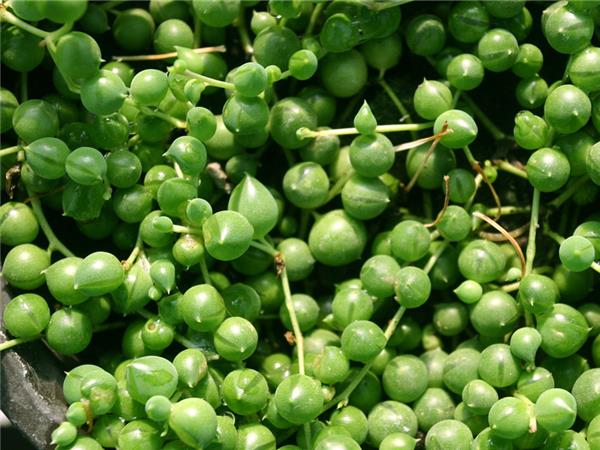
Matching String of Pearls with Home Decor Styles
Placing String of Pearls in the Kitchen
The rate at which plants appear in kitchens is second only to the living room, and the environmental humidity there is also very suitable for most plants. In addition, colorful plants can soften harsh lines and inject a breath of life into the kitchen. The kitchen is usually located in a north-facing room with few windows, and it is a workspace with frequent activity and scattered items, with relatively high smoke and temperature levels, so large potted plants are not suitable; hanging plants are more appropriate. Among them, String of Pearls is the best choice. Placing a pot of String of Pearls in a room can absorb harmful gases such as carbon monoxide, carbon dioxide, sulfur dioxide and nitrogen oxides within 24 hours, acting as an air filter.
Placing String of Pearls in the Bedroom
A bedroom generally needs to be quiet, serene and cozy. String of Pearls is easy to grow, highly adaptable, and one of the most traditional hanging plants for indoor spaces. Its leaves are slender and soft, with small plantlets growing out from the leaf axils, hanging down from the edge of the pot, spreading and trailing like flowers, evergreen all year round. String of Pearls is the "king of formaldehyde removal" among plants.
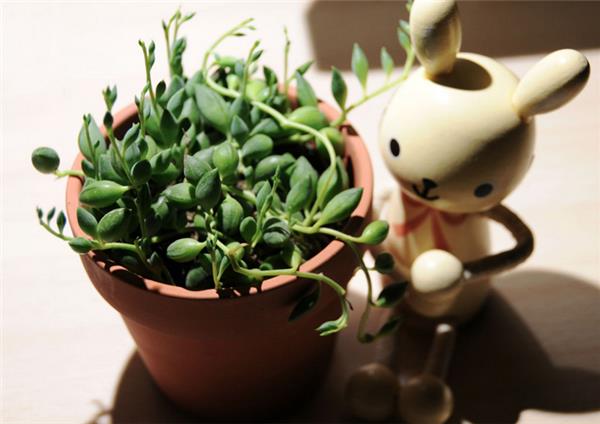
From the suitable placement spots for String of Pearls, you can see that this is a rather likable plant, and it doesn't require particularly careful attention during cultivation. It completely looks like a plant that's very easy to keep alive.
How to Grow String of Pearls
1. Cuttings: Cuttings are one of the propagation methods for String of Pearls and also the most commonly used method. For cuttings, choose healthy stems, cut them from the bumpy nodes, then simply bury part of them shallowly in the soil. At first, just water once, and in about a month they will sprout on their own.
2. Division: Division is another propagation method for String of Pearls. Division cannot be done in winter, because the low temperatures will cause dormancy. Generally, division is done in spring when repotting. Remove the old potting soil, divide the old plant into several clumps, and once separated they can become new plants.
3. Seeds: Seed sowing is generally rarely used for propagating String of Pearls, so no detailed introduction is given here.
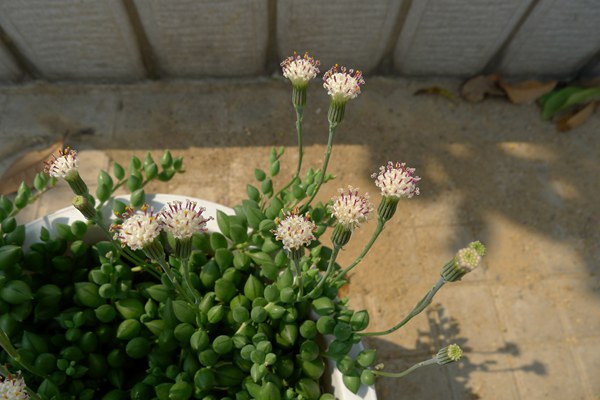
Daily Care of String of Pearls
1. Soil: The plant's root system is very shallow, so it can be planted in a shallow pot. Generally, use a piece of tile to cover the drainage hole, and spread a layer of coal cinder or coarse sand to increase aeration and drainage (especially when using the commonly available plastic pots). For the soil, it is best to use leaf mold (fallen leaves from trees in autumn and winter mixed with a certain amount of crushed soil, then mixed with a certain amount of sand (soil-to-sand ratio of about 1:3).
2. Watering: Root rot is easy in summer, so watering should not be too frequent; use a small spray bottle to water.
3. Temperature: It likes warmth and humidity, is relatively cold-tolerant (when cultivated in the Jianghuai region it can tolerate low temperatures of 0°C), and heat-tolerant. The optimum temperature is around 20°C~28°C. Growth is slow at both high and low temperatures, and it almost goes dormant in high-temperature environments.
4. Fertilizing: In spring and autumn, "apply thin fertilizer frequently." Spraying 1-3‰ nitrogen fertilizer and potassium dihydrogen phosphate on the leaves often helps make it more jade-green and plump, improving its ornamental value.
5. Pests and diseases: There are very few pests and diseases. Aphids in spring are one of them; remove them promptly or spray with 1500-times omethoate to kill them. Mites in summer and autumn are the next; use 1000-times dicofol to kill them. Pay attention to ventilation and increasing leaf surface humidity to reduce mite infection.
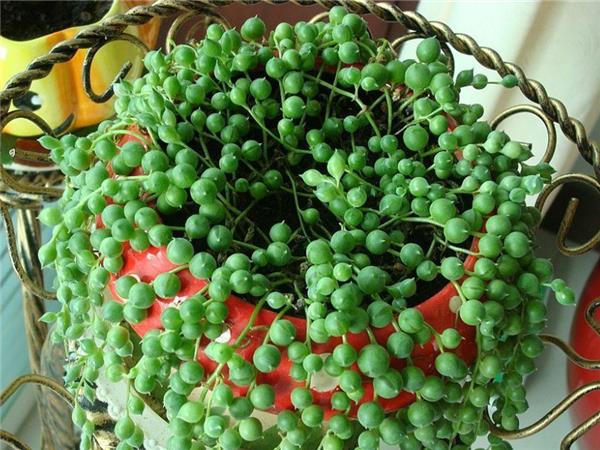
Isn't growing a String of Pearls simple? Moreover, placing it at home can absorb harmful gases and it has its own unique ornamental value. Hurry and grow a pot of String of Pearls by propagating or buying one.