What are the uses and benefits of the Chinese holly tree, and can it be made into a bonsai?
The Chinese holly tree is a species with a rather unique and elegant tree form, making it quite suitable for bonsai shaping, and growing the Chinese holly tree is relatively not too difficult. Let's take a look together below.
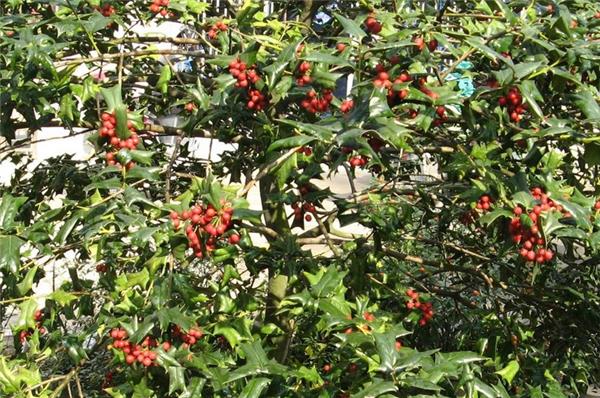
I. Uses and benefits of the Chinese holly tree
1. Ornamental value: The Chinese holly has dense branches and leaves, peculiar leaf shapes, a deep green and glossy appearance, and in autumn it bears abundant red berries that do not fall through the winter, making it bright and beautiful. It is a good species for foliage and fruit viewing, and can be planted in home courtyards, at road junctions, in the center of flower beds and other places, offering relatively high ornamental value.
2. Medicinal value: The leaves, fruits and roots of the Chinese holly are all used medicinally. The leaves can treat tidal fever and hemoptysis caused by pulmonary tuberculosis, the fruits are often used for excessive leukorrhea and chronic diarrhea, and the roots are often used to treat rheumatic pain and icteric hepatitis, among others. The Chinese holly has relatively high medicinal value.
3. Other values: Besides its ornamental, medicinal and other benefits, the Chinese holly also has many other uses, for example: the seeds of the Chinese holly contain oil and can be used as a raw material for soap, the bark can be used as a dye and to extract tannin extract, and the wood is soft and tough and can be used as cattle nose rings, and so on.
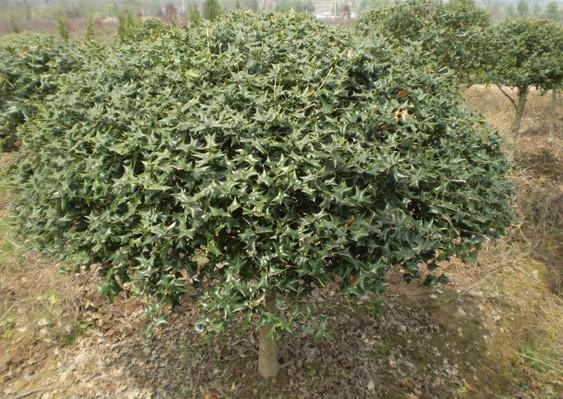
II. Propagation methods of the Chinese holly tree
1. Sowing method: The seeds are harvested in November when the fruits ripen. Pile them up until the fruit skin softens, then mash them, rinse them clean and take the seeds. After low-temperature moist sand stratification storage for 1 year, during which the sand storage should be turned and mixed once every 2 months to maintain a certain humidity and prevent the seeds from spoiling. The seeds are sown in winter of the following year, at a sowing depth of 2 to 3 cm, covered with 1.5 cm of soil, then covered with rice straw. They will germinate and emerge in March; remove the straw in time, and keep them moist and shaded. The seedlings grow rather slowly and can only be transplanted after growing for 2 to 3 years.
2. Cutting method: Cutting propagation is usually carried out in mid-to-late May using softwood cuttings. Select semi-ripened branches of the current year as cuttings, with a length sufficient to include part of the old branch from the previous year, keep 4 to 6 leaves, and half a leaf may be cut off. Insert to a depth of 1/2 to 2/3, water thoroughly after insertion, and take care to provide shade. Water frequently at ordinary times to keep the bed soil moist. After rooting, strengthen seedling-stage management, and transplant after leaving them in the bed for 1 to 2 years.
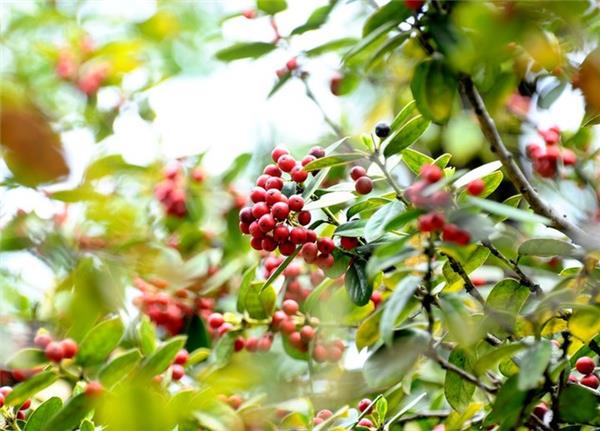
III. Making and caring for a Chinese holly bonsai
Pot selection: For making a Chinese holly bonsai, glazed pottery or purple clay pottery pots are often used, and carved stone pots may also be used; the pot color can be purple, blue, light yellow or grayish brown; deep green is not suitable, because it is similar to the leaf color and does not provide a contrasting effect. As for pot shape, rectangular, square, waist-round and drum-round shapes are suitable.
Soil: The Chinese holly should use fertile, loose, well-draining, slightly acidic soil. The potting soil can be prepared from leaf mold, garden soil, mixed with sandy soil.
Planting: Transplanting is usually carried out after autumn or before spring budding. Since the Chinese holly has fewer main roots and well-developed lateral roots, it should be transplanted with a soil ball to protect the fibrous roots. At the same time, properly prune the branches and leaves on the upper part of the pot.
Shaping: The branches and trunk of the Chinese holly are hard and brittle, so processing is usually carried out during the plum rain season, when the sap flows vigorously. Because its leaves are large and hard, it is generally better to use coir rope for binding rather than metal wire, otherwise the branches and leaves are easily broken or damaged. The leaves of the Chinese holly are hard and have sharp spines, so when shaping, unnecessary branches and leaves can first be cut off, and the remaining branches and trunk can be bound and pruned. The tree form of the Chinese holly can be made into upright-trunk style, slanting-trunk style, curved-trunk style and cascade style, etc. Small bonsai are best in a natural style, while large bonsai can have the branches and leaves bound into cloud-layer shapes, and old stump specimens can appear in the beautiful postures of exposed-root style and bent-trunk style.
Pests and diseases: The main pests harming the Chinese holly are psyllids and scale insects. Sometimes the branches and trunk develop sooty mold caused by psyllid damage, which can be prevented and controlled by spraying Bordeaux mixture and applying lime sulfur mixture. When scale insect damage is severe, it can cause failure to bear fruit, and they can be killed by spraying 40% dichlorvos at 1000 times dilution. Reasonable pruning and improved ventilation and light transmission can reduce pest damage.
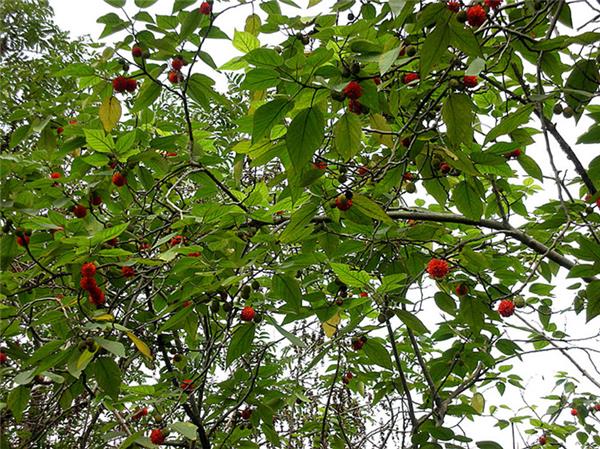
The above is the complete introduction on how to grow the Chinese holly tree and use it to make bonsai shapes. I hope that after reading the above introduction, everyone can grow the Chinese holly tree or make its bonsai more skillfully, and use them to add brilliance to your home life.