What are the advantages of red-fruited elm for shaping, and how should pests and diseases be prevented and controlled?
Like all elms, the red-fruited elm can not only be planted in courtyards and fields, but is also an excellent choice for bonsai tree stumps, with its own unique advantages.
I. Introduction to red-fruited elm
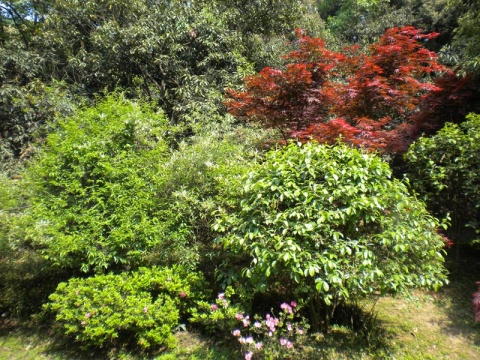
Morphological characteristics: a deciduous tree, up to 28 m tall, with a diameter at breast height of 80 cm; bark dark gray, gray-black or brown-gray, irregularly longitudinally fissured, rough; current-year branches light gray or gray, hairy when young, later becoming glabrous or sparsely hairy, lenticels pale yellow; hairs on sprouting branches denser, sometimes with large irregularly longitudinally fissured corky layers around them; winter buds ovoid, the exposed parts of the bud scales on the back nearly glabrous or sparsely hairy, more densely hairy below, the margins of the inner bud scales with longer and obvious hairs. Flowers arranged in clustered cymes on old branches. Samaras nearly round or obovate-round.
Functions and uses: the heartwood of red-fruited elm is reddish brown, the sapwood white, the material tough, with moderate hardness, straight grain and slightly coarse texture. It can be used to make furniture, farm tools, utensils and so on. The bark fiber can be made into ropes and artificial cotton. In the plains and low hilly areas of the lower Yangtze River, it can be selected as a tree species for "four-side" greening and afforestation.
II. Bonsai advantages of red-fruited elm
Fast growth speed (the fastest-growing of the five famous trees). Whether it is the growth speed of seedling material or cultivation using the technique of trunk truncation and branch storage, this tree grows relatively fast.
The leaves are small and fine, beautiful in shape, and lovely dark green in color, meeting the requirements for making bonsai.
Good callus formation and great plasticity; even relatively large wounds can heal. This characteristic can be used to remodel tree seedling stumps. If it needs to be reduced in size, cutting off part of it will also allow natural healing. If it needs to be enlarged, the "striking" method and the "bark lifting" method can be used, using its callus proliferation tissue to turn into rugged nodules, which not only has a vigorous beauty, but can also give the broad trunk part a feeling of being enlarged.
The branches are soft and not easy to break, which is favorable for shaping and wiring.
The root base is well developed, and by using the principle of callus formation it can be remodeled at will to suit the requirements of various tree styles; it is also ideal for creating root-over-rock styles.
High sprouting rate, with latent buds all over the body. During the sprouting period before the Beginning of Spring, buds sprout on any trunk with wounds. If a branch is needed at a certain position, make a hole there until the xylem is visible, and later buds will sprout there. After growing into a branch, the wound will naturally heal again, without leaving very obvious traces.
III. Pest and disease prevention and control of red-fruited elm
Elm tussock moth: body length about 12 mm, wingspan about 25 mm. Body and wings white, tibiae and tarsi of the legs orange-yellow.
Elm swallowtail moth: body and wings black, body length 22 mm, wingspan 55 to 91 mm, antennae pectinate, forewings brown slightly tinged with yellowish brown.
Actias selene ningpoana: body length 35 to 40 mm, wingspan about 122 mm. Body surface with thick white down, wings powdery green, the anterior margin of the forewing passing through the prothorax purplish brown, with an eye-shaped spot in the center of the wing, hindwings with tail-like projections, 40 mm long.
1. Light trapping: use black light traps during the adult emergence period.
2. Artificial control: in combination with maintenance and management, remove egg masses and newly hatched clustered larvae and destroy them centrally, and eliminate overwintering larvae and overwintering cocoons.
3. Biological control: protect and use natural enemies such as ground bees, hornets and sparrows. Release Trichogramma during the egg stage of Actias selene ningpoana, with a parasitism rate of 60% to 70%. During the young larval stage, spray 25% diflubenzuron No. 3 suspension concentrate at 1500 to 2000 times dilution for control; during the late larval stage, spray Bacillus thuringiensis (Bt) emulsion containing more than 10 billion spores per milliliter at 400 to 600 times dilution for control.
4. Chemical control: during the peak larval period, spray 20% fenpropathrin emulsifiable concentrate at 2500 to 3000 times dilution or 20% fenvalerate emulsifiable concentrate at 2000 times dilution.
IV. Price reference for red-fruited elm
Red-fruited elm price: meter diameter 16 cm, price 4000 yuan;
Red-fruited elm price: meter diameter 15 cm, price 3300 yuan;
Red-fruited elm price: meter diameter 14 cm, price 2500 yuan;
Red-fruited elm price: meter diameter 13 cm, price 1700 yuan;
Red-fruited elm price: meter diameter 12 cm, price 1500 yuan;
Red-fruited elm price: meter diameter 11 cm, price 1200 yuan;
Red-fruited elm price: meter diameter 10 cm, price 800 yuan.
Alright, the above is the introduction to red-fruited elm. After reading these introductions, have you also become interested in planting and growing red-fruited elm? If you are tempted, do not hesitate, hurry up and plant a beautiful red-fruited elm.