Are Night Jasmine and Banana Shrub the Same Thing? Where Do They Differ?
Both Night Jasmine and Banana Shrub are evergreen shrubs of the Magnoliaceae family with fairly high ornamental value, but since they are not the same species, their habits also differ, and there are both differences and similarities in propagation and care.
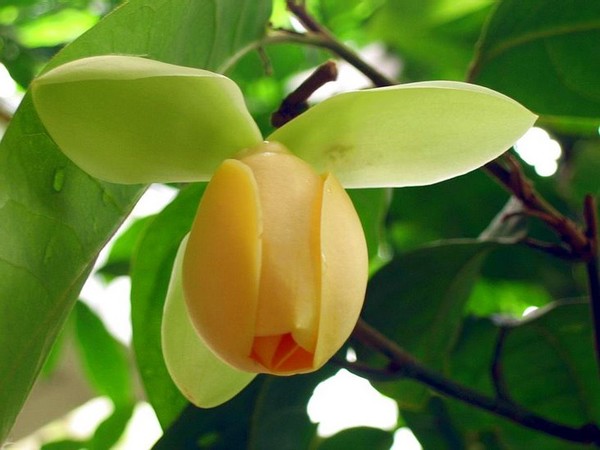
How to Grow Night Jasmine
Habit: It prefers a warm, humid and semi-shaded, semi-sunny environment, tolerates shade, and fears scorching sun exposure. It requires fertile, loose, well-drained, slightly acidic soil, and the winter temperature should not fall below 5°C.
Propagation: Mainly propagated by layering and grafting. For layering, use the air layering method in spring, selecting a mature one-year-old branch, girdling it 1 cm wide, wrapping it with plastic film, filling in leaf mold, then tying it tightly; roots form in 80-90 days, and it can be cut off in autumn and potted. For grafting, the approach grafting method is commonly used, with a one-year-old potted Champaca (Michelia champaca) as the rootstock; select a scion from the mother plant during the plum rain season, support the potted rootstock with a bamboo pole, and after about 2-3 months cut it off below the scion.
Soil: For potting, mountain soil is best. Never use calcareous soil for cultivation; the soil must be acidic, with a pH of 5.5 to 8.5. For home planting, you can also use 6 parts vegetable garden soil, 4 parts river sand, plus half a spoonful of black vitriol (ferrous sulfate) mixed together.
Watering: In spring, water once every 2 to 3 days. Northern springs are dry, which easily causes yellowing leaves, so water with alum fertilizer water three or four times in succession every two or three days. In summer, spray water frequently to increase air humidity. After early autumn, water less.
Fertilizing: During the growing season, apply a top dressing of decomposed cake fertilizer liquid about every 15 days. Stop applying nitrogen fertilizer before the flowering period and apply more phosphorus and potassium fertilizer to encourage larger, more fragrant flowers.
Light: After Night Jasmine is moved outdoors in mid-April, place it in a spot with diffused light for care, with a light transmission rate of 30 to 40% being ideal. In summer, semi-shade is suitable; after early autumn, gradually increase light so the plant becomes sturdy.
Pests and diseases: Leaf blight is a common threat and can be sprayed with a 600-fold dilution of 65% zineb wettable powder. Pests include leaf beetles, aphids and scale insects, which can be killed by spraying a 1000-fold dilution of 50% fenitrothion emulsifiable concentrate.
Overwintering: In winter, move it indoors and place it where sunlight does not shine directly; keep it between 10 and 12°C during the day, and at night not below 5°C and not above 10°C, so as not to hinder winter dormancy and affect flowering the following year. In winter, just keep the potting soil slightly moist. Once moved indoors for winter care, no fertilizing is needed.
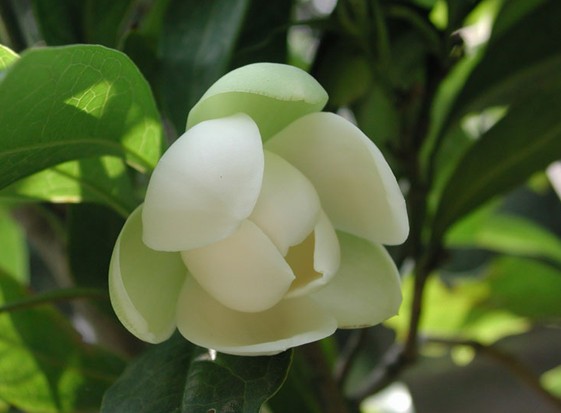
Similarities and Differences Between Banana Shrub and Night Jasmine
1. Both Banana Shrub and Night Jasmine are evergreen shrubs of the Magnoliaceae family.
2. Banana Shrub has dense branches; a perennial old plant can grow to more than 2 m, and its twigs and leaf stalks are covered with brown fuzz. Night Jasmine is short and small with sparse branching, and its plant height does not exceed 1 m.
3. Their leaves are both tender green, leathery, and smooth on the surface.
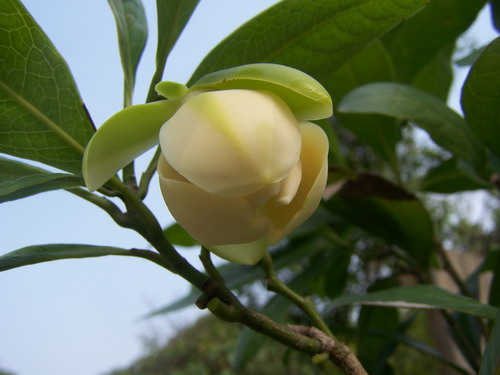
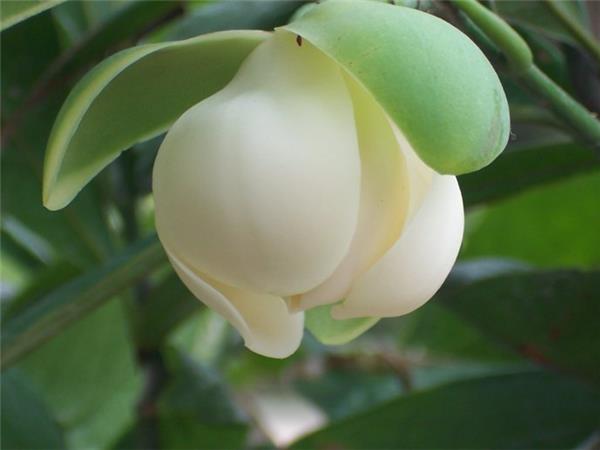
4. The flowers are both boat-shaped with a buckle, with 4 emerald-green sepals and creamy white petals, and both have a rich banana fragrance; Night Jasmine's fragrance is stronger at night, and its flower crown is 2 to 3 times larger than that of Banana Shrub, like an egg.
5. Banana Shrub and Night Jasmine both prefer a warm, humid and semi-shaded environment and cannot endure the scorching sun of the northern dry season; they require loose, fertile and well-drained acidic soil.
6. Both Banana Shrub and Night Jasmine can be propagated by air layering on high branches in early May, take root in early July, and be cut from the mother plant in early September and potted. For mass propagation, cuttings can be used: cut one-year-old branches as cuttings in early June, insert them with leaves into peat or vermiculite, and keep them shaded and moist for care; they take root after 3 months and bloom in the third year.
Well, that is all for the introduction to Night Jasmine. After reading the above, can you distinguish the differences between Banana Shrub and Night Jasmine fairly clearly? Although the two differ, they still share similarities in some respects, so their growing methods can be used for reference with each other during cultivation.