Correct Transport Methods and Care Tips for Citrus Seedlings
Citrus has always been a very popular fruit with extremely rich nutritional value, but if you want your citrus tree to produce an abundant crop of citrus fruits, you still need to put in more effort with care.
I. Transport and Handling of Citrus Seedlings
1. Unlike deciduous fruit trees, citrus trees have no obvious dormant period, so special care must be taken to protect the tree body during seedling transport. Generally, they are transplanted with soil. However, in international transport, due to the quarantine requirements of various countries and transport costs, bare-root seedling transport is generally used.
2. Grafted seedlings are generally 55cm; during transport, they are packed into round barrels with metal at both the bottom and top. The barrel is 74cm tall and 37cm in diameter. Each barrel holds 50 seedlings, the roots are wrapped in wet sphagnum moss, and the outside of the barrel has a layer of plastic to retain moisture. A filled barrel weighs about 22.5kg.
3. Take fully mature branches, and use scissors to cut off the leaves and the portion of the branch tip with underdeveloped buds. Soak the branches in disinfectant water (10% sodium hypochlorite) for 3-5 minutes, then rinse with clean water 1-2 times. Spread the branches flat to dry until there is no floating water on the surface. Bundle 50 branches into a small bundle, seal them in a plastic bag, and then seal them in another layer of plastic bag. Pack multiple bundles into a cardboard box. This method allows transport at room temperature for one month. It is best to transport at 5-15°C.
II. Correct Citrus Seedling Raising Methods
1. Because citrus container seedling raising is equipped with a certain formula of humus nutrient soil, the seedlings produced have well-developed root systems, the survival rate after planting can reach 100%, and there is no seedling recovery setback after planting, and they can bear fruit 2-3 years earlier, which is deeply welcomed by fruit growers.
2. Materials. (1) Equipment: nutrient pots 10cm long and 10cm wide, 33cm high; nutrient bags 17cm wide and 28cm high. (2) Nutrient soil formula: 50% humus peat, 25% river sand, 25% rice husk.
3. Level the seedling raising site, with good ditching and drainage, the bed surface 50-60cm wide, and the length determined by the terrain. After leveling the bed surface, place 3-4 containers on it, drive stakes around it and enclose it with wire to fix the containers and prevent them from tilting or even falling over. The ditches between beds are about 20cm deep and 20cm wide.
4. When the rootstock has 3-6 true leaves, transplant it into the containers. When planting, the main root must be upright and the fibrous roots evenly distributed, and water thoroughly with settling water promptly after planting. Rootstock planting can be carried out in spring, summer, and autumn. The main rootstock types selected are citrange rootstock and sour orange rootstock.
III. Methods for Controlling Red Spider Mite Pests on Citrus Seedlings
Strengthen water and fertilizer management, plant cover plants, change the microclimate and biological composition, so as to disadvantage pests and benefit wax.
Protect and utilize natural enemies. Red spider mites and yellow spider mites have many natural enemies, such as six-spotted thrips, predatory wax and other predatory insects, as well as pathogenic fungi such as bud branch mold. In the orchard, choosing whiteflower weeds, forage grass, and other non-harmful weeds as biological cover for the orchard can regulate the orchard microclimate and provide sufficient food for pest natural enemies, which is conducive to the activity of natural enemies.
Chemical control during the damage period. Spray control with 24% fenbutatin oxide 5000x solution, or 20% dicofol wettable powder 2000-3000x, or 73% propargite 2000-3000x solution, etc. When applying the pesticide, spray evenly, and spray the leaf undersides, leaf surfaces, inner canopy, and branches all together. In addition, you can also choose 10% Uranus emulsifiable concentrate 6000x solution, 73% propargite emulsifiable concentrate 2000x solution, 30% miticide wettable powder 2000x solution, 15% dicofol emulsifiable concentrate 3000-4000x solution. On citrus in winter, spray 1-2 Baume degree lime sulfur mixture or 45% crystal lime sulfur 20x solution.
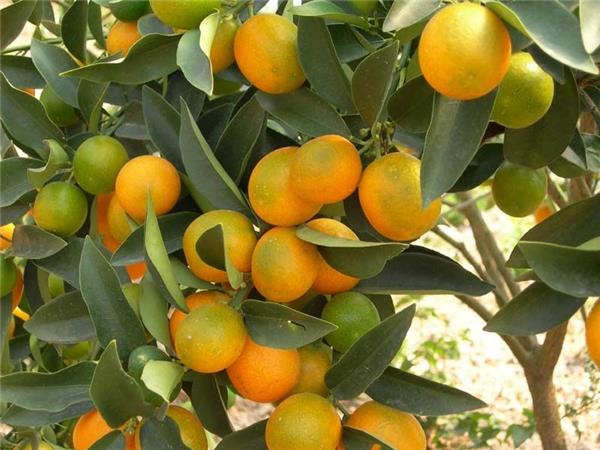
Citrus's most famous role is probably its edible value, but dwarfed citrus seedlings can also be moved indoors for pot cultivation, so it is also a very popular ornamental flowering and fruiting plant.