Potted Grape Growing Techniques and Precautions
Do you remember the song "The Snail and the Oriole Bird"? The lyrics vividly describe the original growing environment of grapes - a tall grape trellis, and the time needed for them to ripen is like a snail crawling all the way from under the trellis up to the grapes. Of course, the description in the lyrics is somewhat exaggerated, but the growing conditions for grapes are indeed like that. Since growing grapes is already not easy, how can you grow grapes in such a narrow space as a flower pot? Well, all of this requires certain conditions.
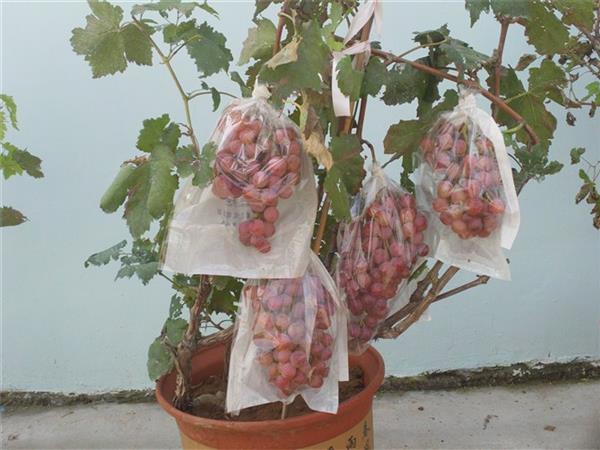
I. Growing Environment for Potted Grapes
If it is a courtyard, based on its size, light conditions, environmental conditions, etc., you can comprehensively consider planting grapes together with other fruit trees, flowers, trees, crops, or livestock in an overall arrangement, with reasonable combinations, so as to make full use of the ground and space. If there is a spacious rooftop platform, in addition to rooftop greening (beautification) and food use, its shading function accounts for a large proportion.
II. Planting Season for Potted Grapes
Spring planting is suitable when the temperature is between 15-25°C, such as from early March to April; layering can begin in early April.
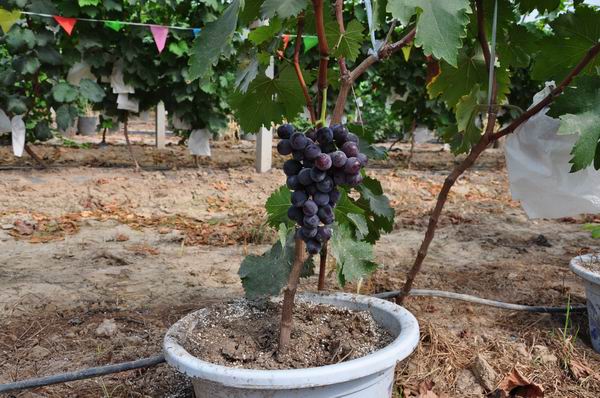
III. Selection of Containers and Potting Soil for Potted Grapes
For the pot, it is best to choose a ceramic pot with a diameter of 35 to 50 cm and good water permeability and air permeability. Potted grapes require loose, fertile loam rich in organic matter and calcium. You can also use local materials according to the specific conditions of each place, choosing cultivation materials that are widely available, low in cost, free of diseases and pests, and pollution-free. Commonly used materials include leaf mold, peat soil, garden soil, sand and gravel, bone meal, expanded chicken manure, etc. After choosing the flower pot, it is best to soak it in 1% bleaching powder water for 5 minutes, take it out and let it dry, then fill it with sterilized cultivation soil.
IV. Planting Methods for Potted Grapes
If planting with grape seeds, buy good grapes you like, put the seeds into soil after eating to let them take root, and place them in a sunny place so they can sprout; in the following spring, the previous year's branches can put out many new buds, so keep a few of the strongest ones; by May, with sufficient rain, the grapes grow quickly and the roots gradually grow; on a rainy day, transplant it. In May of the third year, yellow-green flower buds can appear, and it will bloom and bear fruit.
If propagating by cuttings, it is best to insert 2 cuttings per pot so that you can select and keep the better one, and keep the potting soil moist at all times. You can also use 1- to 3-year-old grape plants and transplant them into the pot with a soil ball before budding. When transplanting, the plant's branches and vines should be heavily pruned, generally keeping 1 to 3 strong branches and vines. In the year of transplanting, the focus is on restoring tree vigor, cultivating the tree shape, and laying a good foundation, so do not let it bear fruit first.
V. Precautions for Growing Potted Grapes
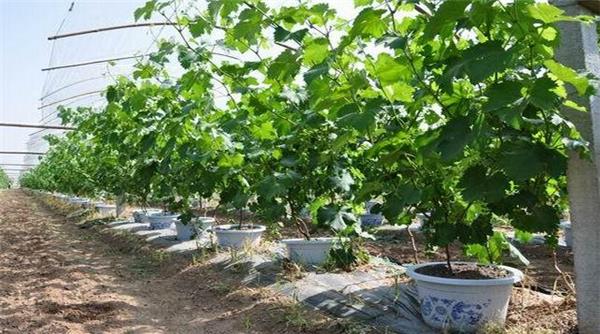
1. Before the grapes bud in spring, first bury the pots in the soil in sequence along the row spacing at about 35 cm, with the pot surface slightly lower than the ground. Gently pull down the branches and vines with plump buds and fruiting ability, with a vine length of no less than 80 cm, press them into the pot, fill with soil, and firm it by stepping on it. Leave 4 to 5 plump buds above the potting soil, then insert a 120 cm long thin pole and tie the branches and vines to it. Twenty days after the grapes bud, carry out girdling on the branches and vines in the pot to encourage early rooting and more rooting. The girdling site is inside the pot, at the end close to the plant roots, and the girdling length is 2 cm, with the bark layer completely removed.
2. When watering, the water temperature is best close to the potting soil temperature. Watering before 10 a.m. and after 4 p.m. is preferable. The water quality should be good, and the watering frequency should depend on the season. Generally, in early spring when the temperature is low, water once every 2-3 days. As the temperature rises and evaporation increases, water once every 1-2 days. After the temperature gradually drops in autumn, the watering frequency gradually decreases again, and it is suitable to keep the potting soil moist.
3. The principle of fertilizing potted grapes is to apply dilute fertilizer frequently. For potted seedlings that have not yet fruited, generally start when the seedlings are about 20 cm tall, applying cake fertilizer water once every 7 to 10 days until the end of September. For potted grapes that have already fruited, to ensure fruit development, it is best to apply once every 5 days. After the fruit is harvested, apply again according to the potted seedling schedule. Note that after each application of liquid fertilizer, water immediately. From the fruit enlargement stage onward, a 0.3% potassium dihydrogen phosphate solution can be sprayed every 7 to 10 days.
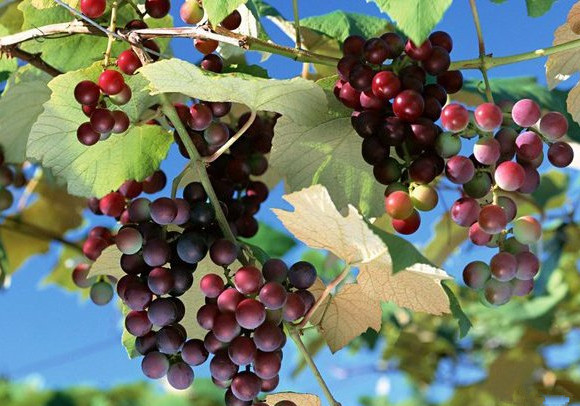
Potted grapes have very high ornamental value. Most vine plants choose to grow by climbing and twining, so they always give people a lingering and elegant feeling. If you want to grow a potted grape, I hope the above introduction can help you.