Why does the mimosa plant shy away? Uncovering the reasons behind its shyness
Hearing the word "mimosa", we can't help but wonder: why does the mimosa plant shy away? When does the mimosa plant shy away? The mimosa is a lovely plant whose leaves fold up as soon as they are touched, making it suitable as a potted flower for balconies and indoors, and many people also plant it in their courtyards. So what are the cultivation methods for the mimosa? Below, while looking at mimosa pictures, let's learn about the cultivation methods for the mimosa. Friends who are interested will surely benefit greatly after reading this.
I. The reason the mimosa plant shies away
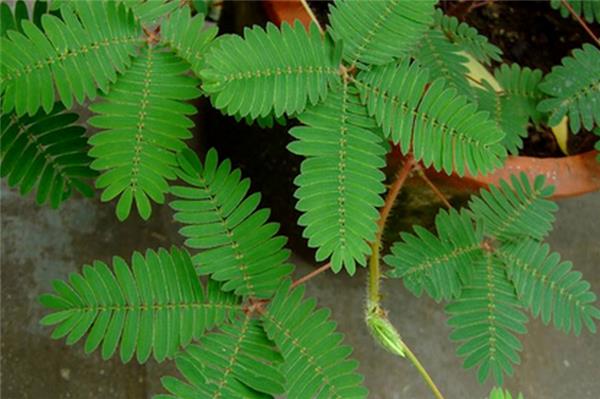
The mimosa grows on grassland with plenty of sunlight. As soon as it is touched by an external force, its pinnae close up, then the other leaves gradually close, and afterwards they droop. Many people find this astonishing. In fact, this is a fairly common plant movement phenomenon in the plant kingdom.
This is because there is a very large vacuole inside its leaves, and at the position of the leaf and the petiole there is a structure whose scientific name is the pulvinus. When these parts are stimulated, some sensory cells with relatively low internal electrical potential immediately release water, and then the petiole droops; because the leaves lose water, they lose the expansion between their internal cells, causing the leaf blades to close. In fact, they also close at night, all due to the internal cell turgor pressure. In fact, its principle is the same as that of the Venus flytrap.
The shyness principle of the mimosa is closely related to its original environment. Because in tropical regions there is abundant water and rainy weather is frequent, the mimosa closes its pinnae in time to prevent wind and rain from damaging the leaves. In fact, this is also a manifestation of evolution in nature.
II. Cultivation methods for the mimosa
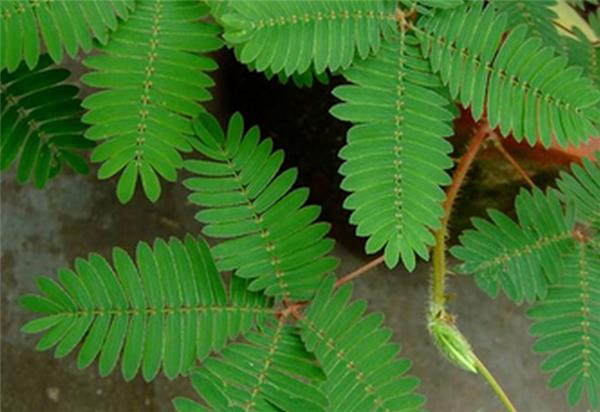
1. Soil: The mimosa has strong adaptability and is not strict about soil; it grows well in moist, fertile soil. Sow it in a culture soil mixed and prepared from 2 parts leaf mold, 3 parts garden soil, and 5 parts fine yellow sand after sieving.
2. Watering: The mimosa likes moisture; during the summer growing period, water once a day.
3. Sunlight: The mimosa likes sufficient light and is slightly tolerant of semi-shade.
4. Temperature: As a potted ornamental flower, the mimosa should be moved indoors to a sunny spot in winter, and maintaining a room temperature of 10-12°C is enough for it to overwinter safely.
5. Fertilizing: The mimosa needs little fertilizer during the growing period; applying diluted liquid fertilizer 2-3 times is enough. Do not let it grow leggy, because the mimosa is mainly grown as an interesting foliage plant, and smaller is better.
III. The uses of the mimosa
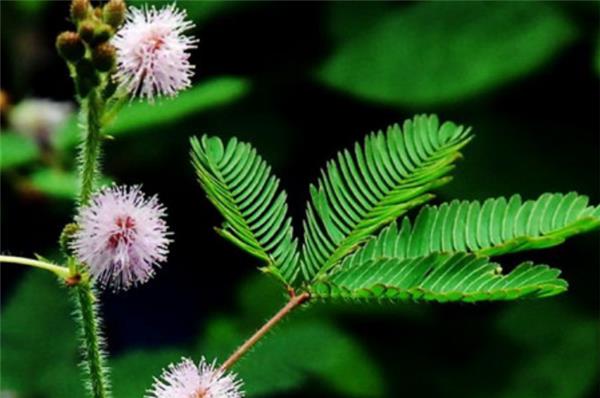
Ornamental use: The mimosa's plant shape is scattered, and its flowers are delicate and charming, giving people an impression of fragility and elegance. Planted at a courtyard wall corner or placed as a potted plant on a windowsill, it has a distinctive charm. Nowadays it is mostly grown as an ornamental plant in the home.
Weather-predicting use: The mimosa is also a wonderful plant that can nicely foretell changes between sunny and rainy weather. If we touch it with our hand, its leaves quickly close, and when it opens it does so very slowly, this indicates that the weather will turn clear; but if when we touch it, its leaves contract slowly and droop sluggishly, or even close slightly and then reopen, this indicates that the weather will turn from clear to cloudy or that it is about to rain.
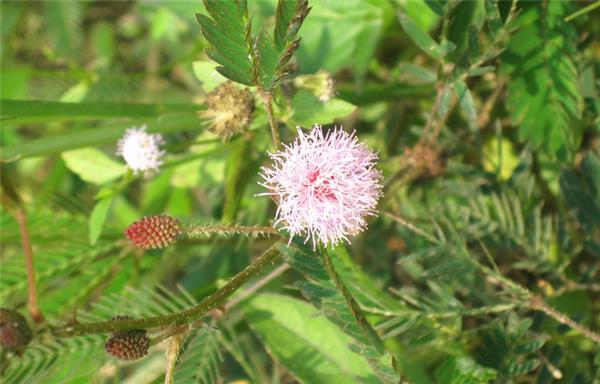
The mimosa has ornamental and medicinal uses, and also has the unique ability to forecast weather and predict earthquakes. If you like the mimosa, you might as well grow a few pots and place them in your home.