How do you plant and care for moss rose so it blooms more beautifully?
Moss rose is a sprawling herbaceous plant, often used in landscape design as a ground cover, or as a bedding flower in flowerbeds. Growing moss rose indoors is meant to beautify the home and enjoy the pleasure of cultivating flowers, so extra care should be taken during cultivation to avoid the disappointment of poor results.
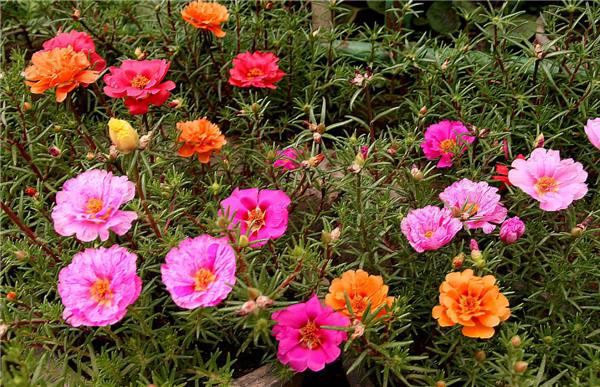
I. Morphological characteristics of moss rose
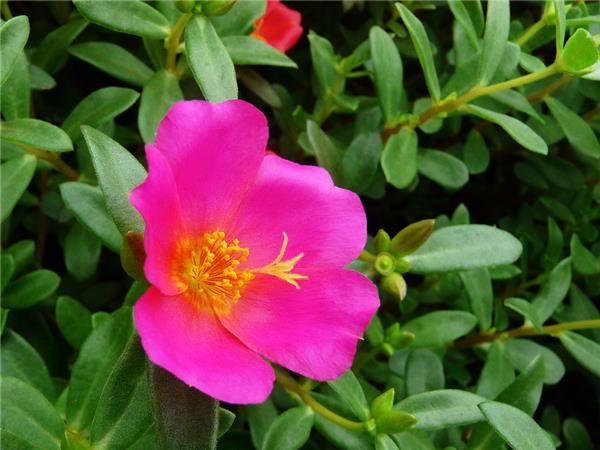
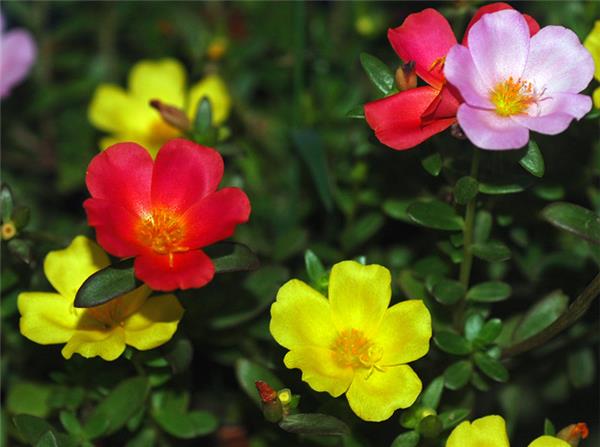
The stems are slender and round, lying flat or sprawling, with tufts of hair at the nodes. The leaves are scattered or slightly clustered, cylindrical, 1-2.5 cm long. The flowers are terminal, 2.5-4 cm in diameter, with leaf-like bracts at the base; the petals are brightly colored, in white, deep, yellow, red, purple and other colors. The capsule splits open by a lid when mature, and the seeds are small and delicate, brown-black. There are many horticultural varieties, divided into single, semi-double and double forms.
II. Propagation methods of moss rose
Seed propagation: moss rose seeds are very small, about 8400 per gram, and can be sown in spring, summer or autumn. Seedling trays are often used, and after sowing you can cover with a little bit of soil, or leave it uncovered. The germination temperature is 21-24°C, and seedlings emerge in about 7-10 days. The seedlings are extremely slender and weak, so if a relatively high temperature is maintained, the young plants grow quickly and can form rather thick, fleshy stems and leaves. At this point the young plants can be potted directly, using pots about 10 cm in diameter, with 2-5 plants per pot; the survival rate is high and growth is rapid.
Cuttings: moss rose is very easy to propagate from cuttings. In summer, use the cut shoot tips as cuttings; wilted stems can also be used. After rooting, flower buds appear right away. Transplanted plants do not need to be moved with soil, and during the growing period they do not need frequent watering. In winter, move the moss rose indoors to a spot that receives sunlight and let the potting soil dry out a little, and it will overwinter safely. After Qingming the following year, the pot can be placed outside the window; if a cold snap arrives, it still needs to be brought back inside for care.
III. How to grow moss rose
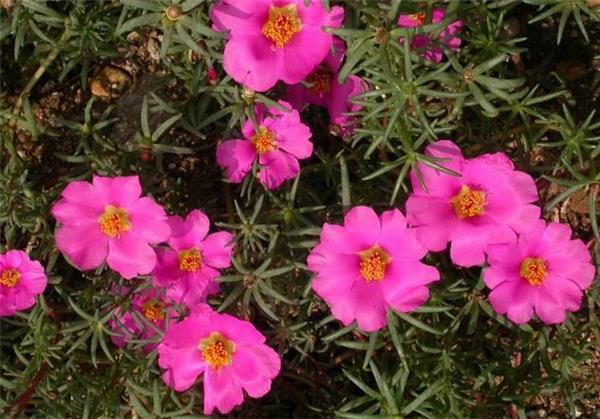
Habits: extremely tolerant of poor, thin soil, and able to adapt to ordinary soil; it can self-sow and spread. The flowers open in sunlight and close in the early morning, at night and on cloudy days, hence the names moss rose and "noon flower." The flowering period is June to September.
Soil: well-drained sandy soil is most suitable. You can mix 3 parts mature garden soil, 5 parts yellow sand, 2 parts rice husk ash or fine sawdust, plus a little superphosphate powder, and stir evenly.
Light: moss rose loves abundant sunlight. If full sunlight can be ensured throughout the growing period, the leaves will be lush and the flowers plentiful.
Temperature: moss rose likes a warm climate. The germination temperature is 21-24°C, and seedlings emerge in about 7-10 days. The seedlings are extremely slender and weak, so if a relatively high temperature is maintained, the young plants grow quickly and can form rather thick, fleshy stems and leaves.
Pests: moss rose has very few pests and diseases; you only need to control aphids, almond sawflies, almond scale insects and the like. The key to controlling aphids is to spray before germination, that is, at the flower bud swelling stage. At this stage you can use imidacloprid at 4000-5000 times dilution. After germination, use imidacloprid at 4000-5000 times dilution plus cypermethrin at 2000-3000 times dilution to kill aphids, which also controls almond sawflies. After fruit set, you can use yamiejing at 1500 times dilution.
Fertilizing: moss rose has low fertilizer requirements. Applying one-thousandth-strength monopotassium phosphate once every half month is enough to achieve large, brightly colored flowers and continuous bloom.
From the introduction above, we can see that moss rose is a plant that is relatively easy to keep alive and can grow with extensive management, so if beginner friends want to experience the joy of growing flowers, moss rose is a good choice.