Weeping Willow Care Tips and Wound Repair Methods
Weeping willows can beautify the environment we live in, but to ensure they can play their greatest role, when cultivating weeping willows you must, on the basis of understanding their growth habits, take corresponding protective measures to ensure they grow strong and healthy.

I. Weeping Willow Care Tips
1. Generally speaking, timely watering can, to a certain extent, effectively guarantee the rapid growth of willow trees. Watering is usually divided into two rounds. The first is carried out immediately after planting the weeping willow is completed, to ensure the soil and the weeping willow sapling are firmly bound together. The second watering must be based on the actual needs of the sapling. Only in this way can you achieve a good irrigation result.
2. During the growth process, willow saplings are relatively susceptible to attack by leaf beetles, weevils and aphids, so pest and disease control work must be carried out regularly. On the one hand, this ensures the healthy growth of the weeping willow; on the other hand, it can shorten the growth cycle of the weeping willow so that it grows quickly.
3. Generally speaking, during the growth period of the weeping willow, some nitrogen fertilizer such as ammonium sulfate and urea should be applied appropriately. In the later stage of sapling growth, some potassium fertilizer such as superphosphate and plant ash should be applied appropriately as a top dressing.
4. After the cultivation of the weeping willow is completed, follow-up work must be done well, with regular weeding to ensure sufficient nutrients for the growth of the weeping willow.

II. How to Prune a Weeping Willow
Planting pruning: When planting one-year-old seedlings, the root system and branches and leaves should be pruned appropriately. Planting should be carried out from after leaf fall in winter until before the leaf buds break in February. Once the main root is too long, it is prone to root balling during planting, which is not conducive to root growth. Generally, the main root and lateral roots are cut and left at 3-6 cm, and the fibrous roots are best retained so that a well-developed root system can form. For plants with thin and weak trunks, a bamboo pole should be used to tie and fix the main trunk, and the thin tip should be cut off, keeping the main bud well and paying attention to bud removal, gradually cultivating an upright main trunk.
Shaping during the sapling-growing stage: During the growing-on stage, the saplings are shaped and pruned to maintain an appropriate branching point and a full crown. According to the growth vigor of the sapling, each year before the leaf buds break, 1-2 whorls of branches should be cut from the main trunk from bottom to top, gradually raising the branching point of the sapling. The trunk-setting height should preferably be 3-3.5 m. Weeping willows must not be subjected to severe branch cutting, because the cut surfaces of the wounds are prone to rot when exposed to water, which will cause the tree vigor to decline.
Pruning for transplanting and leaving the nursery: The weeping willow is a deciduous tree species, and it is best transplanted from after leaf fall in winter until before the new buds break, which gives a high survival rate. When saplings leave the nursery and are transplanted, the main branches should be moderately shortened, and the severity should not be too great. The cut wounds should be coated with a preservative immediately. Thinning should be the main approach; because weeping willows have strong branching ability, the amount of thinning can be somewhat larger.

III. Different Treatment and Repair Methods for Weeping Willows
1. Treatment of trunk wounds: For wounds on the trunk, first use a sharp knife to scrape the area clean and level it all around, so that the edge of the bark layer forms an arc, then disinfect with a chemical agent (2% to 5% copper sulfate solution, 0.1% mercuric chloride solution, or original lime-sulfur mixture), and then apply a protective agent. The protective agent should be easy to apply, have good adhesion, not melt when heated, not allow rainwater through, and not corrode the tree tissues. Generally, lead paint is better; if a hormone coating is used, it is even more beneficial for wound healing.
2. Trunk whitewashing: Whitewashing is also one of the important protective measures for the tree body. Its purpose is to prevent and control pests and diseases and delay tree budding, and to avoid sunscald damage. The preparation ingredients of the whitewash are generally: 10 parts water, 3 parts quicklime, 0.5 part lime-sulfur mixture, 0.5 part salt, plus a small amount of adhesive, so as to extend the whitewashing period of the weeping willow.
3. Repairing tree holes: For tree holes that cannot heal for a long time, we can nail slats onto the surface of the hole and seal it with putty and hemp-fiber lime; then apply white lime latex and pigment powder, and finally press tree bark patterns on top or nail on a piece of real tree bark, so that the appearance is more natural.
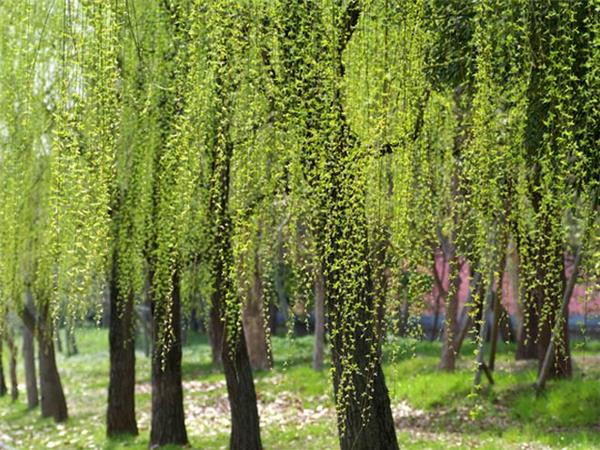
As one of the most common landscape tree species, the weeping willow is inextricably linked with our urban greening construction. It can effectively purify urban air and beautify the urban environment, so it is also a soldier defending urban health.