Rural and Regional Revitalization 11: Enhancing Local Governance Capacity, Participating and Accompanying Together
Text / Hsieh Chih-cheng (Chairman, Rural Development Foundation)
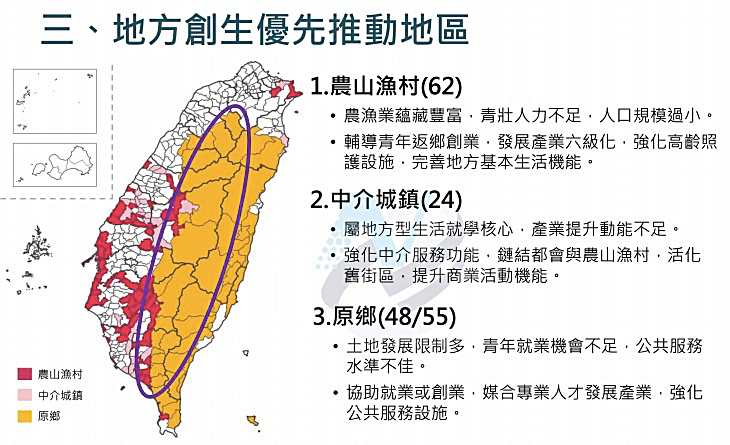
According to the "National Strategic Plan for Regional Revitalization" approved by the Executive Yuan in December 2018, the National Development Council analyzed factors such as population change rate, population size, and resident income, and taking into account the priority of resource allocation and the economic vulnerability of residents in the areas, selected 134 townships and urban districts out of the former 368 nationwide as priority areas for regional revitalization, with the central government assisting these areas in proposing regional revitalization business proposals and promoting related business work.
These priority areas are mainly concentrated in central and southern Taiwan, eastern Taiwan, and other areas outside the six special municipalities. Among them, 62 are of the agricultural-mountain-fishing village type, 24 are of the intermediary town type, and 48 are of the indigenous township type. The land area of the priority areas accounts for 66.5% of the nation, and the population accounts for 11.6% of the nation.
Encouraging universities to assist township (town, city, district) offices in proposing proposals is indeed a good thing from the perspective of talent support. Since the "National Strategic Plan for Regional Revitalization" approved by the Executive Yuan not only emphasizes the proposal process and the building of consensus, but also mentions that local governments, industry-academia-research institutions, enterprises, communities, and associations can all propose regional revitalization business plans on their own or in cooperation. Therefore, given the energy that universities possess, what they can contribute is to step beyond the role of proposer, stand in a higher position, and accompany everyone through the proposal process hand in hand.
Accompany and assist, but don't become a "ghostwriting service"
However, the author must also remind that local governments, industry-academia-research institutions, enterprises, communities, and associations that drive participation in the consensus-building process to conduct various discussions on regional revitalization must absolutely never let it become assistance in the style of a "ghostwriting service."
If, through talent support and the accompanying investment of universities, local governance capacity can be fostered, learning how to integrate all sectors, and accumulating energy for balanced urban-rural development, then this wave of regional revitalization policy is a truly meritorious deed!
The foundation has already launched accompanying actions. Welcome to contact us.
Several friends concerned about regional revitalization policy, including the Agricultural Policy Research Center of the Agricultural Technology Research Institute, the Taiwan Association for Urban and Rural Development, the Rural Development Foundation, and the Department of Bio-Industry Communication and Development at National Taiwan University, the Department of Anthropology at National Taiwan University, and the Department of Landscape Architecture at Fu Jen Catholic University, have closely followed the promotion of Taiwan's regional revitalization policy since a study visit to Japan in September 2018 to observe and learn about policies related to regional revitalization.
The workshop arranged seven sessions of lectures, opening with an introduction by Kuo Fei-yu, Deputy Minister of the National Development Council, on the National Strategic Plan for Regional Revitalization and its implementation methods, followed by Chang Cheng-heng, Wang Chung-jung, and others introducing cases of regional revitalization in Japan, and finally Professor Chen Yu-hua introducing "How to Conduct Township Population Structure Analysis." After the introduction to population structure analysis, participants broke into groups to conduct population structure analysis of their own townships and raise issues and attempt to analyze the causes. The organizing Taiwan Association for Urban and Rural Development specially posted the day's course videos online for reference. The contents are as follows:
● Lecture 1: "National Strategic Plan for Regional Revitalization and Implementation Methods," presented by Kuo Fei-yu, Deputy Minister of the National Development Council.
● Lecture 2: "Observations on Japan's Regional Revitalization Policy," presented by Professor Chang Cheng-heng.
● Lecture 3: "Case of Kasama City, Ibaraki Prefecture, Kanto Region," presented by Professor Wang Chung-jung.
● Lecture 4: "Case of Kamiyama Town, Tokushima Prefecture, Shikoku Region," presented by Director Huang Jen-chih.
● Lecture 5: "Case of Higashikawa Town, Hokkaido," presented by Research Fellow Hsieh Tzu-han.
⟦19
● Lecture 6: "Regional Revitalization Cooperation Team," presented by Associate Research Fellow Chen Chieh-ting.
Lecture 6, "Regional Revitalization Cooperation Team," delivered by Associate Researcher Chen Jieting.
● Lecture 7: "How to Conduct Township Population Structure Analysis," presented by Professor Chen Yu-hua.
(Special note: The Rural Development Foundation will absolutely not intervene in or participate in regional revitalization business proposals. Based on the principle of purely voluntary accompaniment, it assists various places in promoting regional revitalization. The 134 townships (towns, cities, districts) listed as priority areas are welcome to contact us to arrange a meeting if needed.)
(In order to deeply grasp rural development and regional revitalization within Taiwan's real-world context, "News & Market" has cooperated with the Rural Development Foundation on a "Rural Development Special Series," using a series of articles to explore Taiwan's current situation and Japan's policy developments. To read the full series, please click here.)