What Do Tulips Symbolize? A Detailed Explanation of Their Flower Language and Symbolic Meanings
The tulip is the national flower of the Netherlands, prized for its mystery and nobility, and it has now been introduced all over the world. The tulip is a flower endowed with abundant romantic symbolism, and its beautiful blooms are loved by people around the world. Below, let us learn together about what tulips symbolize, as well as the flower language and symbolic meanings of tulips.
I. The Symbolic Meaning of Tulips
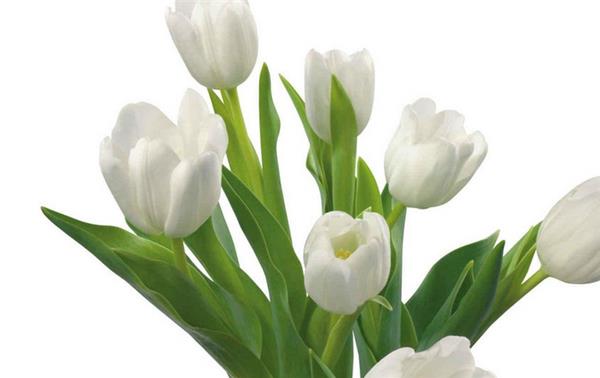
Tulips symbolize elegance, wealth, capability and intelligence. The flower language of tulips is love, charity, fame, beauty, blessing, eternity, a declaration of love and eternal blessings. The tulip, elegant and refined, fresh and timeless, is a flower with a noble and mysterious character. As early as the 17th century, in the imperial gardens of the Ottoman Empire, they were specially planted for royalty and nobles to admire. Tulip flowers are brightly colored and highly varied; for example, a yellow flower speckled with red dots on the petals is called "the King's Blood," while a crimson flower with petals curling around each other is called "the Lover's Hot Kiss."
Red tulips: loving you from the heart, loving you by feeling, remembering you even in sleep, holding you, caring for you, you are the love of my life! Giving this to a girlfriend means conveying a declaration of love to her: "Baby, I love you," just like a red tulip, you are my treasure.
Black tulips represent mystery, nobility, chivalric spirit (or melancholic love). Black has always carried a mysterious quality, so the flower language of black tulips also represents mystery.
Purple tulips represent noble love, endless love and faithful love. The elegant purple tulip makes people fall in love at first sight and want to hold onto it forever, just like when I first met you! In terms of flower language, it is very suitable to give to a wife; your wife is the goddess in your heart, so give all your love to her.
II. Characteristics of Tulips
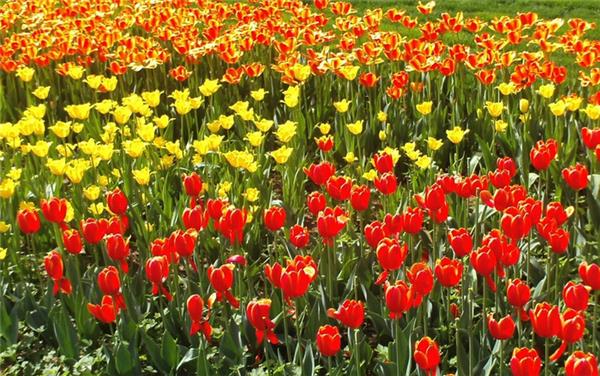
The tulip, also known as the foreign lotus and grass musk, belongs to the Liliaceae family, genus Tulipa, and is a perennial herbaceous bulbous flower. The bulb is egg-shaped, covered with a papery membrane. Leaves number 3-5, basal, ranging from linear-awl-shaped to ovate-lanceolate, 10-21 cm long and 1-8 cm wide. The flower is large, borne singly at the top of the pedicel, goblet-shaped. Flower colors include red, yellow, white, orange, purple and other mixed colors. The flowering period is March to May.
Tulips originated in Central Asia and along the Mediterranean coast. As early as 1258, an Iranian poet mentioned this flower in a poem. After 1554 it was introduced to Western Europe and was extensively propagated, with new varieties emerging endlessly; cultivation was most prevalent in the Netherlands.
The tulip is an autumn-planted bulbous flower. It likes sunlight and is quite cold-tolerant, able to withstand low temperatures of minus 14 degrees, overwintering under snow. It prefers a humid, cool climate and is not heat-tolerant. The soil pH requirement is 6.0-7.8. Neutral or slightly acidic soil is better; soil that has just grown Asteraceae plants is not suitable for planting tulips. Also, continuous cropping is taboo. It is suited to well-drained, moist, sandy loam. The flowers open during the day and close at night and on overcast or rainy days.
III. How to Grow Tulips
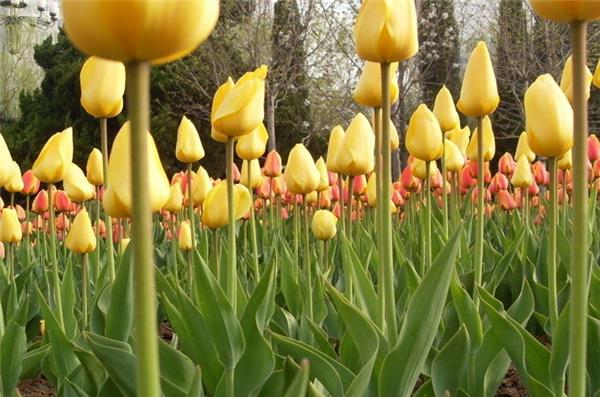
During cultivation, they are susceptible to soil nematodes and Fusarium disease, so clean cultivation soil and fully decomposed fertilizer should be used. In addition, waterlogging in the soil must be prevented, as it causes the bulbs to rot. Keeping the plants growing vigorously is the best disease-prevention measure. Sometimes mottled patterns appear on the flowers of blooming tulips; this is a viral infection, and such diseased plants should be dug up and burned, otherwise they will soon infect other varieties and lose the fine qualities of those varieties.
For home potted tulips, a deep pot should be chosen, and the bottom of the pot should be lined with decomposed barnyard manure plus some supplementary phosphorus and potassium fertilizer as a base fertilizer. After the bulbs are planted, they should be placed outdoors in a cool or freezing spot, keeping the potting soil neither dry nor wet, until 1-2 months before the desired flowering period, when the pot is first moved to a temperature of 5-10 degrees to let it sprout and leaf out. After leafing out, it should be placed at 15-18 degrees in a spot with ample sunlight, with increased water and fertilizer, and it can bloom at New Year's Day or Spring Festival. The specific number of days required varies slightly depending on the variety and temperature conditions.
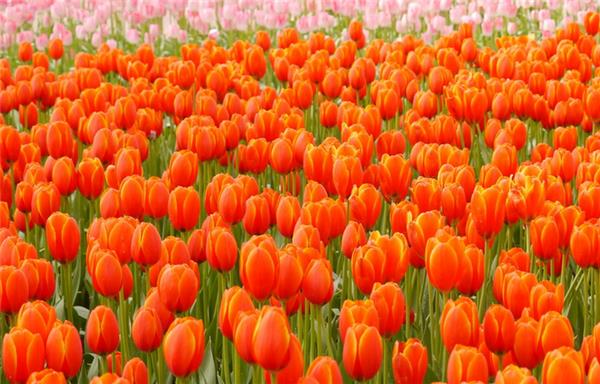
For courtyard cultivation, tulips of various colors can be arranged into specialized flower beds, or combined with other autumn-planted bulbs, or planted in clumps on lawns. They can also be potted for flower appreciation. Their flower stems paired with asparagus fern make the most popular cut flower of spring; used as indoor decorative accents, they can add a cheerful and lively atmosphere.