How to grow tulips? A detailed guide to tulip cultivation methods
Tulips are a very well-known flower with many varieties and brilliant colors, offering excellent ornamental and accent effects. Many people like to grow them in their homes to beautify their living spaces. Tulips come in a great many colors, and different colors represent different meanings. So how do you grow tulips? Let's take a look:
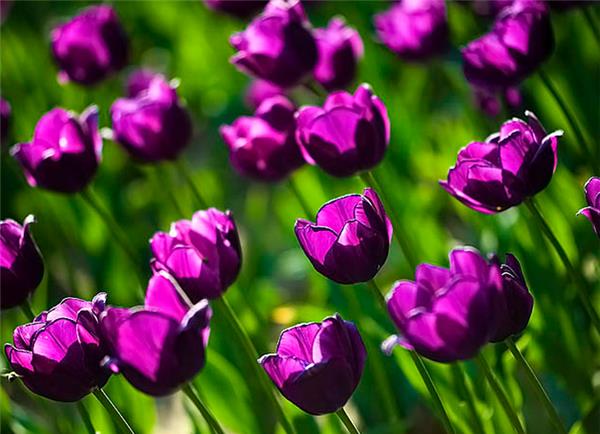
I. How to grow tulips
Tulips originate from the Mediterranean coast and the alpine regions of Central Asia, West Asia and Turkey. Tulips require moist winters and cool, dry summers. Tulips like sunlight and can also grow normally in light shade. They are highly cold-hardy; even when winter temperatures drop to -16°C, the bulbs will not freeze, and tulips can still grow as long as the temperature does not fall below 8°C.
Tulips are generally grown in open ground, but nowadays more and more gardening enthusiasts choose dwarf tulip varieties for container growing. The timing for container-grown tulips is the same as for open-ground cultivation. Usually, in North China the best planting time is from late September to mid-October, while in the middle and lower reaches of the Yangtze River the planting time is before the end of November. The optimal growing temperature for potted tulips is 17-20°C. In February, the room temperature should be kept at 10-15°C, and the tulips can be moved near a south-facing window to get more sunlight.
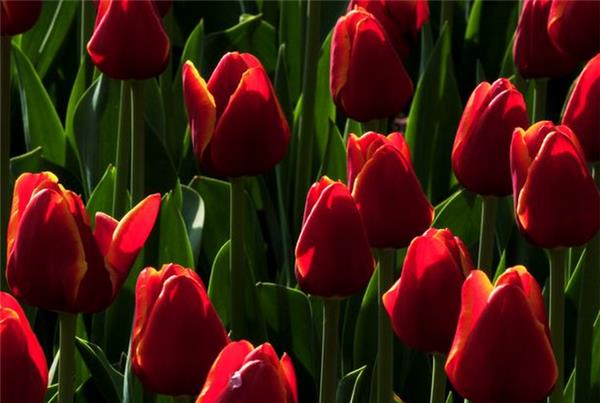
II. Morphological characteristics of tulips:
The tulip is a perennial herbaceous plant. The bulb is flattened conical or flattened ovoid, about 2 cm long, with a brownish skin, covered on the outside with a pale yellow fibrous membrane. The stem and leaves are smooth and covered with a white powder. The leaves emerge in 3-5 per plant, long elliptic-lanceolate or ovate-lanceolate, 10-21 cm long and 1-6.5 cm wide; there are 2-3 basal leaves, which are broader and larger, and 1-2 stem leaves. The flower stem is 6-10 cm tall. The flower is solitary at the top of the stem, large, upright, cup-shaped, with the base usually dark purple. The scape is 35-55 cm long; the flower is solitary, upright, 5-7.5 cm long; there are 6 petals, obovate, bright yellow or purplish red, with yellow stripes and spots: 6 stamens, free, anthers 0.7-1.3 cm long, basifixed, filaments broad at the base; the pistil is 1.7-2.5 cm long, the style split to the base into 3 lobes, recurved. Flower shapes include cup-shaped, bowl-shaped, ovate, spherical, bell-shaped, funnel-shaped, lily-flowered and others, with both single and double forms. Flower colors include white, pink, carmine, purple, brown, yellow, orange and others, in varying shades, either solid or bicolor.
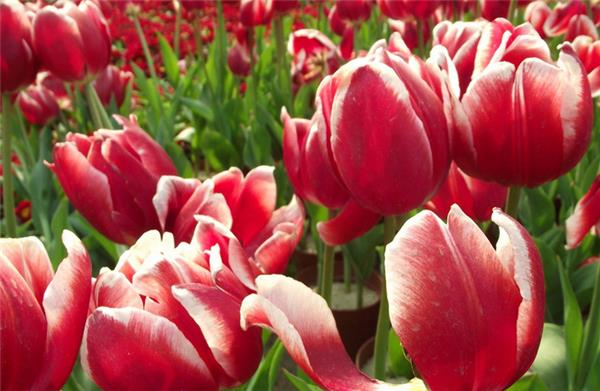
III. Controlling the flowering period of tulips
The flowering period of tulips is in mid-to-late July. Select plump large bulbs and store them in a dry state in a 10°C cold storage room for about a month. Then move them into a 0-30°C cold storage room for 35-40 days. After cold storage, a horseshoe-shaped protrusion appears at the base of the bulb, which indicates that roots are about to emerge, and at this point they can be potted. If the roots have already extended, they are easily broken during planting, which affects the flowering period of the tulips.
When growing in a greenhouse, the temperature difference should be kept as small as possible. Keep it at 14-15°C initially, then it can be raised to 17-18°C. Sudden temperature changes and insufficient water will affect flowering. Lighting plays a role in promoting earlier flowering and improving the flower quality of tulips during their flowering period.
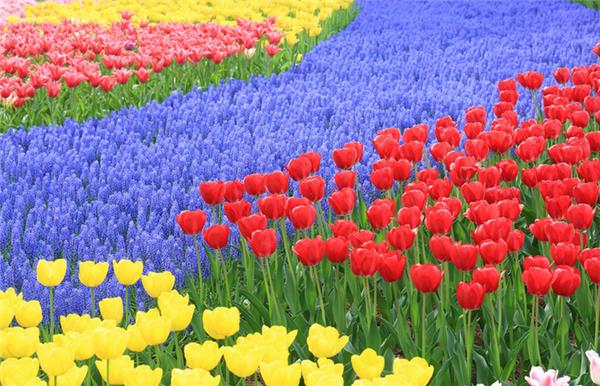
The above content is an introduction to tulip cultivation methods. Tulip cultivation techniques now allow for both hydroponic and soil cultivation, which makes it more convenient for many flower lovers to grow tulips at home, with greater ornamental appeal.