How to Grow Japanese Honeysuckle? Mastering the Planting Technique Is Key
Strengthening field management of Japanese honeysuckle (Lonicera japonica) is the main element of a high yield. Field cultivation management generally includes reasonable arrangement of the population structure, intertillage and weeding, fertilizing and watering, shaping and pruning, and pest and disease control. As a commonly used Chinese medicinal herb, Japanese honeysuckle's medicinal quality is, to some extent, more important than the yield of the medicinal material. So what are the planting techniques for Japanese honeysuckle?
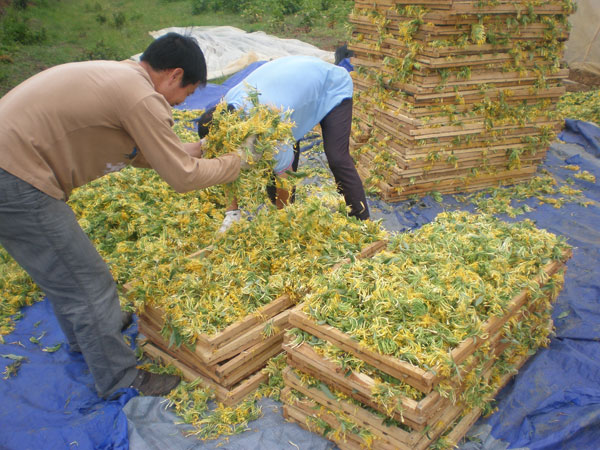
Japanese Honeysuckle Planting Techniques
I. Intertillage and Weeding
Intertillage and weeding are generally done 3-4 times a year. The 1st time is in spring when new shoots and leaves emerge; the 2nd time in June; the 3rd time in July-August; the 4th time in late autumn and early winter. During intertillage, keep it shallow around the root zone of the plant and slightly deeper farther away, to avoid damaging the roots. After the 4th intertillage and weeding, soil should also be banked up around the root zone of the plant to help it overwinter.
II. Topdressing
Each year after budding in early spring and after each harvest of flower buds, a topdressing should be applied. In spring, summer and autumn, apply decomposed human and livestock manure water or nitrogen fertilizers such as ammonium sulfate and urea in a shallow trench beside the roots, then cover with soil to bury the fertilizer. In winter, apply 5-1 kg of farmyard manure, 100 g of ammonium sulfate and 200 g of superphosphate per plant in a ring-shaped shallow trench beside the roots, then cover with soil to bury the fertilizer and bank up soil. If there is no rain after fertilizing, water the plants.
III. Shaping and Pruning
1. The purpose of pruning 1-2 year old plants is to cultivate an upright, thick main trunk. When the main trunk reaches a height of 30-40 cm, cut off the top shoot to promote lateral buds to sprout into branches.
2. After the plants sprout in spring from the 3rd year onward, select and keep 4-5 thick branches on the upper part of the main trunk as main branches, arranged in two layers.
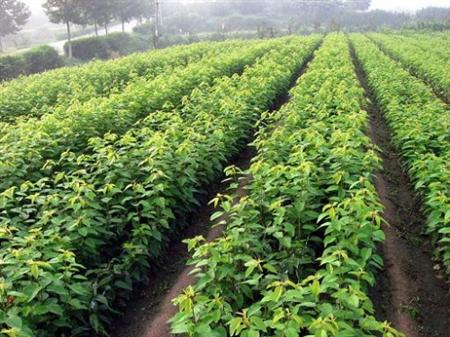
From the primary branches growing from the main branches, keep 5-6 pairs of buds and cut off the upper part; then from the secondary branches growing from the primary branches, keep 6-7 pairs of buds and cut off the upper part; then from the tertiary branches growing from the secondary branches, pinch off the hook-shaped tender tips. Generally, after the beginning of spring, the young branches with dense, short nodes and fine leaves that sprout from the secondary branches or the original old flower branches are all flower branches and should be kept. After Frost's Descent and before the ground freezes, winter pruning should be carried out. During winter pruning, cut off dead and old branches, diseased and pest-infested branches, thin and weak branches, and long branches that cross and disrupt the tree shape. After each harvest of flower buds, summer pruning should likewise be carried out, and summer pruning should be done in moderation. After each pruning, apply a topdressing once.
IV. Drainage and Irrigation
During the flowering period, or when encountering dry weather or excessive rain, flower drop and flower rot may occur, so irrigation or drainage work should be done promptly.
V. Pests and Diseases and Their Control
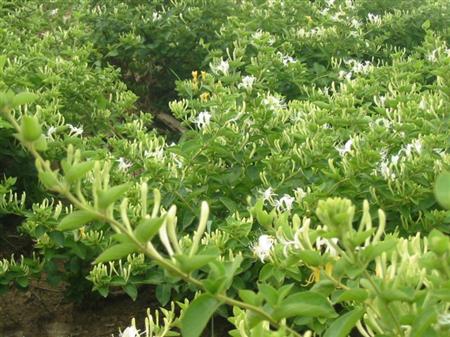
1. The main disease is powdery mildew, which harms leaves and tender stems. In the early stage of leaf infection, round white downy mildew spots appear, then they continuously expand and join together into patches, forming white powdery spots of varying sizes, and finally causing flower drop, leaf withering and branch dieback. The control methods are mainly the following two aspects: First, reasonable close planting and shaping and pruning to improve ventilation and light conditions, which can enhance disease resistance. Second, spray 25% triadimefon 1500x solution or 50% thiophanate-methyl 1000x solution once every 7 days, for 3-4 consecutive sprays.
2. For insect pests, omethoate can be used to control aphids, and phoxim can be used to control the coffee brown longhorn beetle.
The Benefits and Effects of Drinking Japanese Honeysuckle Soaked in Water
Japanese honeysuckle, also known as winter honeysuckle, silver flower, double flower, etc., is sweet and cold in nature with a fragrant aroma, and has the effects of dispelling wind-heat and clearing heat and detoxifying. It is suitable for various heat-related illnesses, such as body heat, heat-toxin sores and carbuncles, and sore, swollen throat. Modern pharmacological studies show that the active ingredients in Japanese honeysuckle have antibacterial, antiviral and immune-enhancing effects. In daily life, many people often drink Japanese honeysuckle soaked in water for health care. What are the benefits and effects of drinking Japanese honeysuckle soaked in water?
Reducing internal heat and preventing bad breath
To prevent bad breath, chrysanthemum or Japanese honeysuckle can be soaked in water and drunk. Chrysanthemum has a weaker wind-dispelling effect but a good heat-clearing effect; for externally contracted wind-heat it is often used together with mulberry leaf, and it can also be combined with baikal skullcap root and gardenia to treat conditions such as restlessness due to excessive heat. Chrysanthemum treats red, swollen and painful eyes, whether caused by liver fire or wind-heat, because this herb can both clear liver fire and dispel wind-heat; it is often used together with cicada slough, tribulus fruit, etc. If liver yin is insufficient and vision is blurred, it is mostly used together with rehmannia and goji berry, etc. Chrysanthemum has an excellent heat-clearing and detoxifying effect and is an important herb in external medicine, mainly used for heat-toxin sores and ulcers and red, swollen, hot and painful conditions; it has a particularly good effect on painful boils and toxin swellings, and can be taken internally or mashed and applied externally. Clinically it is often used together with heat-clearing and detoxifying items such as Chinese violet and dandelion. Chrysanthemum can calm and lower liver yang; for dizziness and vertigo caused by liver yang rising, it is often combined with nacre and kudzu vine, etc.
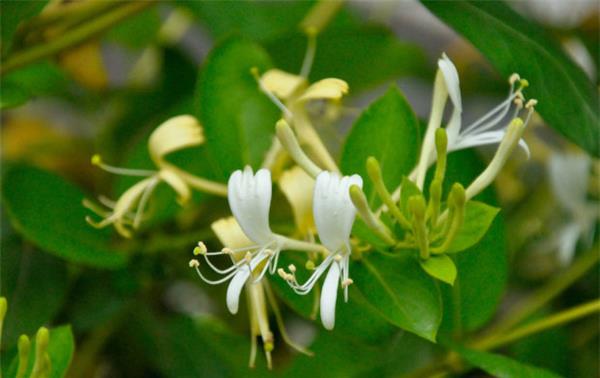
Japanese honeysuckle is cold in nature, sweet in taste and neutral in qi, and has the effect of clearing heat and detoxifying. It can treat heat-toxin swellings and ulcers, carbuncles, boils and sores, etc. Because it also has a dispersing effect, it can also treat externally contracted wind-heat and the early stage of warm diseases. For example, Yinqiao Jiedu Tablets (pills), used to treat wind-heat common cold, use Japanese honeysuckle as the main ingredient. Yinhuang Tablets, made by combining it with baikal skullcap root, can treat acute upper respiratory tract infection, acute pharyngitis, acute tonsillitis, etc. Distilling Japanese honeysuckle with water yields "Japanese honeysuckle distillate," which has the effect of clearing summer heat and can treat heat boils in children, prickly heat, summerheat, etc.
Therefore, friends who have long suffered from excessive stomach fire and dry mouth with a bitter taste may want to drink some chrysanthemum and Japanese honeysuckle tea; it is believed to be of great help to you.
Sore, swollen throat and preventing upper respiratory tract infection
To treat sore, swollen throat and prevent upper respiratory tract infection by drinking Japanese honeysuckle soaked in water as a tea substitute, the method is: take 20 g of Japanese honeysuckle, decoct in water and drink as a tea substitute, or brew as tea, 1 dose per day.
Propagation of Japanese Honeysuckle
First, seed propagation. First add New High Lipid Film to warm water and soak the seeds; sow when about 30% have cracked open, and transplant after the seedlings emerge.
Second, cutting propagation. In rainy weather in summer and autumn, select healthy, pest-free 1-2 year old branches 30-35 cm long, remove the lower leaves and use them as cuttings, using them as soon as they are cut. After the branches are transplanted, spray with New High Lipid Film.
Harvesting and Processing of Japanese Honeysuckle
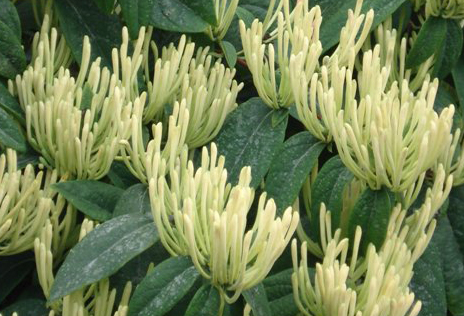
Japanese honeysuckle generally flowers in the third year after transplanting. The first and second flushes of flowers are picked in mid-to-late May, and the third and fourth flushes are picked successively 1 month later. Harvesting must be done before the flower buds have opened; when the flower buds turn from green to white, with the upper part swollen and the lower part still greenish, those picked
Japanese honeysuckle buds are "Erbaihua" (two-white flowers); flowers harvested when the buds have completely turned white are called "Dabaizhen" (large white needles). The picked flower buds should be dried in the shade or dried promptly, and should not be piled up to become moldy. The yield is generally about 150 kg per mu.
Japanese honeysuckle is cold in nature, sweet in taste and neutral in qi, and has the effect of clearing heat and detoxifying. It can treat heat-toxin swellings and ulcers, carbuncles, boils and sores, etc. Because it also has a dispersing effect, it can also treat externally contracted wind-heat and the early stage of warm diseases. For example, Yinqiao Jiedu Tablets (pills), used to treat wind-heat common cold, use Japanese honeysuckle as the main ingredient. Yinhuang Tablets, made by combining it with baikal skullcap root, can treat acute upper respiratory tract infection, acute pharyngitis, acute tonsillitis, etc. Distilling Japanese honeysuckle with water yields "Japanese honeysuckle distillate," which has the effect of clearing summer heat and can treat heat boils in children, prickly heat, summerheat, etc.
Therefore, friends who have long suffered from excessive stomach fire and dry mouth with a bitter taste may want to drink some chrysanthemum and Japanese honeysuckle tea; it is believed to be of great help to you.
Sore, swollen throat and preventing upper respiratory tract infection
To treat sore, swollen throat and prevent upper respiratory tract infection by drinking Japanese honeysuckle soaked in water as a tea substitute, the method is: take 20 g of Japanese honeysuckle, decoct in water and drink as a tea substitute, or brew as tea, 1 dose per day.
Propagation of Japanese Honeysuckle
First, seed propagation. First add New High Lipid Film to warm water and soak the seeds; sow when about 30% have cracked open, and transplant after the seedlings emerge.
Second, cutting propagation. In rainy weather in summer and autumn, select healthy, pest-free 1-2 year old branches 30-35 cm long, remove the lower leaves and use them as cuttings, using them as soon as they are cut. After the branches are transplanted, spray with New High Lipid Film.
Harvesting and Processing of Japanese Honeysuckle
Japanese honeysuckle generally flowers in the third year after transplanting. The first and second flushes of flowers are picked in mid-to-late May, and the third and fourth flushes are picked successively 1 month later. Harvesting must be done before the flower buds have opened; when the flower buds turn from green to white, with the upper part swollen and the lower part still greenish, those picked
Japanese honeysuckle buds are "Erbaihua" (two-white flowers); flowers harvested when the buds have completely turned white are called "Dabaizhen" (large white needles). The picked flower buds should be dried in the shade or dried promptly, and should not be piled up to become moldy. The yield is generally about 150 kg per mu.