What are the biological characteristics and medicinal properties of bamboo?
Bamboo is a very easy plant to identify. As long as you see from a distance a large clump of tall, upright plants growing in clusters with jointed culms, then it is undoubtedly bamboo. But beyond these, bamboo itself has other characteristics too.
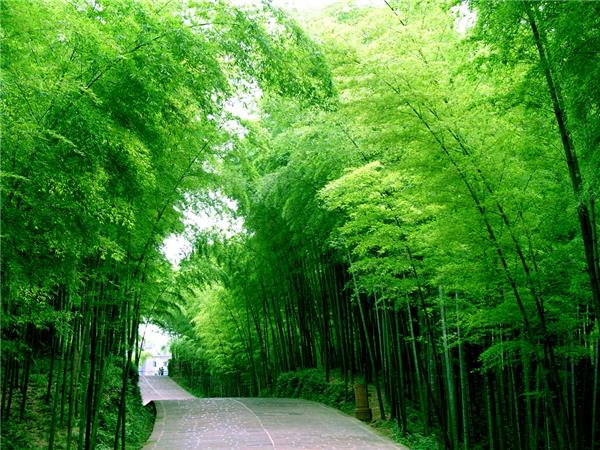
I. Biological characteristics of bamboo
1. Rhizome: The rhizome of bamboo is the stem of the bamboo plant that grows horizontally in the soil, with obvious nodes. Roots form at the nodes, and buds form at the sides of the nodes, which can sprout into new rhizomes or send up shoots that emerge from the ground as bamboo. From a botanical point of view, the rhizome is the main stem of the bamboo plant, and the culm is a branch of the bamboo plant. In a bamboo forest or a bamboo clump, although many culms are produced above ground, underground they are interconnected and originate from the same main stem or a few main stems.
2. Branches: Bamboo branches are hollow and jointed, and the branch nodes are composed of a sheath ring and a branch ring. According to the normal branching pattern of the culm, they can be divided into the one-branch type, in which each node of the culm bears a single branch, as in species such as Qiongzhuea; the two-branch type, in which each node of the culm bears 2 branches, 1 main and 1 secondary, differing in length and size, as in species of the genus Phyllostachys; the three-branch type, in which each node of the culm bears 3 branches, one central main branch with one secondary main branch on each side, as in species of the genus Sinobambusa; and the multi-branch type, in which each node of the culm bears many branches in a cluster, as in Neosinocalamus and Bambusa.

3. Culm: Bamboo can be a substitute for wood. It is one of the hardest building materials, with tensile strength comparable to steel and even surpassing graphite, able to withstand pressure of up to 52,000 pounds per square inch. It has an annual growth rate of 10-30%, compared with 2-5% for trees. Bamboo can produce a very large area of raw material for use; a clump of bamboo can grow 200 culms within five years, while a tree can only grow one.
4. Environmental protection: In the natural environment, bamboo is a very important element for the balance of oxygen and carbon dioxide. It can reduce carbon dioxide, the chief culprit in global warming; some bamboos can even break down as much as 12 metric tons of carbon dioxide per hectare, very efficiently making the air very fresh. For greening poor, infertile soil areas, it is the fastest-growing ground cover and, compared with trees of the same area, can produce up to 35% more oxygen.
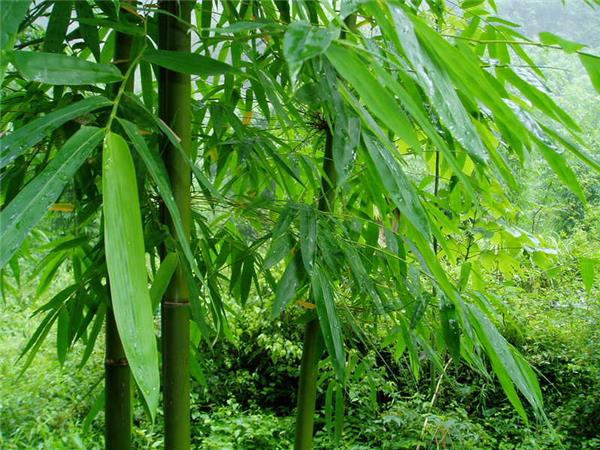
II. Medicinal properties of bamboo
The "Dictionary of Traditional Chinese Medicine" records that the functions and indications of Lophatherum leaf are: clearing heat and relieving restlessness, promoting body fluid and diuresis, treating fever with restlessness and thirst, convulsions in children, cough with counterflow and epistaxis, flushed face, scant dark urine, oral erosion and tongue sores, etc.
The Qing dynasty "Ben Cao Qiu Zhen": "Bamboo leaf, according to what the books record, cools the heart and relaxes the spleen, clears phlegm and quenches thirst. It treats wind-pathogen and vexing heat in the upper jiao, cough with counterflow and rapid breathing, vomiting and retching with blood, and all such conditions as wind-stroke and convulsions, simply because its lightness can relieve the upper, its pungency can disperse stagnation, its sweetness can relax the spleen, its coolness can enter the heart, and its coldness can treat heat."
The Qing dynasty "Ben Jing Feng Yuan": "(Bamboo leaf) governs cough with counterflow and upward qi, treats contracture (spasm) of the sinews and malignant sores, kills small worms... It governs dry cough with counterflow and upward qi because it can clear the heat of the lung and stomach; it treats contracture (spasm) of the sinews and malignant sores because it can transform the qi within the body. When qi is transformed, then the qi throughout the body is transformed; when qi is transformed, then all the bones and joints are free and smooth, so how could there be trouble from small worms?"
The Qing dynasty "Yao Pin Hua Yi": "Bamboo leaf is clear and fragrant, penetrating the heart; slightly bitter, it clears both cool qi and hot qi. The classic says: treat warmth with clearing, specifically clearing heart qi. The leaf is sharp and has a dispersing effect, and its bland flavor frees the orifices, causing the hot qi of the heart channel to be resolved. It is indicated for summerheat with wasting-thirst, hot phlegm in the chest, cold damage with deficiency restlessness, and cough with counterflow and rapid breathing; in all of these it is used as a fine remedy. It is also taken because its green color enters the gallbladder and its clear qi enters the lung; thus for clearing heat in the qi aspect, nothing but bamboo leaf can..."
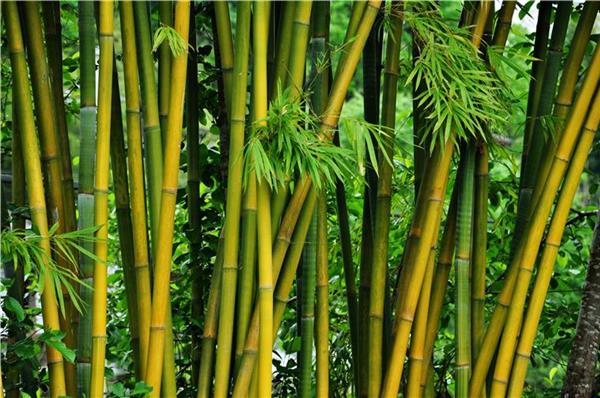
Through what has been introduced above, I hope this can help everyone better understand the characteristics of bamboo and its uses. Overall, bamboo is a plant with relatively high cultivation value. It has a unique ornamental effect and an noble symbolic meaning; these are all things that can enhance its own value.