Bear's Paw is a cute and adorable succulent plant suitable for growing at home
Bear's Paw gets its name because its plant shape resembles a bear's paw. It is a plant that looks very endearing and naive, with relatively high ornamental value and the ability to beautify a room. When growing Bear's Paw, it is necessary to avoid harm to the plant such as water accumulation in the pot and direct strong light.
I. Morphological characteristics of Bear's Paw
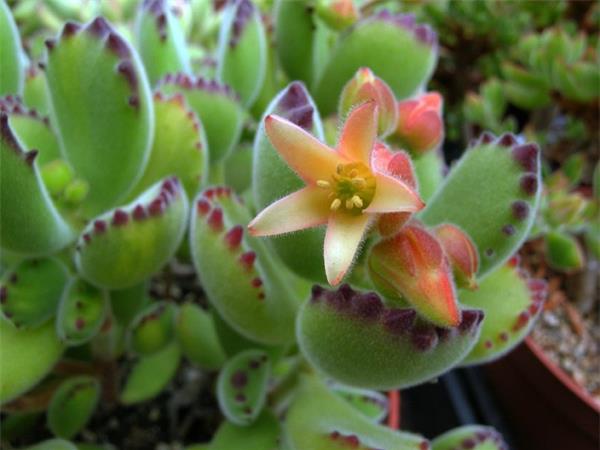
Bear's Paw is a perennial succulent herbaceous plant. The plant is much branched and shrub-like, with dark brown stems. The thick fleshy leaves are opposite, ovate, 2 cm to 3 cm long and 1 cm to 1.5 cm wide, with notches at the leaf margin at the top. The leaf surface is green and densely covered with short white hairs. The leaves of Bear's Paw are fleshy, spoon-shaped, densely covered with white down, entire at the lower part, and with brown teeth at the leaf tip.
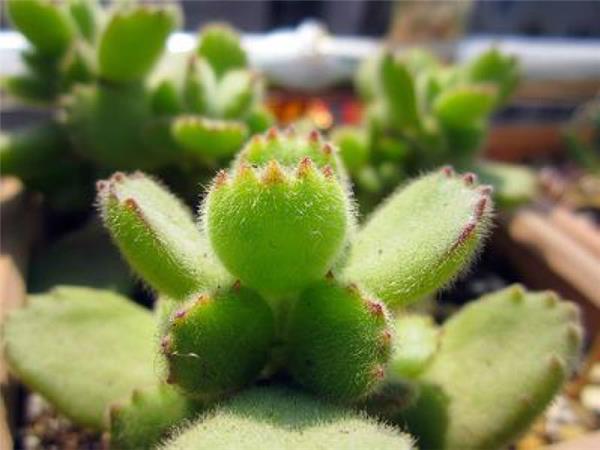
II. How to grow Bear's Paw ⟧7⟧ Propagation: Bear's Paw is generally propagated by cuttings. Take branches with short stem nodes and thick leaves, let the cut dry slightly, then insert them into a sand bed. They will root in 20 days and can be transplanted in one month.
Propagation: The usual propagation method for bear's paw (Cotyledon tomentosa) is cuttings. Take a branch with short stem nodes and thick, fleshy leaves, let the cut surface dry slightly, then insert it into a sand bed; it will root in 20 days and can be transplanted in one month.
Soil: It is best to use sandy soil with good drainage and medium fertility. It can be mixed with coarse sand, garden soil, and leaf mold in a 1:1 ratio.
Watering: Bear's Paw should be watered thoroughly in summer. If it is a sunny day, water once in the morning and once in the evening. In winter, if there is insufficient sunlight, the potting soil should not be too wet.
Light: High temperatures in summer require shading, but if it is too shaded, the stems and leaves become weak and the down lacks luster. Except in summer, maintain light in other seasons.
Temperature: In summer, it is enough as long as the temperature is not higher than 30°C. Below this temperature it can grow vigorously. When the summer temperature exceeds 30°C, the plant's growth basically stalls... In winter, when it is too cold, it should be kept indoors, ensuring the room temperature is not lower than 5°C.
Fertilization: Apply a thin liquid fertilizer once a month.
Repotting: Every one to two years, it should be repotted, preferably in spring.
Disease and pest control: Bear's Paw diseases include wilt disease and leaf spot disease, sprayed with 50% captan 800-fold solution. Pests include scale insects and whiteflies, which can be killed by spraying with 40% omethoate emulsifiable concentrate 1000-fold solution.
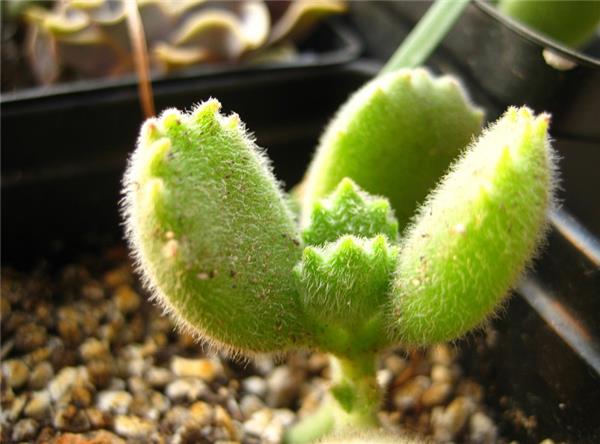
III. Notes on growing Bear's Paw ⟧16⟧ 1. General succulents mostly use leaf cuttings, but Bear's Paw is slightly different. Although Bear's Paw leaf cuttings will root, they rarely sprout, so this method is mostly not used. Bear's Paw cuttings are generally best taken in spring and autumn.
1. Most succulents are propagated by leaf cuttings, but bear's paw is slightly different. Although bear's paw leaf cuttings will root, they rarely produce shoots, so this method is mostly not used. For bear's paw, cuttings are best taken in spring or autumn.
2. Watering Bear's Paw requires good control, and it should not be too dry or too wet. Spring and autumn are its seasons of most vigorous growth. The soil should be watered after it dries out completely, and when watering, water thoroughly. Long-term overly wet potting soil will cause leaf rot, while too dry will cause shrinkage. If too much water is given, the container can be tilted slightly to pour the water out. Bear's Paw does not have high fertilizer requirements. Use fertile, loose sandy loam as potting soil, and apply little or no fertilizer.
3. After leaves drop during the dormant period, immediately reduce the watering frequency, let the soil dry completely, and then water an appropriate amount, so it can safely pass through the dormant period. If leaves drop during the growing period, reducing watering can also be used to deal with it, but it is relatively difficult; measures such as repotting and cooling, ventilation, and increasing air permeability can be used.
4. If the environment is very ventilated, spraying water on the plant can wash off dust and make the leaves clean, but do not let water remain in the center of the leaves, otherwise rot in the center may occur. Otherwise, water droplets staying in the leaf down will form unsightly water stains and affect the ornamental value.
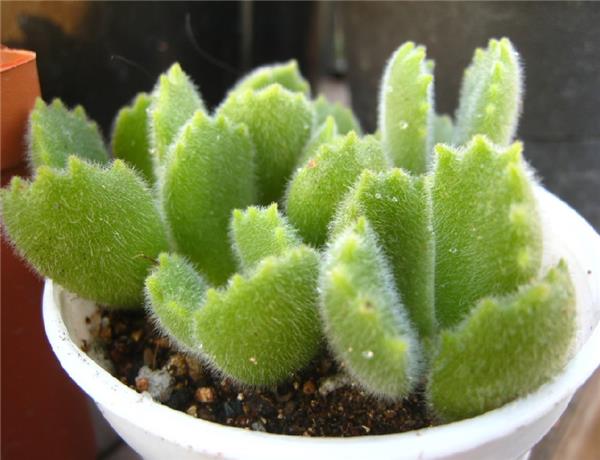
Bear's Paw looks just like a little bear's paw pad, very cute. Bear's Paw has an elegant shape and is uniquely beautiful. It can be used as a small indoor potted plant, giving people a feeling that is both delicate and elegant and full of vitality. In addition, similar fine species in the same genus as Bear's Paw include Silver Wave Brocade, Reincarnation, Light of the Rising Wave, and Fortune Maiden.