A Detailed Guide to the Propagation Methods and Cultivation Precautions of the Southern Magnolia
The southern magnolia is an evergreen tree with a very long lifespan, reaching up to 30 years, and is relatively easy to cultivate. Let's learn about it together below.
I. Morphological Characteristics of the Southern Magnolia
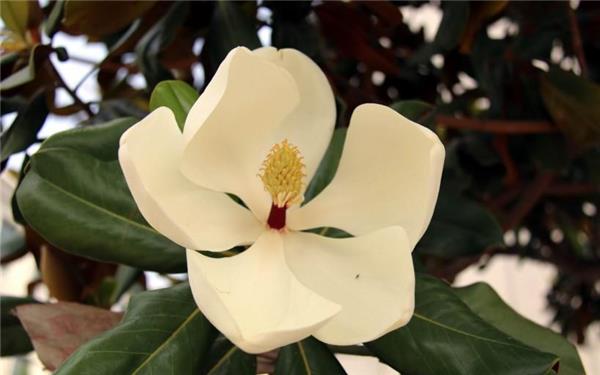
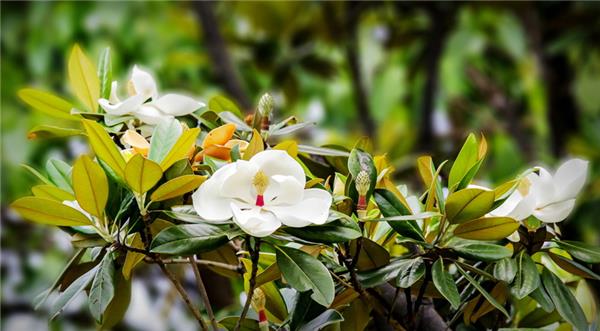
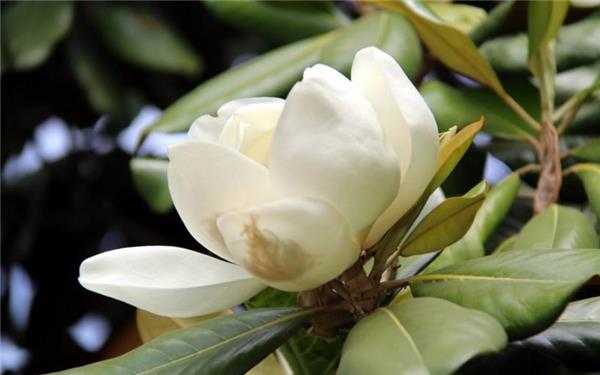
Evergreen tree, up to 30 m tall in its native habitat; bark light brown or gray, splitting into thin scales; branchlets stout, with diaphragmed pith; branchlets, buds, leaf undersides, and petioles all densely covered with brown or grayish-brown short tomentum. Leaves thickly leathery, elliptical, oblong-elliptical, or obovate-elliptical, 10-20 cm long, 4-7 cm wide, apex obtuse or shortly obtuse-acuminate, base cuneate, upper surface dark green and glossy; lateral veins 8-10 per side; petiole 1.5-4 cm long, without stipular scars, with a deep groove. Flowers white, fragrant, 15-20 cm in diameter; tepals 9-12, thickly fleshy, obovate, 6-10 cm long, 5-7 cm wide; stamens about 2 cm long, filaments flattened, purple, anthers introrse, connective extended into a short point; gynoecium ellipsoid, densely covered with long tomentum; carpels ovate, 1-1.5 cm long, style curved. Aggregate fruit cylindrical-oblong or ovoid, 7-10 cm long, 4-5 cm in diameter, densely covered with brown or pale grayish-yellow tomentum; follicles dehiscing along the back, rounded on the back, with a long beak on the outer side at the apex; seeds nearly ovate-round or ovate, about 14 mm long, about 6 mm in diameter, outer seed coat red, the seed with the outer seed coat removed extending at the apex into a short neck.
II. Propagation Methods of the Southern Magnolia
Seed propagation: The seeds of the southern magnolia are rich in oil and cannot be stored through the summer, so they should be sown as soon as they are collected. Before sowing, the seeds need to be mixed with rodent repellent to prevent rats from stealing and eating them.
Air layering: The survival rate is high; after being cut from the parent plant and potted, it should be cut back at 15 cm above the soil surface, keeping one lateral bud below the cut to let it sprout and grow into a new main trunk, so that the plant grown in the future is completely renewed.
Grafting propagation: When the southern magnolia is produced in large quantities, grafting propagation is mostly used. Seedlings of Magnolia liliiflora are used as rootstock, and grafting is carried out when the stem diameter of the rootstock seedling reaches 0.5 cm. Grafting around Qingming has the highest survival rate. When grafting, first cut off the rootstock seedling at about 10 cm above the ground, then cut the scion and divide it into sections 6-9 cm long, graft by the cut-grafting method, then wrap the interface tightly and securely with plastic strips, and finally mound soil to bury the interface. After 15 days the interface heals. After 25 days the grafted scion begins to sprout; at this time, dig open and level the soil mound, and at the same time remove the lateral buds on the rootstock. When the new shoot of the grafted scion grows to 15 cm, to prevent them from breaking, reed poles should be inserted and tied for support.
III. Cultivation Precautions for the Southern Magnolia
1. It is advisable to choose loose, fertile, well-drained sandy loam rich in humus. Do not use calcareous soil for planting.
2. A site with open terrain and sufficient sunlight should be chosen, and it is best to avoid planting in wind gaps, otherwise when flowering, the flowers are easily damaged by strong winds.
3. The southern magnolia prefers a slightly moist but rather dry soil environment, is not tolerant of drought, and is not tolerant of waterlogging; during the vigorous growth stage, water supply should be guaranteed. It has a relatively high demand for fertilizer; in addition to applying base fertilizer at planting, it can be top-dressed once every 2-3 weeks during the vigorous growth stage.
4. The southern magnolia prefers direct sunlight and is slightly shade-tolerant; it should receive no less than 4 hours of sunlight per day. It likes warmth and is relatively cold-tolerant, growing well within a temperature range of 18-28°C, and can tolerate low temperatures of around -12°C.
5. In actual cultivation, the southern magnolia may be harmed by brown spot disease, chlorosis, anthracnose, etc., and may be attacked by harmful animals such as silkworms and bagworms. If this occurs, measures should be taken promptly to deal with it.
6. This species has a very long lifespan. When phenomena such as declining tree vigor and reluctance to bloom occur, consider renewing the plant, and it is best to replace the soil when replanting.
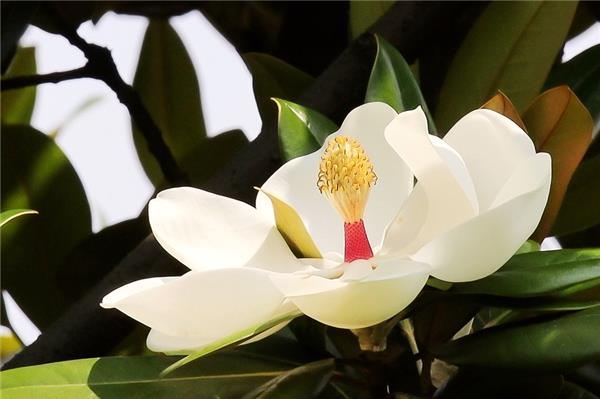
The southern magnolia has a soft and elegant flower shape, pure and elegant white flowers, and a light and charming fragrance. When the flowering season arrives, a tree full of fresh flowers is enough to bring people visual enjoyment, making it an excellent choice for decorating courtyards.