What are the precautions for repotting and potting succulents?
Most succulents are short and compact, making them excellent for placing on a desk to help relieve eye strain and ease tension.
I. Propagation methods for succulents
Sowing: Generally, succulent seeds stored at room temperature for 1 year show a rapid drop in germination rate. For this reason, many succulents are sown immediately after the seeds mature, or stored and sown the following spring. Germination times also differ among families and genera; some sprout in as little as 2 days, while others take 25 days to germinate.
Leaf cuttings: Thick, fleshy leaves are often laid on a slightly moist sand bed or loose soil surface; they root quickly, and adventitious buds grow from the base of the leaf to form small plants.
Stem cuttings: In succulent propagation, stems are cut into sections as cuttings while pruning and shaping the plant.
Root cuttings: For the rather valuable species of the genus Haworthia in the family Asphodelaceae, the roots are very thick and well developed. A fairly mature fleshy root is cut off and buried in a sand bed with the upper part slightly exposed; kept moderately moist and in bright light, new buds can sprout from the tip of the root to form a complete small plant.
Grafting: In succulents, grafting is often used to propagate variegated and fasciated cultivars. However, during grafting, because the plant contains a white latex that is highly sticky, the operation must be done quickly and skillfully to succeed.
Division: Division is the simplest and safest method of propagating succulents and can be done in spring when repotting.
II. How to pot succulents
Change the soil: Whether bought from a flower market, a greenhouse, or online, throw away all the soil from the original pot. Some soil may contain pathogens or insect eggs, and some even has insects in it from time to time.
Wash the roots: You can hold the roots in a basin of water and shake them back and forth. Do not turn on a tap and flush with a strong stream, as this will break off a large number of roots. Shake and soak repeatedly several times until the white main roots are visible. Make sure the soil carried on the roots is basically rinsed off, because it very likely contains large numbers of insect eggs and bacteria.
Trim the roots: Cut off the blackened diseased roots and dead roots, even those that are only empty shells. Also appropriately trim the overly long, heavily tangled lateral roots to encourage new fibrous roots to grow. After root trimming, the newly regenerated root system will be strengthened, making the plant grow more robustly. If you are not confident, you can also skip the trimming.
Soak the roots for sterilization: When trimming roots, the root system will certainly be damaged, so next it needs to be soaked for about one hour in a prepared sterilizing solution. Carbendazim, chlorothalonil, and thiophanate-methyl can all be used. Do not mix the concentration too high; you can soak multiple plants in one small washbasin.
Dry the roots: If you are worried about root rot, let the plant sit for several days before watering, and leave it for one to two weeks; during this time, just do not let the sun dehydrate it. Weak sunlight helps the plant return to its natural state more quickly, and once it has taken hold, place it in the sun for normal care.
III. How to repot succulents
Generally, succulents are repotted once every 1 to 3 years. Most varieties are usually repotted from mid-March to early April, while some "winter-growing types" that grow in winter and go dormant in summer can also be repotted from late August to early September. In short, repotting should be done when the dormant period is about to end and the plant is about to start growing. Clustering plants can also be divided and propagated at the same time as repotting. In addition, if root rot is found in a plant, emergency repotting can be carried out at any time.
Stop watering 3 to 5 days before repotting. When repotting, first knock the plant out of the pot and shake the soil off the roots. Cut off all old roots, rotten roots, and hollow roots, keeping only the robust, plump roots with good absorption capacity. However, for varieties with thick fleshy roots, such as those in the cactus family genera Ariocarpus and Lophophora, it is not advisable to trim the roots excessively, because these fleshy roots store abundant nutrients; excessive trimming will affect growth and, in severe cases, even cause root rot and death of the whole plant. If there are young plants beside the old plant, they can be broken off, their roots properly trimmed, dry leaves removed, and then planted separately. If the wound from division is too large, apply sulfur powder, charcoal powder, carbendazim, or other anti-rot agents to the wound and let it dry for 3 to 7 days, then pot it up after the wound has dried.
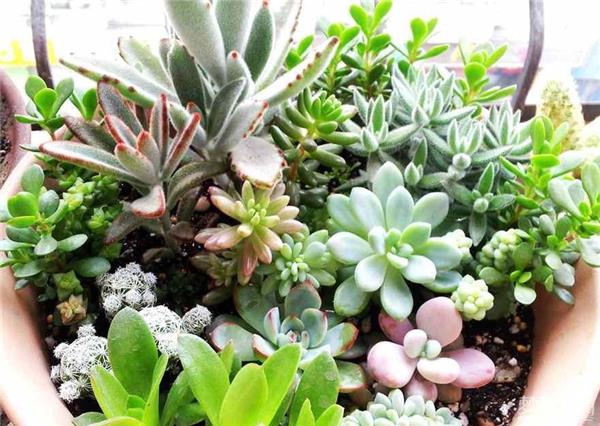
The stems and leaves of succulents are mostly plump and chubby, very cute, and have a great ornamental effect, so in daily care, everyone must handle them carefully and give them extra attention.
The stems and leaves of succulents are mostly plump and chubby, very cute, and have a great ornamental effect, so in daily care, everyone must handle them carefully and give them extra attention.