Precautions for Cultivating Elaeocarpus and Methods for Pest and Disease Control
The branches and leaves of Elaeocarpus are very dense. If multiple Elaeocarpus trees are planted together, they will form a lush, dense forest feel, and they can also achieve a foliage-viewing effect before the flowering period, so they are often seen in various landscape designs.
I. Introduction to Elaeocarpus
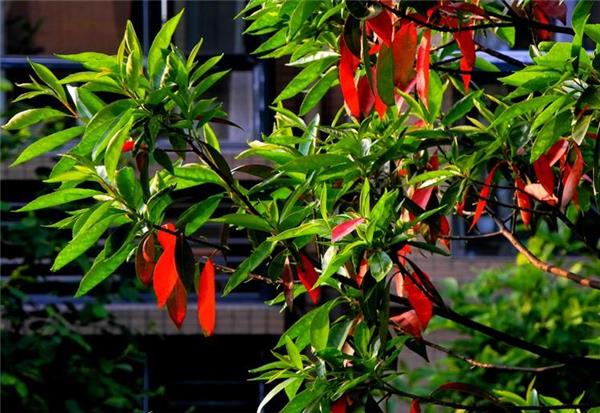
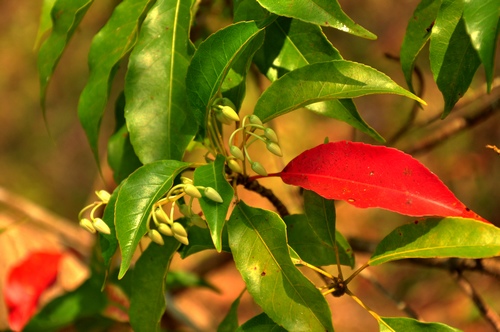
Elaeocarpus belongs to the genus Elaeocarpus in the family Elaeocarpaceae. It is an evergreen tree, generally 10-20 m tall, up to 26 m at most, with an ovoid spherical crown. The bark is dark brown, smooth and not cracking. The branchlets are reddish brown, sparsely covered with short pubescence when young, and smooth later. The leaves are thinly leathery. The flowering period is from June to August, and the seeds mature from October to December. This species has dense branches and leaves, and some leaves turn red after frost. The mixture of red and green is very beautiful. It is suitable for group planting on lawns, slopes, forest edges, in front of courtyards, and at road intersections, and can also be planted as a background tree for other flowering plants.
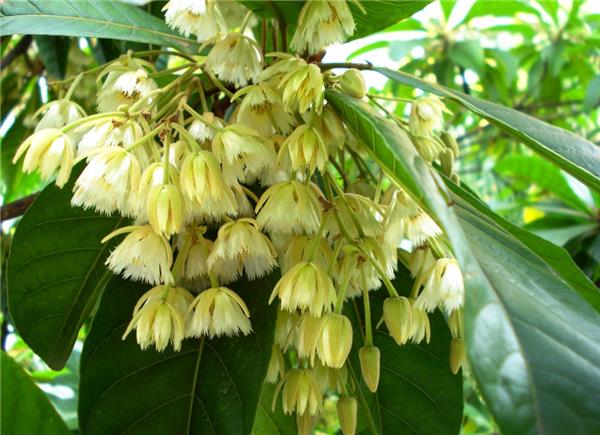
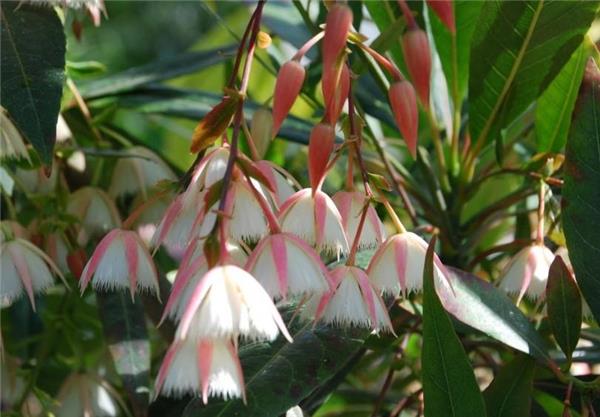
June to July is the flowering period of Elaeocarpus. Flowering branches grow from the branch tips, and on each flowering branch there are two rows of alternate flowers, with more than ten flowers per row. Elaeocarpus flowers are small white flowers, with a flower diameter of less than one cm. The upper part of the five petals splits into filaments, and there are also five green sepals supporting them. In the middle there is a green column, with dozens of stamens arranged around the column. On closer look, the small, plain and elegant white flowers are quite beautiful. When passing by the tree, one can smell a strong, sweet floral fragrance.
II. Key Technical Points for Cultivating Elaeocarpus
Sowing: The sowing time is from February to May. Use drilling, with a row spacing of 25 cm, a furrow width of 10-12 cm, and a depth of 3 cm. The sowing rate is 8-10 kg per mu. When sowing, spread an appropriate amount of calcium magnesium phosphate, which is beneficial for root development. Cover with soil thinly; it is best to cover the seeds with burnt mud ash, with the thickness just enough that the seeds are not visible.
Seedling raising: Keep the soil loose and moist, which is beneficial for seed germination. The emergence period is about 30-40 days. After 70% of the seedlings have emerged, remove the covering in the evening. The next evening, spray the seedbed with a 0.1% dexon solution to prevent disease.
Fertilization: In the early stage of seedling growth, apply dilute human feces and urine at a concentration of 3%-5% every half month. After mid-May, it can be watered with a 1% superphosphate or 0.2% urea solution.
Weeding: Carry this out according to the principle of "remove small, remove early, remove completely." Weed 3 to 4 times. By the end of July, the seedlings can close their canopy and rows, and no further weeding is needed afterward. Use 50% acetochlor at 1200 ml/ha and 12.5% haloxyfop at 600 ml/ha alternately sprayed at 45-day intervals.
Water: During the plum rain season, clear ditches and drainage should be done well; during dry seasons, irrigation should be done well.
III. Pest and Disease Control of Elaeocarpus
1. Control methods for inchworms:
Before adult emergence, dig for pupae at the base of the trunk.
Use light traps to kill male adults. Male adults fly at night and mate with female adults. Taking advantage of their phototaxis, set up black light lamps to trap and kill male moths.
2. Control methods for sunscald:
Maintain an appropriate trunk height so that from 11 a.m. to 3 p.m. in summer, the crown can shade its own trunk and prevent the trunk from being exposed to strong direct sunlight in midsummer;
When planted as a landscape tree, the planting density should be appropriate so that the crowns can mutually shade the trunk from the sides;
When the crown cannot shade the trunk, wrap the trunk with straw rope up to the lowest branching point to protect the trunk from direct strong light.
3. Control methods for leaf blight:
Use 50% thiophanate wettable powder at 500-600 times dilution, or 75% chlorothalonil wettable powder at 500 times dilution, or 50% dithiazole (yekuling) powder at 1000 times dilution, or 10% shakujing wettable powder at 1000 times dilution. To enhance the adhesion of the solution on the leaves, 0.1% laundry detergent can be added to the solution.
That is all for the related introduction to Elaeocarpus. In addition to the key points introduced above, when cultivating Elaeocarpus, attention should also be paid to timely pruning and overwintering protection to prevent the Elaeocarpus tree from growing crooked or freezing to death, and waterlogging prevention measures should also be taken.