What is the flower language of the crabapple flower? Understanding the culture and uses of the crabapple flower in one article
The crabapple flower has a story about courage and family love, and this story undoubtedly adds even more charm and appeal to the already much-loved crabapple flower. Let us take a look below.
I. The flower language and legends of the crabapple flower
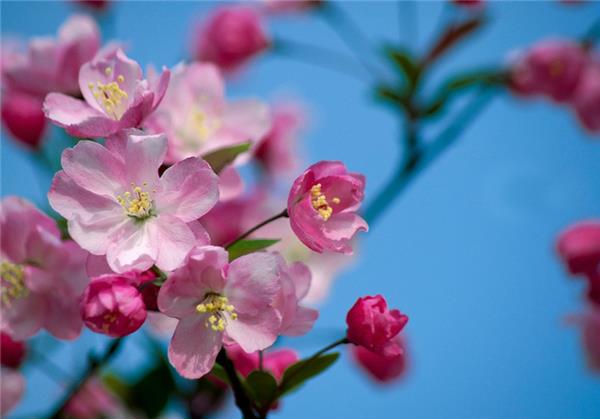
The meaning of the crabapple flower: gentle, beautiful, happy; it symbolizes a wanderer's longing for home and expresses the sorrow of parting; some also say it means following the guidance of others. Crabapple is divided into many types, including Malus micromalus, Chaenomeles speciosa, Malus halliana, and Chaenomeles sinensis.
Legend has it that long ago, a father and daughter lived in the deep forests of Wangjing Tuo. The father was named Ma Sanhe, and the daughter was named Haitang. The two relied on hunting for a living and depended on each other. One day, the young Haitang, just sixteen years old, followed her father hunting at Wangjing Tuo, where wild beasts were numerous. Suddenly, a fierce tiger with its bloody jaws wide open came pouncing toward Ma Sanhe with a whistling sound of wind. To save her father, Haitang stepped forward and fought the tiger, but being frail and alone, she fell beneath its savage claws. The villagers on the mountain, who were cutting wood, herding sheep, and gathering herbs, came as soon as they heard the news, drove off the vicious tiger, and rescued her from Wangjing Tuo. Along the more than 30 li long valley back to the village, blood dripped all the way, drop by drop. Later, fiery red mountain flowers bloomed wherever the blood had spilled. In memory of Haitang, who sacrificed herself to save her father, the villagers named this flower the crabapple flower.
II. The cultural background of the crabapple flower
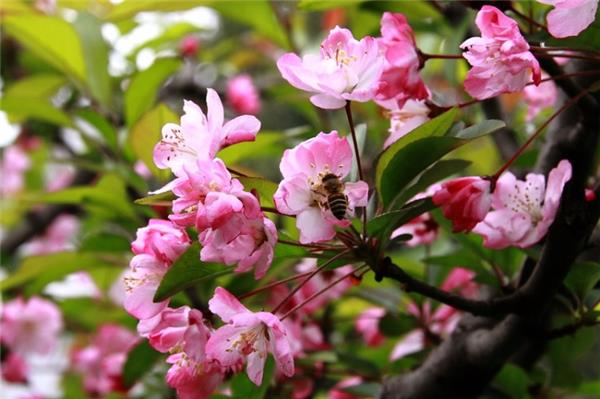
About 2,500 years ago, the "Book of Songs, Wei Feng, Mu Gua" recorded: "You throw me a mu tao, and I return it with a qiong yao. Not as repayment, but to be forever good friends." According to textual research, mu tao refers to Chaenomeles sinensis or Chaenomeles speciosa. This is the earliest written record about crabapple that can be found so far.
During the Zhenyuan era of Emperor Dezong of Tang, Jia Dan served as chancellor and wrote the "Hundred Flowers Manual," in which crabapple was praised as the "immortal among flowers." This book was one of the earlier works to use the term crabapple; before this, crabapple was mostly referred to generally as "nai."
In the Northern Song dynasty, Shen Li's "Record of Crabapple" states: "I once heard that Emperor Zhenzong personally composed Ten Miscellaneous Flowers of the Rear Garden, with crabapple as the first chapter, and bestowed it upon close ministers to match in verse. Thus one knows that crabapple is fully able to rival peony and stand alone in Xizhou."
During the Yuan, Ming, and Qing dynasties, crabapple became a commonly used image among literati, and many poems and lyrics praising crabapple have been passed down.
There were also many famous modern and contemporary figures who loved crabapple. Zhu Ziqing wrote in his prose essay "Watching Flowers": "I love the apricot with its many blossoms and old trunk, the little red peach swaying gracefully in the wind, and the redbud clinging to the trunk in clusters like beads; but what I love most is the Xifu crabapple." Another prose essay by Zhu Ziqing was even directly titled "The Moon Is Hazy, the Bird Is Hazy, the Curtain Rolls Up on the Red Crabapple."
III. The role of the crabapple flower in the home
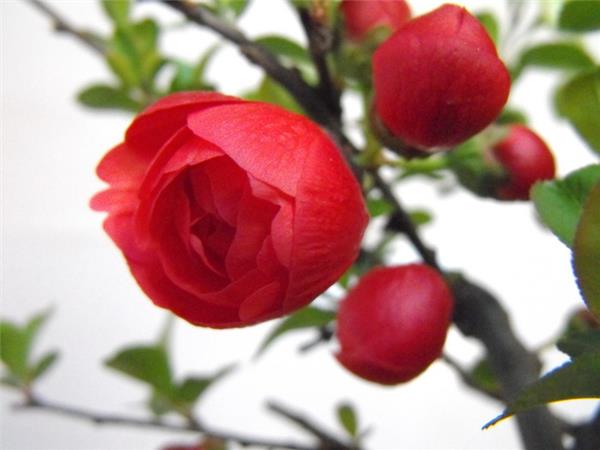
1. Resistance to sulfur dioxide. Crabapple is highly resistant to sulfur dioxide, hydrogen fluoride, nitric acid mist, and others, and among these, its ability to absorb sulfur dioxide is especially notable, so crabapple is often planted on city streets as green space. For newly renovated homes, purchasing one or several pots of crabapple has a very good function in removing harmful gases. Besides removing sulfur dioxide, it can also adsorb smoke and dust, remove dust from the air, keep the home environment clean, and help maintain good health.
2. Absorbing radiation. In addition to absorbing dust, crabapple can also absorb radiation, so it can be placed beside a computer and is good for the eyes.
3. People love crabapple mostly for its ornamental value, achieving a manifestation of taste and appreciation value. This also earned it the title "flower imperial concubine," with great symbolic significance. To a large extent, placing crabapple at home can highlight one's taste.
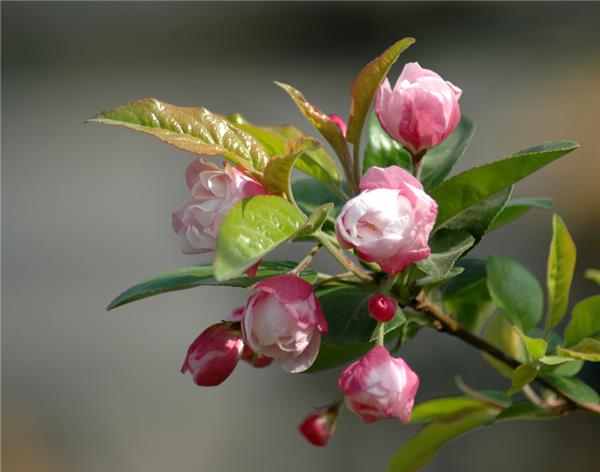
The crabapple flower has a beautiful and distinctive flower shape, brilliant and colorful blooms, and a romantic and touching flower language. It is very suitable for home cultivation, and interested friends can all try growing a pot of crabapple.