When Do Pomegranate Flowers Bloom? A Detailed Guide to the Blooming Period
The pomegranate is a plant with simple leaves that are either opposite or clustered. Its young leaves are tender green or bronze in color, and its flowers usually grow in clusters of several at the tips of branches or along the leaf veins. Because pomegranate flowers are bisexual, the degree of development of their pistils varies, so we generally divide them into complete flowers and incomplete flowers.
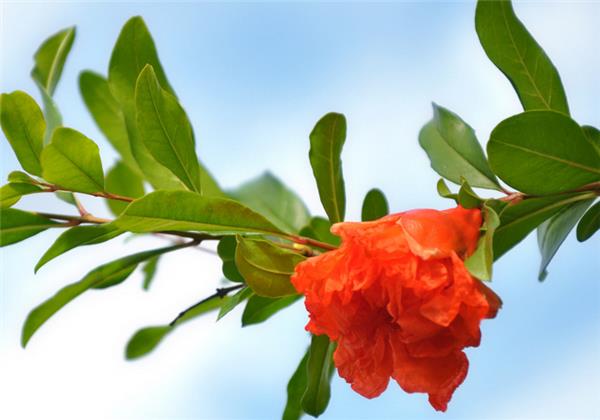
I. Pomegranate Flowers in Bloom
The blooming period of pomegranate flowers is generally between June and August, and it lasts for about two weeks.
Girdling during the blooming period: We can generally perform girdling on the plant in early May. This temporarily blocks the downward transport of organic nutrients produced by photosynthesis and can also increase the fruit-setting rate.
Hand pollination: Pollen from the same pomegranate flower can pollinate the pistil of the same flower, but this generally does not set fruit. However, when pollen is transferred between different flowers and different plants for pollination, the fruit-setting rate becomes relatively higher, and pollination between varieties yields an even higher fruit-setting rate. During the blooming period, hand pollination can increase the fruit-setting rate. The simplest method is to use a brush to pick up pollen from a flower that has just opened and shed pollen not long ago, then apply it to other different potted flowers or to tubular flowers that have just opened not long ago for hand pollination. Remember, when pollinating, place the pollen in a small bottle, then dip the tip of the brush into the pollen and gently dab it onto the stigma of a just-opened tubular flower.
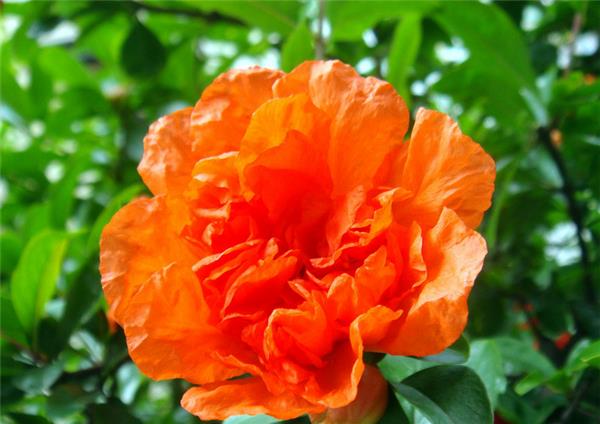
II. Care and Management of Pomegranate Flowers in Bloom
1. Plenty of sunlight: The pomegranate is a sun-loving plant that prefers sunlight and fears shade and dampness. Potted pomegranates should be placed in a sunny spot, and throughout the entire growing season they require ample light. As long as water is not lacking, the pomegranate is not afraid of strong light. Insufficient light will inevitably affect plant growth, which in turn affects flower bud formation and blooming and fruiting.
2. Control flowering to promote growth: Sometimes newly propagated cuttings can bloom and bear fruit in the same year. For young plants, the first priority is to promote growth and form a sturdy trunk so that they can bear the burden of fruit later. Blooming and fruiting too early is detrimental to the growth of the plant, so in the first few years the flower buds should be removed to make the tree grow stronger. After it has grown into a sturdy tree form, then appropriately leave a few flowers and fruits. After that, do not leave too many fruits either; too many will disperse the nutrients and make it hard for them to grow large, and in severe cases will affect the following year's growth.
3. Do not prune too early: In the first few years, only rough pruning should be done to maintain the tree shape. After 3 to 4 years, do a rough pruning before dormancy in late autumn, and then do a shaping pruning before sprouting the following spring. Fruit-bearing branches that affect the tree shape can also be pruned off. After blooming and fruit setting, some newly grown thin and weak branches and inward-growing branches should also be pruned off in time.
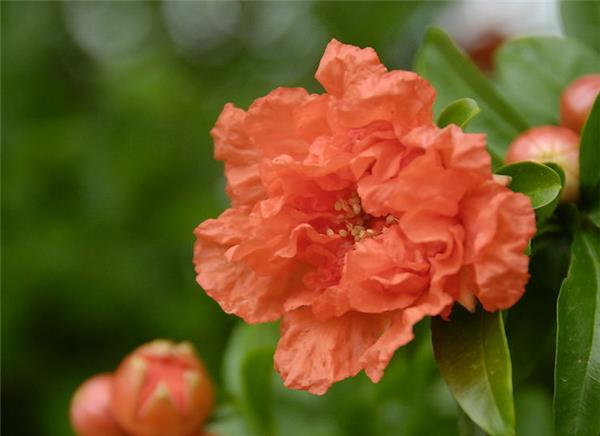
III. What Color Are Pomegranate Flowers
Because of hybridization, many variant varieties of pomegranate flowers have appeared. Generally, the flower color is red with yellow stamens, which is the most common. Another common color is white, though this white carries a small amount of pale yellow, making it quite attractive. Red flowers produce red pomegranates, while white flowers produce white pomegranates.
With the advancement of cultivation techniques, many other pomegranate varieties have also appeared, such as the yellow-flowered pomegranate, whose flowers are yellow and quite vivid. Some grown in greenhouses also have orange flowers, with the flowers appearing orange-red. Varieties include the double-petaled pomegranate and the black pomegranate, among others. There is also a pomegranate called the agate pomegranate, named because its flowers are generally red but inlaid with yellow-white stripes; it is a variant variety.
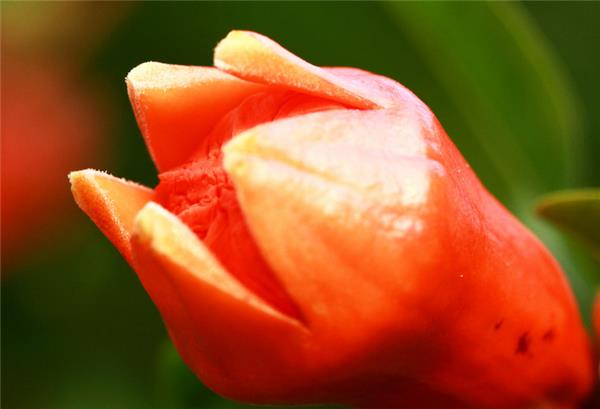
Because the pomegranate can adapt to many growing environments and appears rather ordinary, yet can produce beautiful and vivid flowers. Only when it matures does it instantly become incomparably gorgeous, so the flower language of the pomegranate flower is "mature beauty." Through the above introduction, we have clarified some knowledge about pomegranate flowers in bloom.