How to make and care for a Caragana bonsai? A detailed guide to the methods
Caragana, also known as yellow sparrow flower, earth soybean, sticky socks, sauce petal, sun sparrow flower, and yellow thorn, is a deciduous shrub of the genus Caragana in the Fabaceae family. Its plant grows several chi tall and is clump-forming. Because its flowers are golden yellow, grow in the leaf axils, and bloom in April to May each year, many people now prefer to make Caragana into bonsai for growing. Below, let us look at what the knowledge on Caragana bonsai care and making is like.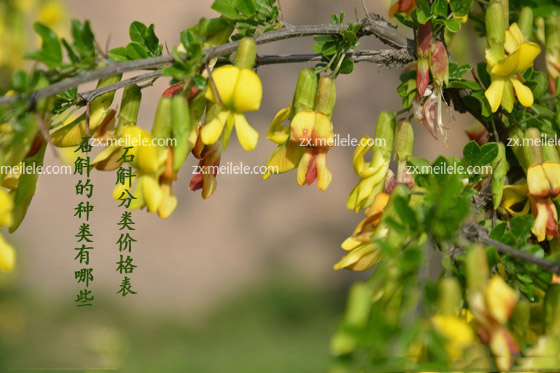
Material selection for making Caragana bonsai
When making a Caragana bonsai, in addition to choosing old stumps to cultivate small seedlings, we can also dig up old stumps from the wild that have grown for many years to make it. When digging wild old stumps, choose ones with an aged appearance and excellent posture, which can achieve the effect of rapid shaping. Generally, digging should be done during its dormant period and the rainy season. For collected material, first cut off most of its aboveground stems, then scrape away the surface soil, clarify the growth direction of the main root, and dig patiently and carefully along the course of the main root from far to near. This helps protect the root system and reduces damage. Because the dug-out Caragana roots are very long, they do not need to be cut short when potting.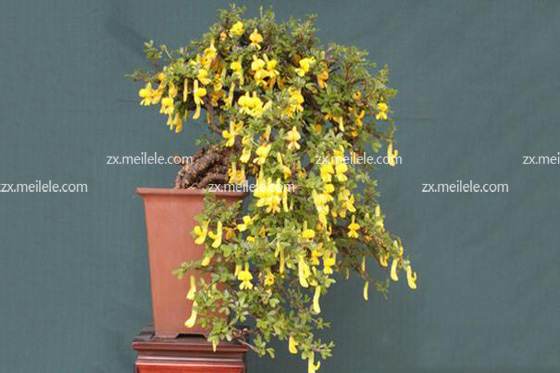
Potting a Caragana bonsai
The flower pot used for making a Caragana bonsai can be a round or square purple clay ceramic pot; if it is a cascade-style bonsai, a tall cylindrical pot can be chosen. To let the roots of Caragana show, some shallower pots can be chosen. For the soil used to make a Caragana bonsai, neutral or slightly acidic loam or light clay can be used; alkaline soil must not be used. Ordinary potting soil or garden soil can also be used. Potting should be done in early spring.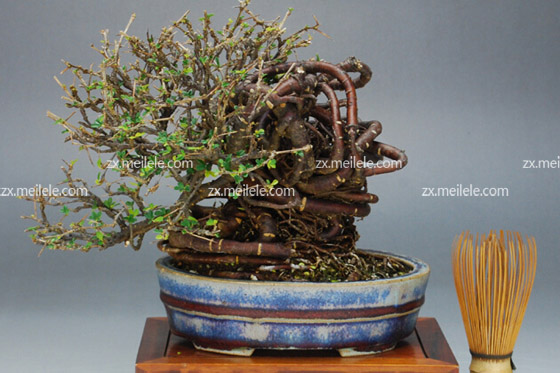
Styling a Caragana bonsai
When making a Caragana bonsai, its styling is very important. Its main branches and trunk can be given appropriate bending shaping, but attention should also be paid to the visual effect from all sides. Do not have bending only on the same plane. For some small branches, pruning should be the main method; do not cut these branches to the same length, so as to appear varied and well-arranged. When changing soil or repotting, be sure to make use of Caragana's twisted and changeable root system, arranging and laying out its roots so they intertwine with one another, or appropriately bind them with palm fiber, so as to bring out the beauty of its gnarled and tangled roots.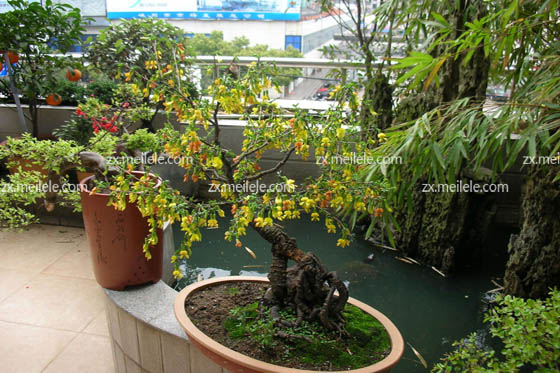
Introduction to Caragana bonsai care
1. Because Caragana likes light and is drought-tolerant, it is suitable to place it in a sunny, well-ventilated place for growing. In winter it is relatively cold-tolerant, and it is best to bury it together with the pot in soil. When watering Caragana, be sure to follow the principle of not watering until dry, and watering thoroughly when you do. Especially during its flowering period, be sure to keep the potting soil moist, as this can extend the flowering period. When Caragana enters dormancy in winter, apply liquid fertilizer once, and water with liquid fertilizer once before flowering in spring. After flowering, apply topdressing once more to promote the growth of its branches and leaves.
2. After leaf fall in winter, all kinds of branches in the Caragana bonsai that affect the tree shape can be cut off. After flowering in spring, the branches that have already bloomed can be shortened, which can promote new flowering branches. During the vigorous growth period, excessively long branches can be pruned at any time, and pinching back can be done appropriately.
3. A Caragana bonsai should be repotted once every 2-3 years, preferably in early spring. When repotting, about half of the old soil can be removed, new potting soil added, the root system trimmed, and the plant replanted. Place it in a place with diffused light and water it thoroughly.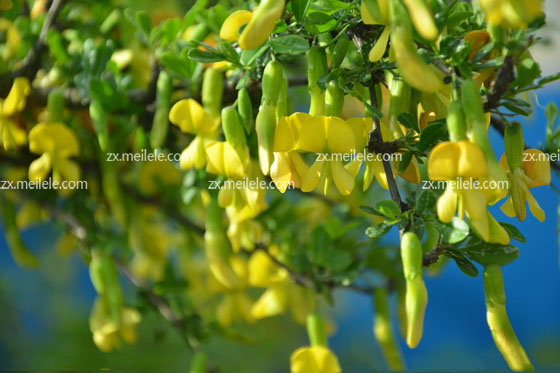
Summary: The above is the end of the editor's introduction. After reading the knowledge on Caragana bonsai care and making introduced by the editor, I believe everyone has a fairly good understanding. In fact, Caragana bonsai has very high ornamental value. Its shape is unique with gnarled branches, its posture is antique and elegant, and its branches and leaves spread and droop, which is very beautiful. I believe everyone has a fairly good understanding. In fact, Caragana bonsai has very high ornamental value. Its shape is unique with gnarled branches, its posture is antique and elegant, and its branches and leaves spread and droop, which is very beautiful.