How to Grow Phalaenopsis Orchids? A Detailed Guide to Care Methods
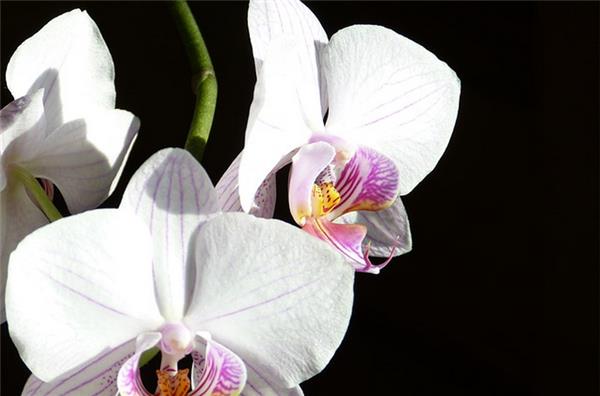
The genus Phalaenopsis is a famous group of cut flowers, with more than 50 species in the entire genus. It is a monopodial epiphytic orchid with a short stem, large leaves, and one to several arched flower spikes. The flowers are large and named for their butterfly-like shape. Its flower posture is elegant and its colors are gorgeous, making it a treasure among tropical orchids, and it has the reputation of being the "queen of orchids."
I. How to Grow Phalaenopsis Orchids
1. Growing location and temperature
For growing Phalaenopsis at home, the key point is to ensure the temperature stays above 15°C, and it is best to place it where 18°C can be maintained. The minimum temperature should not be lower than 7°C; below this temperature, the plant will wither. In heated rooms in winter, be careful not to place the flower on or too close to a radiator, and do not let warm air from an air conditioner blow directly on it. To allow the orchid plant to receive light, it is best to place it on an indoor windowsill and shade it with a window screen. After the weather turns warm, it can be moved outdoors, and attention should be paid to ventilation and shading, avoiding continuous high temperatures above 33°C. From autumn to spring, place it in sunlight filtered through glass; in summer, place it in a spot outdoors without direct sunlight (50%-60% shading is needed in summer).
2. Watering and humidity
If the growing medium remains wet for a long time, the roots of Phalaenopsis will rot, the leaves will turn yellow, and in severe cases the plant will die. The principle of watering when dry and letting it dry between waterings should be followed. If the sphagnum moss remains too wet for a long time after watering, the plant can be removed from the pot and exposed to the air, and after the plant dries slightly, it can be replanted in the pot. The water temperature is best kept close to room temperature. Using a humidifier to increase air humidity is best, and a sprayer can also be used to spray a fine mist on the leaves, but be careful not to spray the mist onto the flowers.
II. Precautions for Growing Phalaenopsis Orchids
1. Pay attention to choosing a suitable growing medium. Generally, aquatic plants, moss, and other seaweed-type media with high permeability and the ability to retain water and nutrients are chosen. If the growing time is too long (more than 2 years), the medium should be replaced in a timely manner, with the time chosen when new leaves emerge.
2. Pay attention to ensuring a suitable growing temperature. The growth is best at 18°C to 28°C; it should not be lower than 15°C, nor higher than 33°C. When watering, the water temperature should be close to room temperature. During flowering, the temperature can be appropriately lowered to extend the flowering period.
3. Pay attention to choosing a suitable light environment. A semi-shaded environment without direct light is best in summer, autumn, and spring, and in winter place it in a sunny spot facing south.
4. Pay attention to mastering reasonable fertilization principles. Fertilize less and use dilute fertilizer; normally apply a special orchid fertilizer to the roots about once a month. Before flowering, apply phosphorus fertilizer about once a week by spraying on the leaves; during the flowering period and when the temperature is relatively low, fertilizing is strictly prohibited; after flowering, promptly cut off the flower stems, strengthen fertilizer and water, and apply fertilizer to the roots about once every half month.
III. The Role of Phalaenopsis Orchids
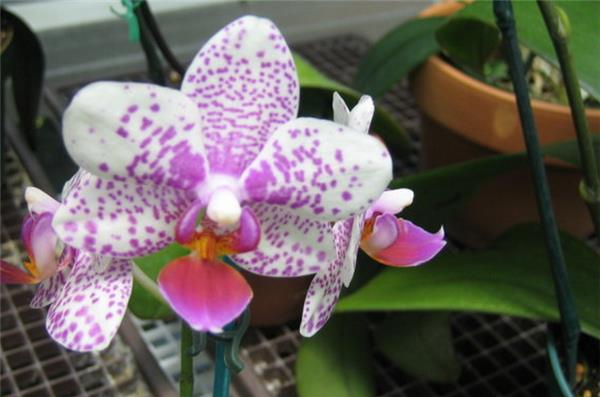
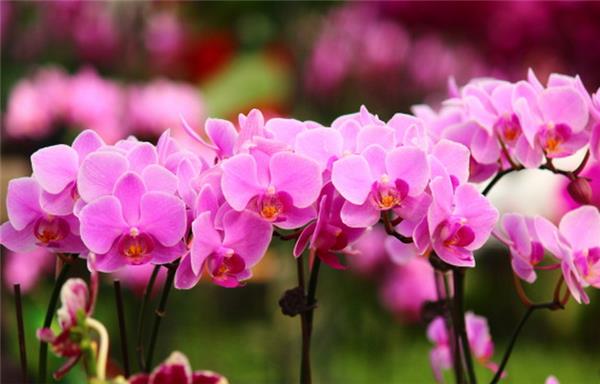
1. Phalaenopsis has a powerful effect in beautifying the home environment. Its plant is very unusual, having neither stolons nor pseudobulbs. Each plant grows only a few broad leaves as thick as spoons, alternately stacked above the base. Thick white aerial roots are exposed around the leaves, and some cling to the outer wall of the flowerpot, full of natural wild charm. When the New Spring season arrives, a flower stem up to a full chi long emerges from the leaf axil, and then opens one flower after another. Each flower has 5 petals, with the lip set in the middle. The flower colors are bright and dazzling, including pure white, goose yellow, and crimson, as well as light purple, orange-red, and azure blue. Many varieties have two or three colors at once; some look like embroidered patterned stripes, and some look as if evenly sprayed with colored dots. Each stem bears seven or eight flowers, and at most twelve or thirteen, and can be enjoyed continuously for sixty or seventy days. With such a beautiful appearance, could you still resist it?
2. Phalaenopsis can fill a home with vitality from the outside in. The name "butterfly flower" has a meaning many people do not know. The scientific name Phalaenopsis means, according to its Greek origin, "an orchid that looks like a butterfly." It can survive by absorbing nutrients from the air, which proves its dynamic role in the home, flying around in the air like a butterfly, and this is where vitality and liveliness are generated. As for its appearance, although it does not move, it is so beautiful and dazzling that it can add a lot of atmosphere to a home, like a festival, full of joy.
These are the growing methods and precautions for Phalaenopsis orchids. It can be seen that growing a pot of Phalaenopsis is not easy, so everyone must carefully care for their Phalaenopsis.