How to plant Chinese trumpet creeper? I'll teach you the correct planting method
The Chinese trumpet creeper's color is extremely vivid, making it a very eye-catching flower, and its myriad forms and graceful, slender appearance attract countless people to stop and admire it. This very common flower is also relatively easy to keep alive; it not only has ornamental value but also possesses other benefits. Do you know about the Chinese trumpet creeper? If not, please read the article below.
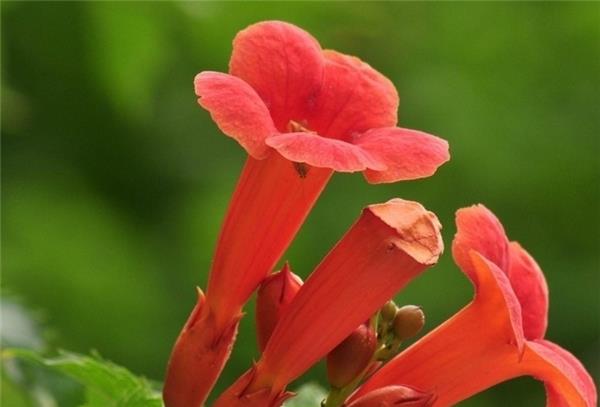
I. Planting Chinese trumpet creeper
1. Soil: The Chinese trumpet creeper has no strict requirements for soil; it can grow in both sandy loam and clay loam.
2. Watering: During the flowering period of the Chinese trumpet creeper, a certain humidity must be maintained; the potting soil should not be too dry, but it also must not be too wet.
3. Temperature: The Chinese trumpet creeper likes warmth and is not cold-tolerant; in winter it should be placed indoors in a frost-free place to overwinter.
4. Fertilizing: The Chinese trumpet creeper likes fertilizer and moisture; after sprouting in spring, water and fertilizer management should be strengthened. Generally, apply liquid fertilizer 1-2 times per month.
5. Pruning: If the Chinese trumpet creeper is to be planted with a trellis, in order to promote vigorous growth and abundant flowering, the weak, winter-killed and crowded branches can be cut off before sprouting in early spring, so as to improve ventilation and light penetration and favor growth and flowering.
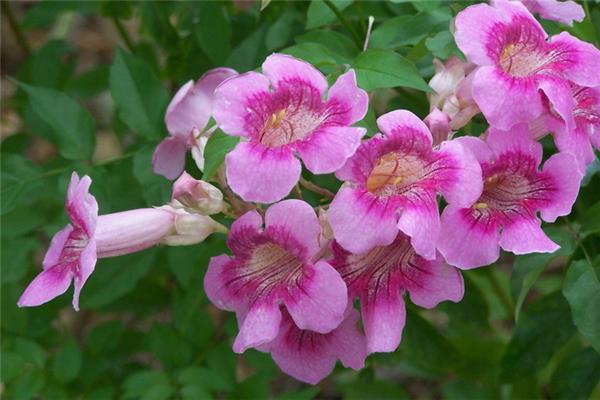
II. Growth habits of the Chinese trumpet creeper
A complete flower of the Chinese trumpet creeper is about 4-5 cm, mostly shrunken and curled, with an extremely vivid color, mostly yellow-brown to brown. The calyx is tubular-campanulate in form, with 5 lobes; the calyx teeth are pointed and have longitudinal ridges, about 2-2.5 cm long. The corolla also has 5 lobes, funnel-shaped in the lower part, with fine lines on the surface; the stamens are attached, the anthers are sagittate, and the style is flat.
The leaves of the Chinese trumpet creeper are opposite, with a pinnately compound leaf form; the petiole is 5-10 mm long, and there are pale yellow-brown tufts of hair where the petiolules are attached.
The seeds of the Chinese trumpet creeper are flat. Those of the American trumpet creeper (Campsis radicans) are similar, ovate-oblong or elliptical.
The Chinese trumpet creeper likes places with abundant sunlight, but can also grow in shaded environments. It likes a warm and humid climate and has low soil requirements; fertile, moist and well-drained soil is sufficient. The Chinese trumpet creeper is drought-tolerant and waterlogging-tolerant, and can also tolerate saline-alkaline soil; its sprouting and reproductive capacity is relatively strong.
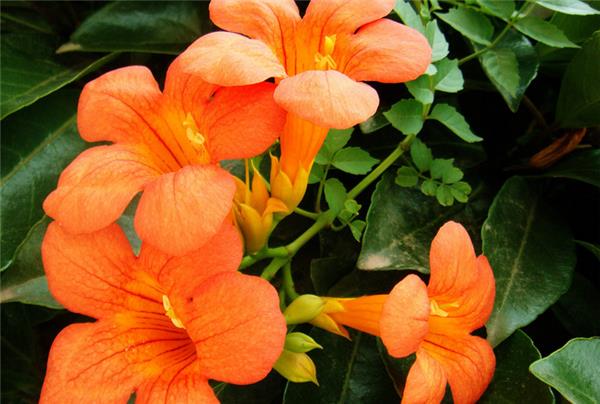
III. Benefits of the Chinese trumpet creeper
1. The Chinese trumpet creeper is also called zibei, jihua, and has more than ten other aliases. Besides being usable as a garden plant, the Chinese trumpet creeper also has good medicinal benefits; it can be used as a Chinese herbal medicine. The Chinese trumpet creeper also has an alias called abortion flower, so the Chinese trumpet creeper has an abortifacient effect; therefore pregnant women must not take it, and people with too weak qi and blood are also not suited to using the Chinese trumpet creeper.
2. The Chinese trumpet creeper can clear heat and cool blood and has a certain anti-itching effect; it can also dissolve blood stasis and disperse nodules and dispel wind. In clinical traditional Chinese medicine, the Chinese trumpet creeper can be used to treat amenorrhea and dysmenorrhea due to blood stasis, as well as some cases of metrorrhagia and metrostaxis, or wind-itch of the blood-heat type. The Chinese trumpet creeper is a very good blood-cooling medicine.
3. In traditional Chinese medicine, the Chinese trumpet creeper is considered a Chinese herbal medicine that is sour in taste and slightly cold in nature; it can be used to treat dysmenorrhea; metrorrhagia and metrostaxis; scabies and hidden rashes; or acne rosacea, so the Chinese trumpet creeper has a certain beauty effect. It can be taken internally or used externally; take 3-6 g and decoct it in water to drink, or decoct it in water for washing. It can also be made into some powder preparations. Some people have breast swelling after childbirth, which can also be treated with the Chinese trumpet creeper; the Chinese trumpet creeper can be used to treat some skin itching and acne. The Chinese trumpet creeper is a very good medicinal treatment for women's diseases.
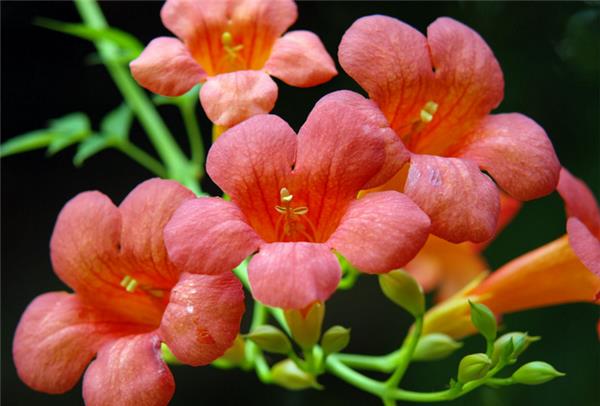
The Chinese trumpet creeper is also quite suitable for potted planting to beautify the home environment, but care should be taken to set up a frame for it to climb. That is all for the cultivation methods of the Chinese trumpet creeper; I hope it is helpful to everyone.