How to grow Haworthia fasciata? Master the care methods and precautions
Haworthia fasciata is a small succulent plant native to the tropical arid regions of southern Africa. Its leaves grow in a tight rosette on the stem axis, arranged in a lotus-like form, and the leaves are studded with white star-like dots, giving them great ornamental value. For plant lovers who enjoy succulents, Haworthia fasciata is very popular. Today, let's take a look at what Haworthia fasciata is like, and what its care methods and precautions are.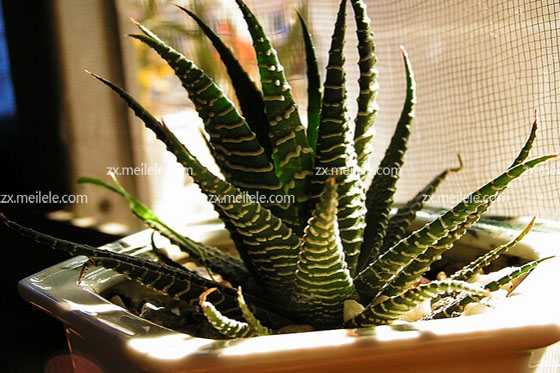
Introduction to Haworthia fasciata
Haworthia fasciata is a perennial succulent herbaceous plant of the genus Haworthia in the Liliaceae family. Its leaves grow in a tight rosette on the stem axis, forming a lotus-like shape. The leaves are triangular-lanceolate with sharp tips, smooth on the surface and dark green, while the underside of the leaves is green with fairly large white tubercle-like protrusions. These protrusions are arranged in horizontal stripes, forming a striking contrast with the dark green upper surface of the leaves. It has great ornamental value.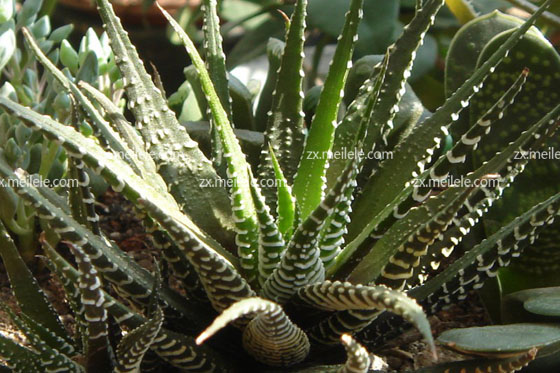
How to grow Haworthia fasciata
Haworthia fasciata likes a warm, dry growing environment with plenty of sunlight. It is native to the tropical arid regions of southern Africa, so it is fairly drought-tolerant. It fears low temperatures and humidity. Its ideal growing temperature is 16-20°C. From March to September each year, the temperature should be 16-18°C, and from September to March of the following year, the temperature should ideally be 10-13°C. In winter, the temperature must not be lower than 5°C. It is not demanding about soil and grows well in fertile, loose, sandy soil.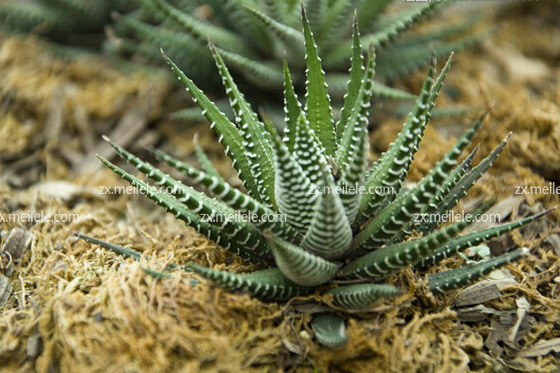
Care methods for Haworthia fasciata
Propagation methods: Haworthia fasciata is generally propagated by division and cuttings. Division can be done together with repotting. When repotting in April-May each year, the young plants around the mother plant can be peeled off and potted directly. Cuttings are taken in May-June each year by gently cutting off the fleshy leaves with a semi-lignified portion at the base and inserting them into a sand bed.
Humidity: Haworthia fasciata likes a dry air environment. During long periods of rainy weather, it is susceptible to damage from pathogens. The optimal relative air humidity is 40-60%.
Temperature: Its growing temperature is 15-32°C. It fears high temperatures and stuffiness. If the temperature is above 33°C, Haworthia fasciata will enter a dormant period. It will also enter dormancy when the temperature is below 5°C. Therefore, when growing it in summer, be sure to strengthen air circulation so that heat can dissipate, and place it in a bright spot for growing.
Light: When growing Haworthia fasciata in summer, give it 50% shade, and the leaf color will become more beautiful. In spring and autumn, because the temperature is not high, give it direct sunlight to help Haworthia fasciata carry out photosynthesis. In winter, place it in a bright spot for growing.
Fertilizer and water management: Haworthia fasciata has fairly strong drought tolerance and can grow well even under dry conditions. Therefore, when watering it, be sure to follow the principle of "alternate dry and wet, dry means thoroughly dry, do not water if not dry, and water thoroughly when watering." When applying fertilizer, avoid getting the plant wet.
Pest and disease control: Under poor air circulation, Haworthia fasciata is prone to root rot and brown spot disease. In this case, spray with a 1500-fold dilution of 65% zineb wettable powder.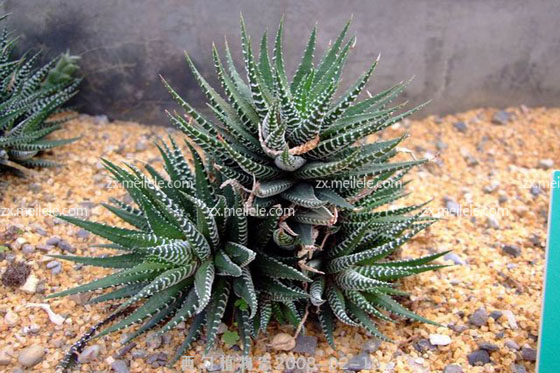
Precautions for growing Haworthia fasciata
1. If Haworthia fasciata is grown indoors, place it near doors and windows facing southeast so it can receive light, and every one month or one and a half months, move it outdoors for two months. Otherwise, its leaves will grow thin and yellow, and new branches or petioles will become slender with elongated internodes, resulting in leggy growth.
2. The root system of Haworthia fasciata fears waterlogging. If water accumulates in the flower pot, or if it is watered and fertilized too frequently, root rot is likely to occur. Therefore, watering and fertilizing must be properly controlled.
3. When Haworthia fasciata enters its dormant period, do a good job of controlling fertilizer and water. When watering it, do so at noon on a sunny day when the temperature is relatively high.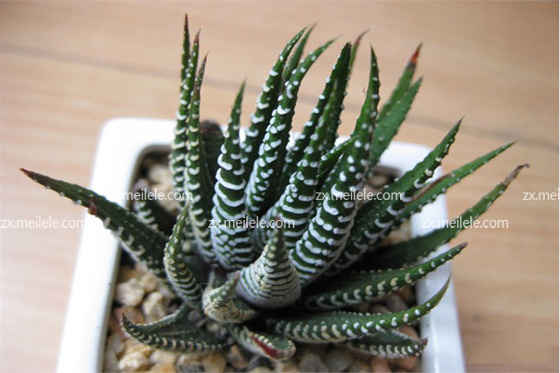
Summary: The above is the introduction brought to you by the editor on how to grow Haworthia fasciata, its care methods and precautions. After reading the editor's introduction, I believe everyone has a good understanding of it. Haworthia fasciata is a common succulent plant. Its thick leaves are studded with band-like white star dots. According to the size and arrangement of the star dots, varieties such as Haworthia attenuata, Haworthia fasciata var. caespitosa, and Haworthia fasciata 'Zebra' can also be found.
Summary: The above is the introduction brought to you by the editor on how to grow Haworthia fasciata, its care methods and precautions. After reading the editor's introduction, I believe everyone has a good understanding of it. Haworthia fasciata is a common succulent plant. Its thick leaves are studded with band-like white star dots. According to the size and arrangement of the star dots, varieties such as Haworthia attenuata, Haworthia fasciata var. caespitosa, and Haworthia fasciata 'Zebra' can also be found.