Canna Lily Flower Meaning and Its Legendary Stories Explained
The canna lily's flower meaning is "a solid future," which shows that this is a beauty with a tough, resilient character. The canna lily originates from India and the tropical regions of South America and tropical Asia, and was bred by hybridizing plants of the same genus native to South America and the subtropics. It is valued for its large, brilliantly colored and richly varied flowers, its good plant form, and its ease of cultivation. And there are many legends about this beauty as well.
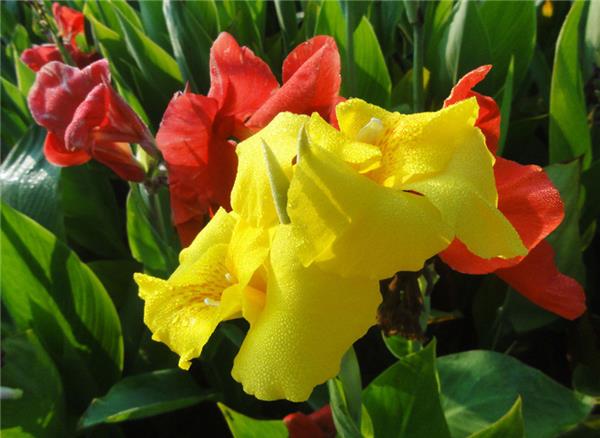
I. Legends of the Canna Lily's Flower Meaning
1. It is said that long ago, several fairy maidens in the heavenly court slipped out of the palace and descended to the mortal world. There they saw a waterfall plunging straight down, water clear as a mirror, a scene of breathtaking beauty, and unable to restrain themselves, they took off their outer garments and one by one jumped into the pool, chasing each other and playing in the water. As the mountain birds chirped and dawn broke, the fairy maidens realized they could no longer return to the heavenly court, so they transformed into slender, graceful canna lilies, as if forever smiling in welcome to visitors from all directions.
2. Legend says the demon Devadatta found out the itinerary of the Buddha's outing, lay in ambush on the hill the Buddha would pass, and hurled rolling boulders down to harm him. Yet man proposes and heaven disposes: before the boulder could roll down onto the Buddha, it shattered into thousands of small stone fragments, and one of those fragments injured the Buddha's toe. The blood that flowed out was absorbed by the earth, and from it grew a beautiful, vivid red canna lily, while at the same time the earth split open and swallowed up the despicable demon Devadatta.
3. Legend says that Xiang Yu drew his sword and cut his own throat by the Wu River; the golden whip he carried was thrust into the ground and grew into a highly vital green plant called bawangbian (the "overlord's whip"), just like the majesty and martial valor of the Hegemon-King of Chu. And Yu Ji, who had taken her own life for Xiang Yu earlier, could not let her fragrant soul disperse after death, and followed him to the banks of the Wu River. Seeing the bawangbian her husband had become, she immediately transformed into a canna lily to stay forever by the bawangbian's side, accompanying her deeply loved husband day and night.
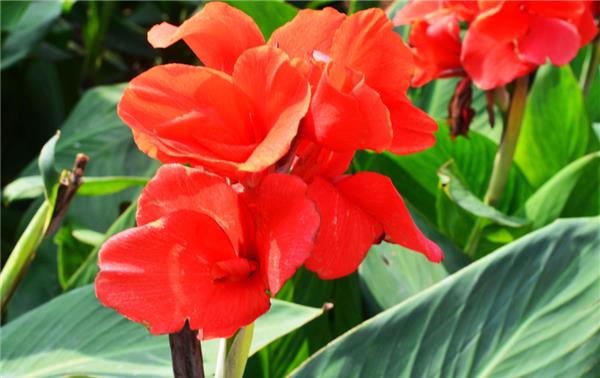
II. Common Varieties of Canna Lily
There are many varieties of canna lily; by the early 19th century there were already nearly a thousand varieties. The common ones are as follows:
Canna generalis: also called French canna, an improved variety of canna lily. The plant grows 1.5 m tall; both stems and leaves are covered with a white powdery bloom; the leaves are large, broadly elliptical, about 40 cm long and about 20 cm wide; the common peduncle is long; the florets are large and richly colored; the calyx and petals are covered with a white powdery bloom; the petaloid stamens are upright and do not curve.
Purple-leaved canna (Canna warscewiczii): the plant grows about 1 m tall; both stems and leaves are purplish brown; the involucre is brown; the calyx and petals are both purplish red; the petaloid stamens are deep purplish red; the labellum is bright red. The canna lily's fruit is a roughly spherical capsule with wart-like protrusions; the seeds are black and hard.
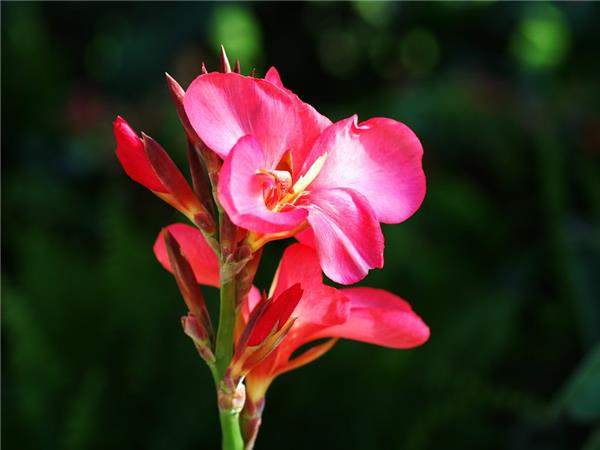
Bicolor mandarin duck canna: introduced from South America, it is currently a treasure among the Canna genus, named for producing two colors of flowers, bright red and five-star brilliant yellow, on the same flower stalk.
III. Notes on Growing Canna Lily
1. For potted canna lily, first choose a suitable variety; dwarf varieties are the most suitable for potting. Potted care should begin with selecting rhizomes, and you must pay attention to mastering the cultivation techniques for every growth stage. In spring, from March to April, dig up the rhizomes, trim away the rotted parts, and cut them into several pieces according to the size of the rhizomes and the number of stem buds. The cuts should be smooth; after cutting, coat them with plant ash or charcoal powder, then plant them separately. When planting separately, choose rhizome pieces with 2 to 3 stem buds, bury them in the pot, with the depth set so the tips of the buds are exposed above the potting soil.
2. Canna lily likes fertilizer and tolerates moisture. The potting soil should be mixed and blended from leaf mold, garden soil, peat soil, mountain soil and other soils rich in organic matter, and organic fertilizer such as bean cake and bone meal should be applied as a base fertilizer.
3. After separate planting, the first watering should be thorough, and afterward the potting soil should often be kept moist. When it has grown to 5 to 6 leaves, apply a liquid fertilizer once every 10 to 15 days. The liquid fertilizer can be fully decomposed dilute bean cake water with an appropriate amount of ferrous sulfate added, or a compound chemical fertilizer solution. The concentration should be on the weak side, generally around 0.3% is suitable, and fertilization should stop when it blooms.
4. During the flowering period, move the flower pot to a shady, cool place; this helps extend the flowering period.
5. After the flowers fade, promptly cut off the flower stems to encourage it to sprout new buds, grow flowering branches, and continue to bloom.
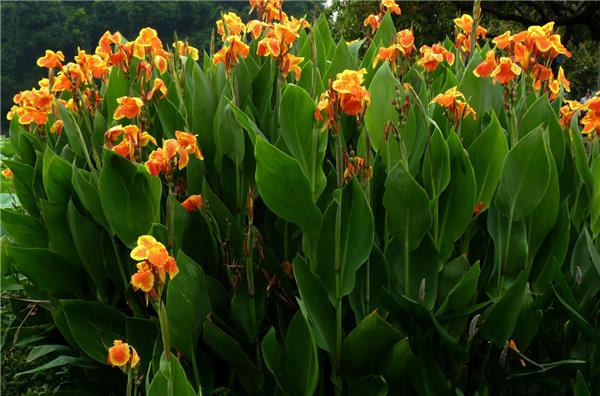
So, after reading these legends about the canna lily's flower meaning, do you all like this pitiable flower even more? Therefore, to keep this beauty radiant for a long time, you must take careful care of her when growing her at home.