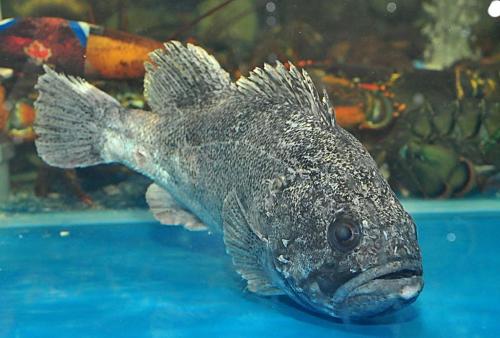
Why are Taiwan, China's live grouper exports being blocked? China suddenly increases testing for VER virus
The volume of live grouper exported from Taiwan, China to China has been declining year after year. According to Customs Administration statistics, from January to March 2018 it was about 3711 metric tons, while in the same period this year only 2478 metric tons were exported, with output value plunging by more than 430 million yuan. In early March, it was reported that a fish farm in Kaohsiung exporting live grouper to China was rejected after viral encephalopathy and retinopathy virus (VER) was detected at Xiamen Customs. China not only suspended that farm's qualification to export, but also raised the random testing rate for VER virus on live grouper imported from Taiwan, China to 30 percent. It is feared that live grouper export volumes in the second half of the year will be affected.
Gao Huanglin, deputy director of the Animal Quarantine Division of the Bureau of Animal and Plant Health Inspection and Quarantine, said that in the past mainland China only required annotations confirming compliance with health and safety conditions, and did not require quarantine certificates to state negative test results for specific viruses; since the incident in March, no document from Chinese authorities adding quarantine conditions has been received to date. At this stage, fishermen can only be encouraged to pay for testing themselves, to avoid being unable to enter at the port and being blacklisted.
Carrier status of VER virus in adult fish cannot be identified by appearance; the Bureau of Animal and Plant Health Inspection and Quarantine encourages operators to test on their own to avoid being blocked from exporting to China
Gao Huanglin explained that viral encephalopathy and retinopathy virus (VER) causes lesions in the brain and retina and other areas of grouper fry, but not every virus-carrying fish will develop the disease. The mortality rate is high at the larval stage, while the impact on adult fish is relatively small, so whether an adult fish is a carrier cannot be judged from its appearance or activity level.
Gao Huanglin further pointed out that for export quarantine, controls are generally carried out in line with the quarantine conditions issued by the importing country. "Since the importing country does not require it, the exporting country is under no obligation to test on its behalf." For example, for grouper fry exported to Vietnam, the importing country requires testing for viral encephalopathy and retinopathy virus (VER), so the Bureau of Animal and Plant Health Inspection and Quarantine tests each batch, and only releases them for export if the test result is negative. This sudden random testing for VER at the Chinese port is somewhat inconsistent with usual practice, "but it is also their right, and we can only respect it."
At this stage, because the port has raised the testing rate, the Bureau of Animal and Plant Health Inspection and Quarantine and the Fisheries Agency held a meeting and decided that the Fisheries Agency would compile a list of fish farms volunteering for testing, with operators paying for the tests themselves. Quarantine officers from the Bureau of Animal and Plant Health Inspection and Quarantine can be present to take samples and assist in sending them to the Animal Technology Institute for testing, with results available in about a week. "If it is negative, you can go with peace of mind, but if it is positive, you have to judge for yourself. Although the Bureau of Animal and Plant Health Inspection and Quarantine will not stop it, if it is then randomly tested at the port, the random testing rate may be raised afterward, affecting the entire industry," Gao Huanglin said.
In the past, VER was not tested for live adult grouper exports; Kaohsiung currently has no other cases
Lin Congjun, head of the Inspection Division of the Kaohsiung City Animal Protection Office, said that because VER has relatively little impact on adult fish, in the past live grouper export quarantine did not specifically test for this item. Industry operators in the city speculate that China's sudden tightening of port controls this time is a strategy to protect its domestic industry because domestic live grouper supply in China already exceeds demand. In early March, in response to this situation, the Kaohsiung City Animal Protection Office invited the Bureau of Animal and Plant Health Inspection and Quarantine and the Animal Technology Institute to the Yong'an District Fishermen's Association to conduct virus prevention and animal drug training sessions, and further contacted that fish pond to provide assistance; so far no news has been received of other operators being stopped at the port.