What are the precautions for growing lily of the valley? Keep these points in mind
The entire lily of the valley plant is very charming, because from the plant to the fruit, every part of lily of the valley can be described with the word "tiny," so it has a unique ornamental value and is very suitable for indoor growing.
I. Morphological characteristics of lily of the valley
Plant: Lily of the valley is a short perennial herb, about 20 cm tall, with a multi-branched, creeping, flat-growing rhizome underground.
Stem and leaves: In spring, 2 to 3 oval or narrowly oval leaves with arcuate veins grow from the terminal bud at the tip of the rhizome. The leaves are 13 to 15 cm long and 7 to 7.5 cm wide, with an acute tip and a slightly narrowed base. The base is wrapped by several sheath-like leaves. The narrowly oval or broadly lanceolate leaves with arcuate veins, 2 to 3 of them, are basal, with several sheath-like membranous scale leaves wrapping the base, and are glossy. The petiole is about 16 cm long, sheath-like and clasping each other, with several sheath-like membranous scales at the base.
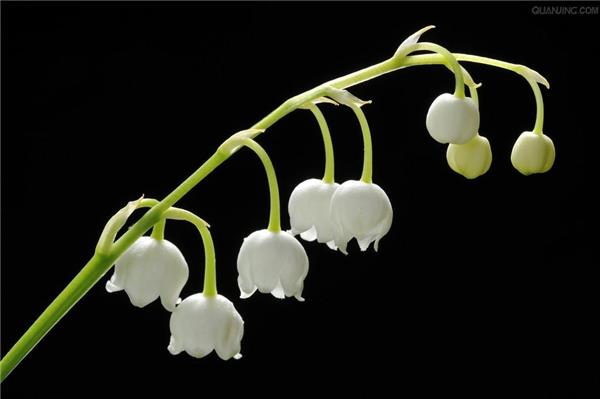
Flowers: The flowers are bell-shaped, nodding, in racemes, with 6 to 10 flowers per raceme, about 7 mm long and about 1 cm wide, milky white; the scape extends from the axil of the scales; the raceme is one-sided; the bracts are lanceolate and membranous; the perianth is 6-lobed at the tip, with ovate-triangular lobes; there are 6 stamens; the style is shorter than the perianth.
Fruit: In autumn it bears round, dark red berries, which are poisonous, containing 4 to 6 oval, flat seeds. It is an excellent potted ornamental plant, usually used in flower beds and for small cut flowers, and can also be used as a groundcover plant. Its leaves are often used as material for flower arrangements. The flowering period is generally in early summer from April to May, and the fruiting period is from June to July.
II. Precautions for growing lily of the valley
1. Propagation: Propagate by dividing the rhizome and the small bulbs at the end of the rhizome, that is, by division. It can be done in spring and autumn, with November being the best. There are young buds of various sizes on the rhizome. After the aboveground part withers in autumn, dig up the rhizome, cut off each terminal bud with a section of rhizome, and plant it to form a new plant. After division, the plump buds can bloom the following spring, while the small ones need to wait 1 year before blooming. In autumn, wash the seeds out of the ripe red berries and sow them directly in an open seedbed; they will germinate the following spring.
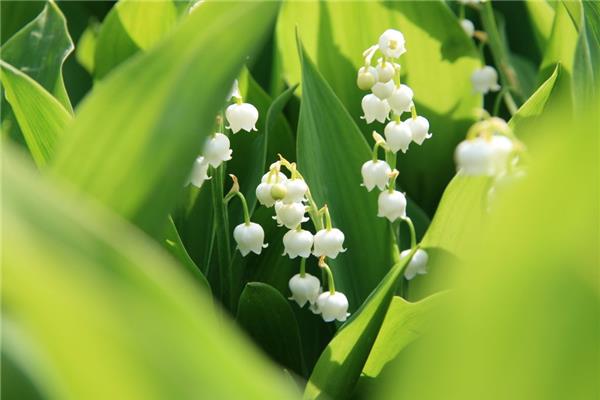
2. Growing conditions: Lily of the valley likes a semi-shaded, moist, cool environment, is cold-tolerant, and dislikes heat. As long as there is suitable cool, shaded conditions, it will rapidly spread by means of spreading rhizomes. Shade and moist, fertile soil are important conditions for successful planting. Humus-containing and sandy soil is ideal, as this kind of soil is both fertile and well-drained. In modern factory greenhouse commercial production, pollution-free cultivation is used to improve flower quality and yield. Avoid excessive single application of nitrogen fertilizer and use less ammonium nitrogen fertilizer; this is worth noting and emphasizing.

3. Fertilizer and water: Lily of the valley is robust by nature and easy to manage. When planting, cover with more than 5 cm of soil, and water thoroughly after planting. If, after sprouting in spring, decomposed cake fertilizer is applied once every 15 days, it will bloom profusely; pay attention to watering in dry weather. After the flower stems are produced, stop fertilizing; after the flowers fade, promptly cut off the pedicels, then apply fertilizer 1 to 2 more times to promote the rhizome to sprout new tillers. After the aboveground part withers in late autumn, cover with fallen leaves and cow manure to protect the rhizome and its dormant buds for overwintering in the open ground.
4. Temperature: For potted plants, the rhizomes with buds can be dug up in November and stored at 3°C to 5°C for 14 to 21 days, then taken out and planted in pots, but kept out of light, with the temperature maintained at 12 to 14°C. Only after the young buds emerge should they be exposed to light, and at this time the temperature should be controlled between 20 and 22°C. Then water and fertilize appropriately. If cultivated properly, they can bloom afterward. If low temperature and darkness are not given in advance, the leaves often grow unevenly and the flower stems fail to sprout.
5. Repotting: For ground planting, divide and replant once every 3 to 4 years. For potted plants, choose plump, large rhizome buds, plant 4 to 5 buds per pot, and repot once a year.
6. Pests and diseases: There is damage from brown spot disease; spray with 75% chlorothalonil wettable powder at 700 times dilution.
Compared with other plants, lily of the valley is not difficult to grow, because it can survive even under wild conditions, but to ensure its ornamental value, everyone still needs to care for it carefully.