How to Grow Oenothera speciosa? A Detailed Guide to Cultivation Methods
Oenothera speciosa - this name always gives people the feeling of "a beauty dancing gracefully in the bright moonlight," and it sounds very appealing. In fact, once Oenothera speciosa blooms, it truly has the elegance of a beauty under the moon, and it is relatively easy to grow, making it very suitable for home cultivation.
I. Main Values of Oenothera speciosa
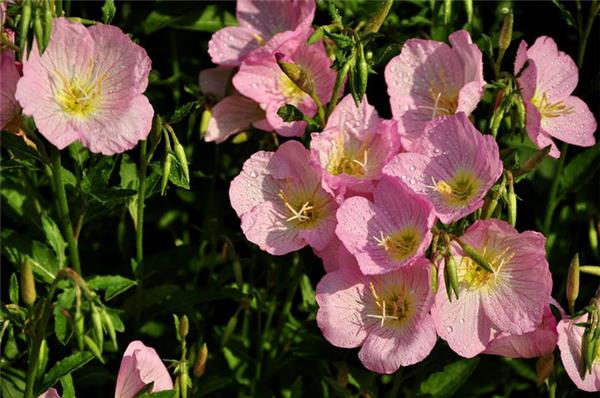
1. Ornamental value: It can be used for large-scale landscape arrangements and can also be cultivated as a flower bed plant. It can be sown and cultivated directly in the open ground, or used as a ground cover plant produced and sold by nursery units.
2. Medicinal value: Oenothera speciosa not only has beautiful flowers but also has high economic and medicinal value. Oenothera speciosa is native to the Americas. Hundreds of years ago, Native Americans had already discovered the medicinal value of evening primrose, soaking the whole evening primrose plant in warm water to make a paste-like poultice to treat bruises, and also applying it to the skin surface to treat external skin injuries and dermatitis. It was not until the 18th century that Oenothera speciosa seeds were carried to England as stowaways on cotton-carrying ships, and it was at this time that Europe began to fully develop the benefits of evening primrose. Many scientists and physicians devoted themselves to the study of evening primrose and used it for the treatment of multiple sclerosis, atopic dermatitis, and rheumatoid arthritis.
II. Morphological Characteristics of Oenothera speciosa
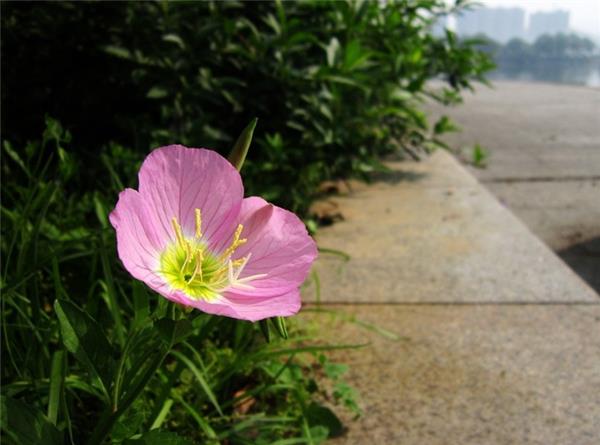
Root cylindrical, stem erect, rosette-shaped at the seedling stage, with red long hairs at the base, leaves alternate, lower stem leaves petiolate, upper leaves sessile; leaf blades oblong or lanceolate, margins with sparse fine serrations, both surfaces covered with white soft hairs. Flowers solitary in leaf axils at branch tips, arranged in loose spikes, calyx tube slender. Flowers white to pink, flower diameter reaching over 8 cm, blooming continuously from May to October. Height range: 50-80 cm. Oenothera speciosa is a low-growing ground cover plant, robust in growth, very drought-tolerant, and widely adaptable. Flowering period April-October, flowers bright pink, large flower diameter, abundant blooms. It can also be sown and transplanted in protected cultivation in winter. Flowers open each evening and wither by near noon the next day. Not cold-tolerant; in the Jiangnan region it can overwinter in the open ground in sheltered spots.
III. Growth Habits of Oenothera speciosa
Growth habits: Sun-loving, cold-tolerant, intolerant of waterlogging.
IV. Cultivation and Care of Oenothera speciosa
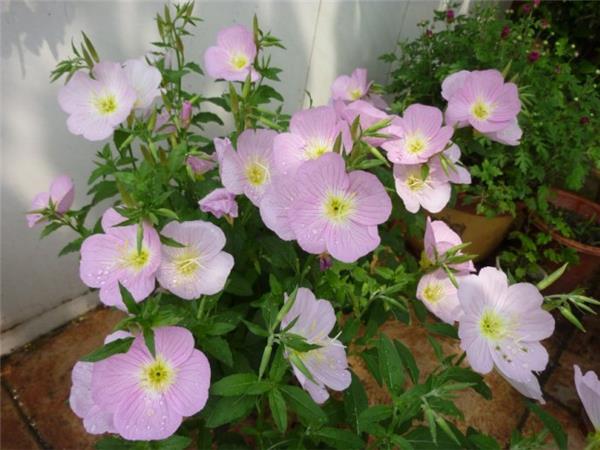
Planting: Taking growing conditions in North China as an example. In spring, deeply plow and level the green space, apply fertilizer rich in phosphorus and potassium, and plant at a spacing of 15 cm x 15 cm; once established, after 1 month, as new branches and leaves emerge, it will close canopy and begin blooming successively, reaching peak bloom in May-June; after flowering, prune promptly in July-August, leaving stubble about 10 cm, so that the rosette-shaped basal leaves can fully absorb nutrients, ushering in a second peak bloom, with flowers blooming continuously until November.
Water and fertilizer management: Oenothera speciosa is not demanding regarding water and fertilizer. Generally, sufficient organic fertilizer and humus are applied before planting, and no additional fertilizing is usually needed during the growing period. It is relatively sensitive to nitrogen fertilizer and prone to excessive vegetative growth; if water and fertilizer are too abundant or management is neglected for a long time, it is prone to excessive growth and lodging with reduced flower quantity; generally, applying liquid fertilizer once before peak bloom can enhance the flowering effect and promote full seeds.
Pest and disease control: Oenothera speciosa has very few pests and diseases. When planted too densely, it is susceptible to rot disease; the roots of affected plants gradually discolour and rot, with mycelium produced, leaves wilt and dry up, leading to death of the entire plant. Pay attention to reasonable planting density, prune promptly, remove overly dense plants, maintain ventilation and air permeability, and at the same time, irrigate with 1% lime water or 50% thiophanate-methyl 1500x solution, or irrigate with 75% chlorothalonil 1000x solution.
Pruning: Oenothera speciosa has strong regrowth ability. In order to create a good landscape effect and avoid the situation of overly dense plants and reduced flower quantity due to years of growth and neglected management, it generally needs to be replanted and renewed annually. However, by adopting the "one gap, two prunings" maintenance and management technique, it is not necessary to replant and renew annually to maintain a good landscape for many years. The main approach is in July-August after the second year's peak bloom, cutting back the aboveground part of Oenothera speciosa to about 10 cm, and evenly retaining 36 plants/sq m, thinning out other basal sprouts, ensuring good growing space for the plants; before winter, cut the aboveground messy parts again leaving 10 cm stubble; the newly sprouted red tender shoots still maintain a good winter landscape effect.
V. Price of Oenothera speciosa
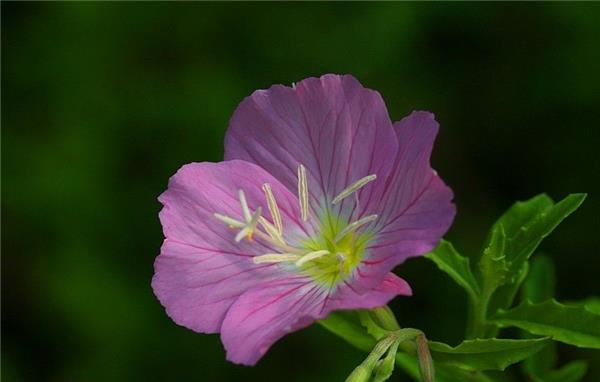
The market price of Oenothera speciosa is not expensive; generally, potted Oenothera speciosa costs only around ten to twenty yuan. Of course, if the flower colour is better, the form is beautiful, and the pruning is neat, the price of Oenothera speciosa will be a bit higher, but none are very expensive. Oenothera speciosa is generally grown from seed; because of its extremely strong growth ability and ease of survival, sowing is also a viable option.
That concludes the introduction to Oenothera speciosa. After learning about it, do you have a deeper understanding of Oenothera speciosa? It is important to note that Oenothera speciosa has a very strong reproductive capacity, so when pruning, you must "be ruthless" to let it produce large, beautiful flowers.