The Meaning of the Phalaenopsis Orchid's Flower Language and a Detailed Guide to Its Cultivation
The Phalaenopsis orchid not only has beautiful flowers, its flower language is also very beautiful, so growing a Phalaenopsis orchid at home can add a great deal of romantic and beautiful color to your home life.
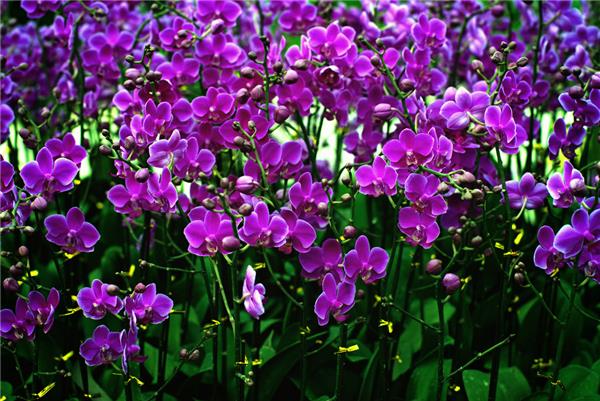
I. What Is the Flower Language of the Phalaenopsis Orchid
The flower language of the Phalaenopsis orchid is: I love you, happiness is flying to you!
Of course, Phalaenopsis orchids come in many flower colors, and the most eye-catching are the red Phalaenopsis, yellow Phalaenopsis and white Phalaenopsis, whose flower languages are also different.
The flower language of the white Phalaenopsis is pure love and precious friendship. When newly married, placing a white Phalaenopsis at home foretells a happy marriage; for those who live with friends, placing one at home foretells harmonious coexistence.
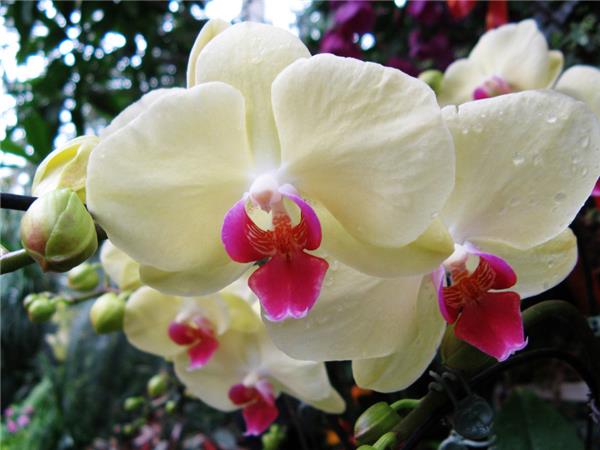
The flower language of the red-centered Phalaenopsis is good fortune and a lasting union.
The flower language of the red Phalaenopsis is a smooth career and perfect happiness, which is believed to be the wish of all young couples; planting a red Phalaenopsis can add a touch of color to marriage and career.
The flower language of the striped Phalaenopsis is that everything goes smoothly and all wishes come true. It can be said that the striped Phalaenopsis is suitable for every family and every age group.
The flower language of the yellow Phalaenopsis is a flourishing career and prosperous business. The yellow Phalaenopsis is especially suitable for businesspeople, as it can bring them good luck.
Also, the flower language of the mini Phalaenopsis is happy angel and in the prime of youth.
II. The Legend of the Phalaenopsis Orchid
Long, long ago, in a mountain of peerless beauty, there was a quiet and secluded valley, and in the empty valley lay a serene pool of clear water. One day, a lonely butterfly was drawn by the elegance of the great mountain and, without realizing it, came to this empty valley. It was at once enchanted by that peerless tenderness, that timeless charm, and that serene clear water together with the loneliness of a world apart! "I have finally found what my dreams rest upon," the butterfly said in its heart: "this place I have sought for a thousand years -- the empty valley."
So, on a night spangled with starlight, when a beautiful shooting star streaked across the sky, the butterfly made the one and only wish of its life: when the golden wind first rises and the white dew first falls, at the moment the butterfly turns to dust, it hoped that a thousand years of adoration could become seeds of life, scattered throughout the empty valley.
The shooting star traced a graceful arc and returned to the void. When the mountain flowers bloomed in profusion the next year, a valley of purple orchids really did sprout in the empty valley ---- the Phalaenopsis.
Just like the Lotus Royal Clan, the Crape Myrtle Imperial Clan and the Phoenix River Ancient Clan, the Phalaenopsis Clan is one of the oldest and most mysterious clans in this world, possessing peculiar powers.
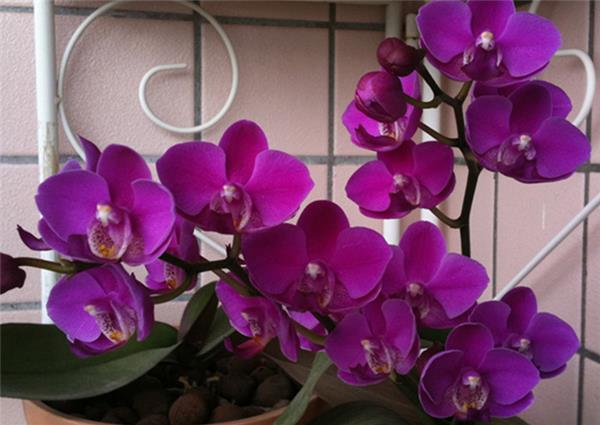
III. How to Grow the Phalaenopsis Orchid
1. Temperature control. The key to growing Phalaenopsis is to ensure the temperature stays above 15°C; it is best placed where 18°C can be maintained, and the lowest temperature must not fall below 7°C. In winter, place it in a heated room, but do not let the warm air from an air conditioner blow directly onto the plant. The pot is best placed on an indoor windowsill and shaded with a window screen. After the plant has bloomed in spring, only the lower 3~4 nodes of the flower stem need to be kept, and the rest should be cut off promptly to let it produce axillary buds.
2. Humidity control. The principle of watering when dry and letting it dry between waterings should be followed. Autumn weather is relatively dry, so spraying a fine mist on the leaves is even more helpful to the orchid plant. Winter is the growth period of the flower buds of Phalaenopsis, so the whole plant can be misted, preferably before noon, and the water temperature should ideally be close to room temperature.
3. Fertilizing. Fertilizers with comprehensive nutrients should be chosen, such as special orchid fertilizer, fish fertilizer, compound chemical fertilizer, etc. In spring, a 1000-fold liquid fertilizer is generally suitable, applied once every 7 days. In summer, apply a 1500~2000-fold liquid fertilizer once every 7 days, and in autumn continue applying the 1000-fold liquid fertilizer.
4. Pest and disease prevention. If the cultivation environment is well ventilated and the planting medium and air humidity are suitable, regularly spraying Bordeaux mixture, chlorothalonil and other such agents can prevent disease.
As long as the Phalaenopsis is grown well, it has very high ornamental value, because relatively speaking, the Phalaenopsis is a little more delicate than other plants and flowers, and the degree of difficulty in growing it is also a major basis for determining a flower's ornamental value.