How to Grow Caryopteris clandonensis 'Worcester Gold'? A Complete Guide to Cultivation Methods
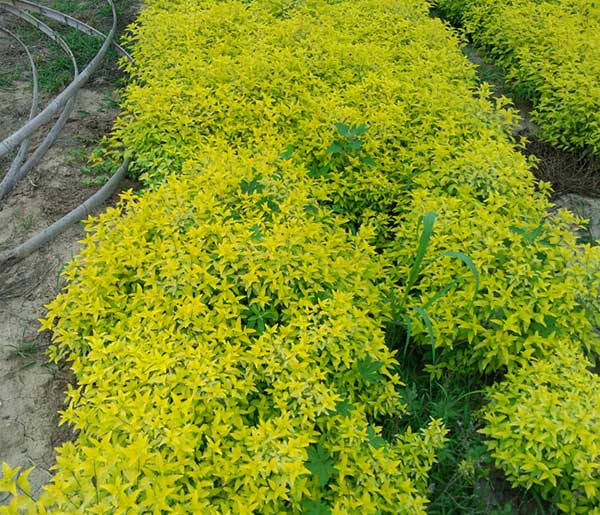
Caryopteris clandonensis 'Worcester Gold' is a rather remarkable plant, with particularly outstanding drought tolerance. The drier the weather and the more intense the sunlight, the more golden its leaves become, which is why this plant is so easy to grow.
I. Morphological Characteristics of Caryopteris clandonensis 'Worcester Gold'
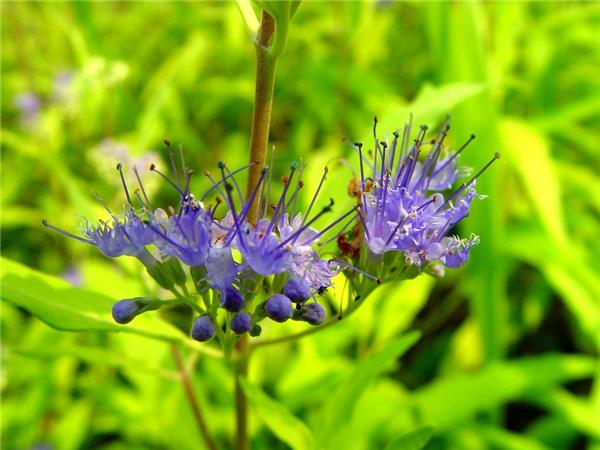
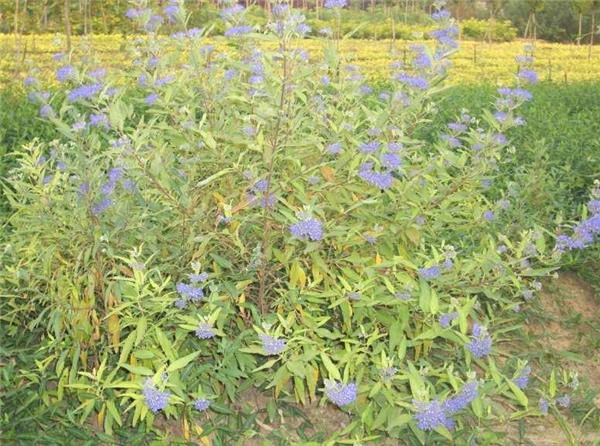
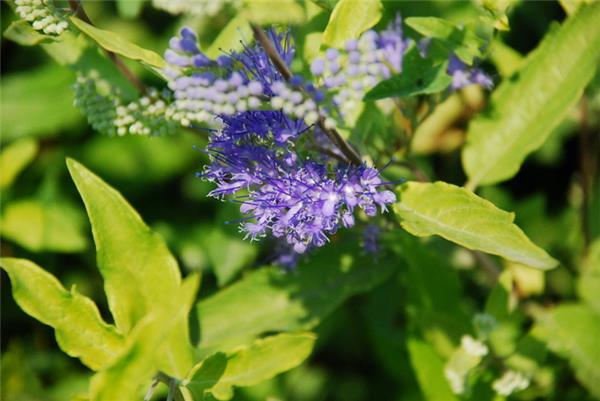
Caryopteris clandonensis 'Worcester Gold' is a clump-forming shrub, reaching 1.2 m in height with a crown width of 1.0 m. Its branches are cylindrical. The leaves are simple and opposite, wedge-shaped, about 3-6 cm long, glossy, light yellow, with pointed tips, bluntly rounded bases, and coarse teeth along the margins. The cymes are dense, and the corolla is blue-purple. The pedicels are distributed on the upper part of the branches, opening from bottom to top. The calyx is bell-shaped, two-lipped with 5 lobes, the lower lobe being larger and finely striped. There are 4 stamens. The corolla, stamens, and pistil are pale blue. The flowering period runs from July to September.
II. Ecological Habits of Caryopteris clandonensis 'Worcester Gold'
Caryopteris clandonensis 'Worcester Gold' prefers light but also tolerates partial shade. It is heat-tolerant and cold-tolerant, capable of safely overwintering outdoors in areas below -30°C. It has strong drought resistance. The drier the weather and the more intense the light, the more golden the leaves; under prolonged partial shade conditions, the leaves tend to show a golden color as well. Caryopteris clandonensis 'Worcester Gold' has low soil requirements. It grows well in sandy loam with organic matter content above 0.5%, as well as in loam and black soil. It grows normally at pH below 9. It also grows normally in soil with a total salt content of less than 0.24%. It is suited to medium-fertility, light, and well-drained soil. Caryopteris clandonensis 'Worcester Gold' should avoid waterlogging; if water frequently accumulates or soil moisture is excessive, the roots, root crown, and areas near the root crown are prone to rot, causing plant death.
III. Propagation Methods of Caryopteris clandonensis 'Worcester Gold'
Caryopteris clandonensis 'Worcester Gold' can be propagated by sowing and cuttings.
1. Seed propagation: Sowing is generally done in April-May, when the soil temperature reaches about 7-10°C. Before sowing, soak the seeds in 40°C warm water for 24 hours, then disinfect with 0.3% potassium permanganate solution for about 2 hours, rinse with clean water, remove and drain, mix with clean river sand equal to 2 times the seed volume, and stratify indoors. Keep humidity at about 60%. After 5-7°C, when about 1/3 of the seeds have split and shown white, they are ready to sow.
2. Cutting propagation: During the growing season, select semi-lignified branches of the current year that are free of pests and diseases as cuttings. When cutting the segments, generally leave 2-4 buds and 2-4 small leaves. If the leaves are too large, cut them in half to reduce transpiration. Make a flat cut at the upper end 0.5-1 cm above the top bud, and a slanted cut at the lower end 0.5-1 cm below a bud. The cutting time is from June to October, but June is best, as temperature and humidity are easy to control then. July-August is also possible, but temperature and humidity are harder to control, which can make management difficult.
IV. Daily Care of Caryopteris clandonensis 'Worcester Gold'
Water: Caryopteris clandonensis 'Worcester Gold' is drought-tolerant and dislikes wet conditions. Each year in early spring and late autumn, water thoroughly for the green-up watering and the freeze-up watering. At other times, if there is no particularly severe drought, it can basically grow on natural rainfall. If water frequently accumulates or soil moisture is excessive, the cortex of the roots, root crown, and basal branches is prone to rot and turn brown, causing plant death. Therefore, when planting in rainy summer regions, attention should also be paid to draining accumulated water to prevent root rot. This makes Caryopteris clandonensis 'Worcester Gold' all the more economical and practical in arid regions with little rain, drought, and water shortage, and sandy soil. Water less during the rainy season to prevent flooding.
Fertilizing: Apply decomposed base fertilizer before planting. From May to July, apply a topdressing once a month combined with irrigation, applying 75 kg of urea per hectare each time.
Pruning: Caryopteris clandonensis 'Worcester Gold' should be pruned appropriately in early spring or during the growing season, only 2 to 3 times a year, to stimulate new branches and leaves. The more it is pruned during the growing season, the more vivid the yellow of the leaves, and the more bright yellow and attractive the new leaves. For mature plants, cut back hard in early spring leaving 10-15 cm above ground; by autumn they can grow into robust plants 50-60 cm tall with a crown diameter of 40-50 cm, and can bloom profusely. In landscaping, it can be used for large-area color blocks and foundation planting. It can be planted at lawn edges, beside rockeries, by water, and along roadsides. It can also be used for color bands, color hedges, and ground cover. Mass planting gives an excellent effect: a sea of gold in spring, summer, and autumn, and a sea of blue at peak bloom.
Pests and diseases: For insect pests, mainly prevent scale insects, which cause leaf distortion. Attention should be paid to their control. Spray with Jieba, Jiean, or Jietuo at 2000 times dilution for prevention. For disease control, use 50% zineb wettable powder at 500 times dilution or 50% carbendazim wettable powder at 1000 times dilution combined with foliar fertilizer for spraying, which gives good results. Only 1 to 2 times a year is needed, and the maintenance cost is low.
V. Notes on Growing Caryopteris clandonensis 'Worcester Gold'
1. Pay attention to drainage; never allow water to accumulate.
2. Because Caryopteris clandonensis 'Worcester Gold' has strong suckering ability and few weeds grow, it is easy to manage. When planting, the planting density can be adjusted appropriately to enhance internal ventilation and light penetration and reduce humidity.
So, after reading this introduction, do you now recognize this relatively uncommon plant? Does its golden expanse look somewhat similar to rapeseed flowers, both being very bright and eye-catching? If you are interested in it, hurry and try growing some yourself.