How to Plant Daylilies? A Detailed Guide to Growing Methods
The price of 'Golden Doll' daylily is not expensive; generally it is 0.15 yuan per plant, though some are a little over 0.2 yuan each. The growing techniques for 'Golden Doll' daylily start with planting, fertilizer and water, removal of dead leaves, and propagation methods. So what are the growing methods for daylilies?
Cultivation Techniques for Daylily
Cultivation and management are simple and extensive; the spacing between plants and rows is about 0.5 x 1 m, with 3 to 5 plants per hole. Apply sufficient base fertilizer before planting. Because daylily is highly adaptable and can be grown almost anywhere, left to grow on its own, the clumps can expand year after year. However, when planting in garden combinations, they should be matched according to plant height and flower color to improve the ornamental effect.
Key Points of Cultivation
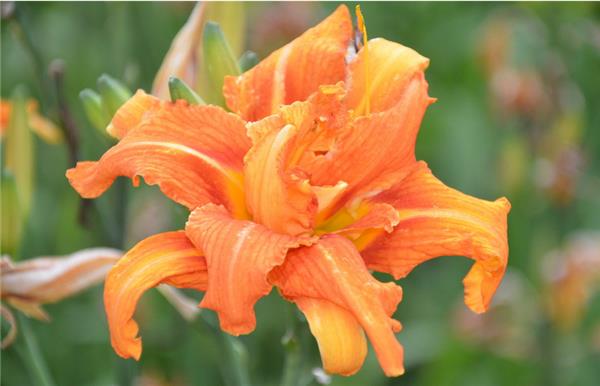
It prefers a warm and humid environment. Soil that is slightly clayey is better. It can be cultivated on field ridges, beside ditches, and near homes. Propagate by division. After the aboveground parts wither in October to November, or in spring before the plants sprout, dig up the whole plant and divide it into clumps of 2 or 3. Before planting, open holes at a row spacing and plant spacing of 40 cm each, with a hole depth of 17 to 20 cm. Plant one clump per hole, spreading the roots evenly in all directions, then cover with soil and press firm. Water or irrigate with human and livestock manure water. From the second year onward, carry out intertillage, weeding, and topdressing 3 times each year: the first in March when seedlings emerge, the second in June before flowering, and the third in October after the plants die back. After each intertillage and weeding, apply human and livestock manure water.
3. Cultivation and management: Daylily has strong tillering ability, so when planting, the plant and row spacing must be maintained at 30 cm x 40 cm. After planting, during the seedling stage, intertillage and weeding should be done in time. Intertillage during the seedling stage should be shallow rather than deep, and should deepen as the seedlings age. Carry out one shallow loosening of the soil before spring seedlings emerge, and after emergence, shallow hoeing three or four times at appropriate times, which can achieve the dual purpose of weed control and drought prevention. Intertillage and weeding should be carried out when soil moisture is moderate, and can stop once the leaf clumps cover the ground. Remove weeds in the daylily field in time; if weeds grow densely, they can easily cause pests and diseases, affecting the growth and appearance of daylily. After flowering, cut off the flower stems from the ground, and promptly remove dead and residual leaves at the base of the clumps.
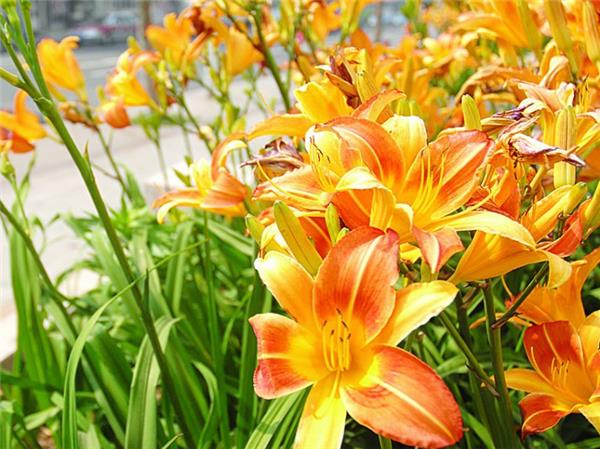
4. Soil dressing and mounding at the base: According to the biological characteristics of daylily, its roots emerge from shortened stem nodes and have the trait of rooting from bottom to top, one layer per year, with the rooting position moving upward year by year. After daylily enters full flowering stage, root growth becomes very developed. If soil is dressed and mounded at the base, the root absorption function and drought resistance will be greatly weakened, causing a significant decline in flowering. Therefore, doing a good job of soil dressing and mounding at the base in autumn is one of the important measures that cannot be ignored in daylily cultivation. The specific method is: first cut off the aboveground parts of the daylily, then while applying sufficient autumn fertilizer as planned, take fertile pond mud, river mud, and other mud fertilizers, pile them on the clumps and spread them between rows, thickening the soil layer and improving the soil. Before spring seedlings sprout, rake apart the soil dressing on top of the clumps and bank it around the clumps. Note that soil dressing and mounding at the base is only suitable for daylilies that have entered full flowering stage; young clumps are not suitable for mounding.
Pest and Disease Control
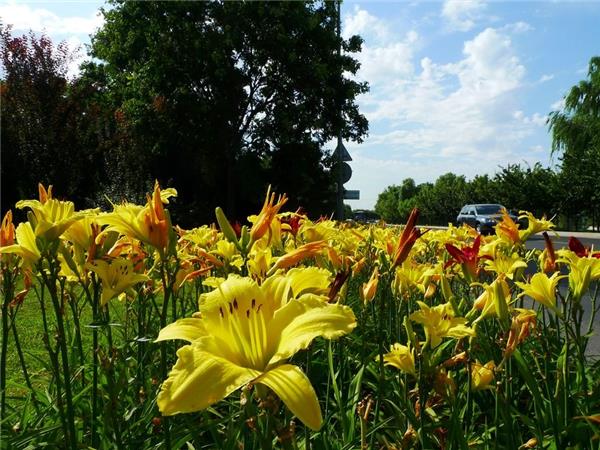
The main diseases of daylily are rust, leaf spot, and leaf blight; the pests are aphids, snails, scarab beetles, and red spider mites.
1. Disease control: Rust, leaf spot, and leaf blight are diseases to which daylily is highly prone. Rust is a fungal disease and the main disease in the middle and late stages of daylily. It begins in early May, is most severe in June and July, and gradually stops only after October, damaging leaves and flower scapes. At first, a small number of yellow powdery spots appear on the leaves, then gradually spread to the whole leaf, eventually causing the whole plant to die. When the disease occurs, spray 25% triadimefon wettable powder at 200 times dilution or 65% zineb at 500 times dilution for control. Leaf spot is caused by fungi of the genus Fusarium and is the main disease during the daylily seedling stage. It begins from late March to early April, with the peak from mid-to-late April to mid-to-late May. It can be controlled by spraying Bordeaux mixture or lime sulfur mixture. Leaf blight is caused by pathogenic fungi of the genus Colletotrichum and is a seedling-stage disease that occurs after leaf spot. It generally begins in early May, is most severe in early to mid-June, and mainly damages leaves, as well as flower scapes. It occurs from the seedling stage onward. Small water-soaked spots first appear at the middle edge of the leaves, then gradually spread upward and downward, forming brown streaks, and finally turning grayish white; in severe cases, the whole leaf dies. It can be controlled by spraying 50% carbendazim at 600 to 800 times dilution or zineb wettable powder at 600 times dilution, or by spraying Bordeaux mixture around Qingming.
2. Pest control: The main pests of daylily are red spider mites, Indian tailed aphids, and snails.
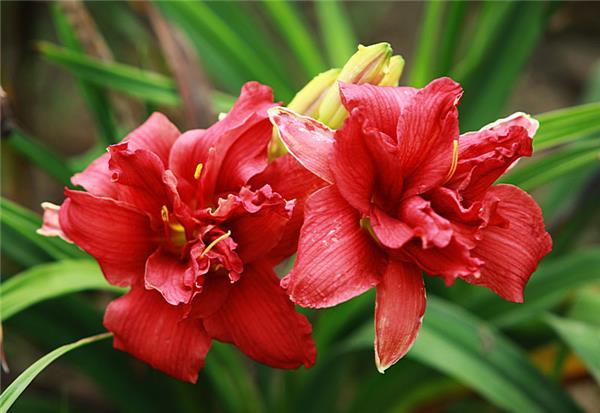
For Indian tailed aphids, the control methods are: remove weeds, prune dead branches and fallen leaves, especially leaves with insects; use yellow thin plastic sticky traps to trap and kill winged aphids; take care to protect natural enemies such as ladybugs and lacewings. When there are many natural enemies, use broad-spectrum pesticides as little as possible and choose suitable biological pesticides, such as spraying 1.2% nicotine and turpentine oil emulsion at 800 to 1000 times dilution; when outbreaks are severe, spray promptly, using one of the following for foliar spraying: 2.5% deltamethrin at 2500 to 3000 times dilution, 6% imidacloprid at 3000 to 4000 times dilution, etc., and pay attention to safety when spraying.
For red spider mites, the methods are: carry out good forecasting and forecasting, promptly inspect the upper and lower leaf surfaces, preferably with the aid of a magnifying glass, and spray pesticide early once leaf mites are found damaging many leaves. Controlling early damage is the key to controlling later outbreaks; remove diseased and pest-damaged branches and clear weeds, and burn them in a centralized manner; in summer when mite numbers are not large, spray clean water to wash them off; when pest occurrence is severe, use 1.8% abamectin emulsifiable concentrate at 7000 to 9000 times dilution for uniform spray control; or use 15% pyridaben emulsifiable concentrate at 2500 to 3000 times dilution, both of which have good control effects. Do not use dichlorvos to kill mites; dichlorvos has the effect of stimulating mite proliferation. Do not use pyrethroid pesticides; they are ineffective against mites; protect natural enemies such as ladybugs and lacewings.
For snails, the methods are: remove weeds and spread quicklime powder to reduce snail breeding sites; spread lime belts on the ground of daylilies to poison and kill snails; use 50 g to 100 g of 6% niuloxing granules per 100 sq m. Alternatively, use 50 g to 100 g of 6% niuloxing granules per 100 sq m, mix with 1.5 kg to 2.5 kg of sand and soil, and spread evenly so that snails can easily contact the pesticide. Or make poisoned bait with soybean cake powder and cornmeal and apply it in the evening where snails appear to trap and kill them; manually capture adult and young snails, or first make trapping piles with leaves, weeds, vegetable leaves, etc., and after snails hide under the trapping piles before dawn, capture them in a centralized manner.
Propagation methods in the growing techniques of 'Golden Doll' daylily:
Tissue culture and division propagation methods can be used. The annual propagation coefficient of 'Golden Doll' daylily is generally 1:6, and can reach 1:10 in fertile soil. Division can be carried out during the dormant period. In the Jiangsu and Zhejiang area, before early February, cut open dense clumps, keep two or three buds per clump, and replant; they will flower in the same year of planting. 'Golden Doll' daylily is a perennial herbaceous plant of the genus Hemerocallis in the Liliaceae family, and is the only multi-season flowering variety among the large-flowered daylilies introduced from North America. 'Golden Doll' daylily has bright green leaves; its flowers are golden yellow, with a good group ornamental effect. In landscaping, it is mainly used as a groundcover plant, and can also be used in flower beds and flower borders. 'Golden Doll' daylily plants are clustered, with a natural height of 30-40 cm, which is 1/3 of the plant height of common daylily; in spring the plants sprout early, with bright green leaves; the flowers are golden yellow, with a good group ornamental effect, flowering continuously from early May to mid-October, with a flowering period as long as half a year. 'Golden Doll' daylily has strong cold and drought resistance, tolerates poor soil, and is relatively tolerant of extensive management. In northern regions it can overwinter naturally under winter conditions of minus 20 degrees, and after two years of planting, it can maintain normal growth relying on natural rainfall. In landscaping, it is mainly used as a groundcover plant, and can also be used in flower beds and flower borders.