How to grow white daisy chrysanthemum? Detailed explanation of white daisy chrysanthemum planting methods
In today's era where a hundred flowers contend in beauty, the white daisy chrysanthemum, though lacking the gorgeousness of roses and the fragrance of jasmine, has still won people's affection with its own fresh and delicate style, bringing a refreshing feeling to people in the scorching summer. Now let us learn together about how to grow white daisy chrysanthemum.
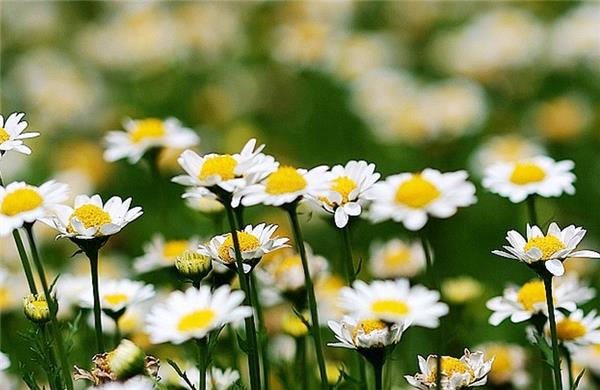
I. How to grow white daisy chrysanthemum
White daisy chrysanthemum, also known as little white chrysanthemum, is a biennial herbaceous flower of the Asteraceae family, and is a one- or two-year herbaceous flower. Native to Europe. It prefers a warm, humid environment with plenty of sunlight. It is relatively cold-tolerant and tolerant of partial shade. It is suitable for growing in loose, fertile loam with good drainage. The white daisy chrysanthemum is short but robust, with many flowers, an early flowering period, and a long flowering period; when planted in masses, it is dazzling to the eye. The capitulum is terminal, and after flowering it produces achenes, which mature in late June.
White daisy chrysanthemum is a perennial herbaceous plant in the Asteraceae family. It is often sown in autumn and cultivated as a biennial (in alpine regions, sown in spring and cultivated as an annual). The leaves are clustered at the base, spoon-shaped. The capitulum is solitary, with a flower diameter of 3-5 cm, and the ligulate flowers are strip-shaped. There are white, pink, red and other colors. Cold-tolerant, suited to a cool climate. Under hot conditions, flowering is poor and the plant tends to wither and die.

II. Management of white daisy chrysanthemum
White daisy chrysanthemum is a perennial herbaceous plant in the Asteraceae family. It is often sown in autumn and cultivated as a biennial (in alpine regions, sown in spring and cultivated as an annual). The leaves are clustered at the base, spoon-shaped. The capitulum is solitary, with a flower diameter of 3-5 cm, and the ligulate flowers are strip-shaped. There are white, pink, red and other colors. Cold-tolerant, suited to a cool climate. Under hot conditions, flowering is poor and the plant tends to wither and die. It can be sown and propagated in an open-field seedbed in mid-August or early September. After sowing, it is advisable to shade with reed curtains; do not cover with plastic film. Once the seedlings have all emerged, remove the curtains. When two or three leaves have grown, carry out the first pricking out, with bare roots and no old soil attached; the soil in the bed needs to be moist, watering should be timely, and if necessary shade with reed curtains; two or three days after pricking out, when the soil is dry, water once more. Two days later, loosen the soil to preserve moisture and harden the seedlings.
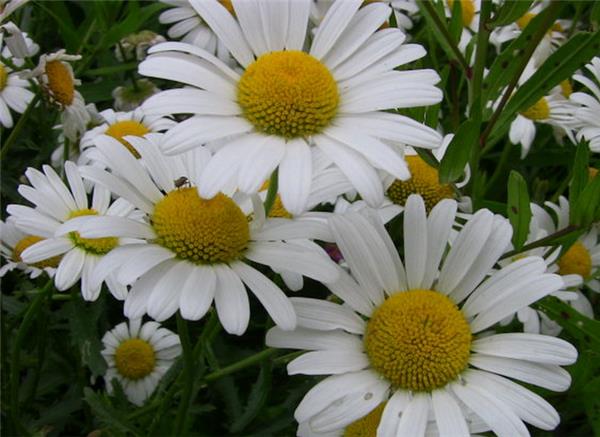
III. Care of white daisy chrysanthemum
Growth habits: It is a one- or two-year herbaceous flower. Native to Europe. It prefers a warm, humid environment with plenty of sunlight. It is relatively cold-tolerant and tolerant of partial shade. It is suitable for growing in loose, fertile loam with good drainage.
Propagation methods: Mainly by sowing and division. Sow in autumn from August to September. Broadcast the seeds on a medium mainly composed of peat soil, cover with a thin layer of soil, soak the pot in water, place in a sunny and ventilated spot, and at 15-21°C, they germinate in 10-14 days, flowering 90 days after sowing. Division is carried out in spring or autumn; after division, pay attention to shading.
Pest and disease control: Common diseases include leaf spot and stem rot, which can be sprayed with 65% zineb wettable powder. Pests include mirid bugs and leaf miners, which can be killed by spraying with 25% carbaryl wettable powder at 1500 times dilution.
Production applications: The flowering period is from February to November; the flower colors are white and yellow; the plant is low-growing with abundant flowers; it is suitable for flowerbed and courtyard arrangements, and can also be planted as a groundcover flower.

Because the white daisy chrysanthemum blooms abundantly and has a long flowering period, after the flowers fade, the spent flowers must be pruned away promptly to prevent wasting nutrients and to encourage new flower buds to open. That is all for the introduction on how to grow white daisy chrysanthemum and its planting methods; we hope it is helpful to everyone.