How to grow Caladium? A detailed guide to cultivation methods
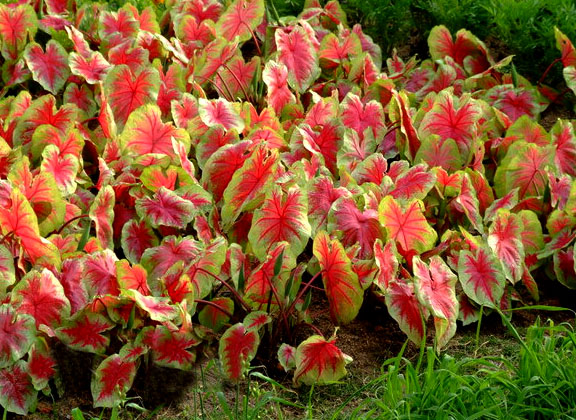
From a distance, the leaves of Caladium look as if they have bloomed into flowers, incredibly beautiful and striking. Today, many different cultivars of Caladium have been bred, and the leaf colors have become more and more varied. Growing Caladium does not require too much effort, so it is very well suited for decorating a home.
Variety characteristics of Caladium
1. Caladium leaves are textured, dark green, and the leaf surface has red, white, or yellow spots of various kinds, transparent or opaque.
2. The main vein of Caladium is trifid, the lateral veins are reticulate, the petiole is slender, cylindrical, and its base expands into a sheath shape with small brown spots.
3. The spathe inflorescence of Caladium arises from the base; the lower part of the spathe is tubular, green on the outside, greenish-white on the inside, purplish-green at the base, white; the spadix is slightly shorter than the spathe and has a short stalk.
4. Caladium flowers are unisexual and lack a perianth; female flowers are borne on the lower part of the inflorescence, male flowers on the upper part, and the middle is separated by sterile neutral flowers. The neutral flowers have staminodes.
5. The berries of Caladium are white, and the flowering period is 4-5 months.
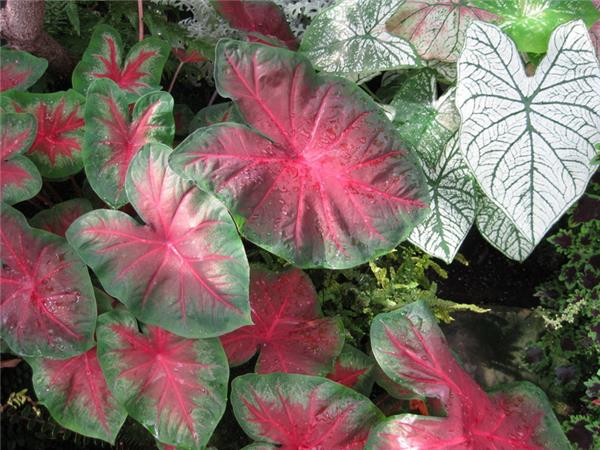
Main cultivars of Caladium
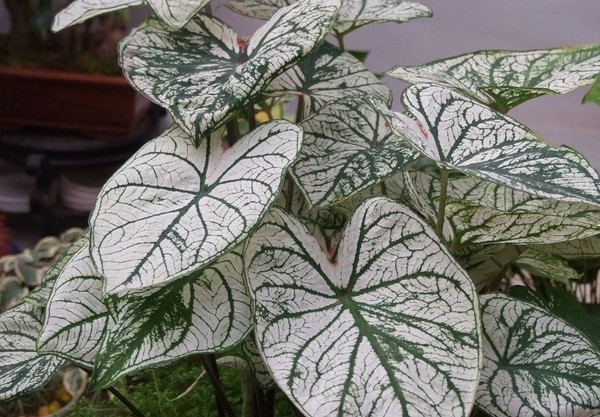
1. White Caladium: leaves are white, with emerald green veins.
2. Bright White Caladium: leaves are white, semi-transparent and semi-glossy.
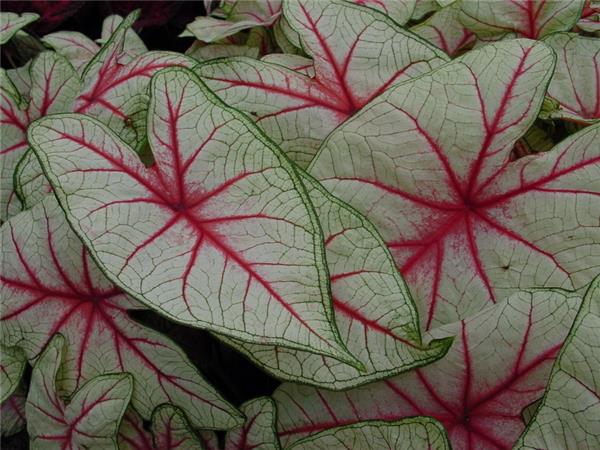
3. Dong Deng: the middle of the leaf is crimson red, with green edges.
4. Seagull: leaves are dark green with prominent wide white veins, bicolored.
5. Red Cloud: leaves have red spots.
Propagation methods of Caladium
1. Division propagation: in April to May each year, before the tubers sprout, peel off the small tubers around the tuber, then coat the wounds with plant ash or sulfur powder, air-dry for several days, and pot them after the wounds are dry.
2. Cutting propagation: if the mother bulb is relatively large with many buds, you can use a knife to cut and divide the mother bulb for cutting propagation; make sure each cut piece has 2-3 buds, then pot them after the cut surfaces have dried and healed.
3. Seed propagation: because Caladium seeds are not easy to store, sow them immediately after harvesting, otherwise the germination rate will be greatly reduced.
Cultivation methods of Caladium
1. Soil: Caladium is not tolerant of saline-alkali or poor soil, so when planting, choose a fertile, loose loam with a certain water-holding capacity. You can use a soil mix made from materials such as garden soil, leaf mold, river sand, or perlite. For the pot, you can use a white plastic cachepot or a white porcelain cachepot.
2. Temperature: Caladium likes high temperatures; the suitable growing temperature is 25-30°C. It is not cold-tolerant; when the temperature is below 15°C, the leaves of Caladium will gradually fade and begin to turn yellow, wilt, and soften. During high summer temperatures, measures such as shading, spraying water, and increasing ventilation should be taken to lower the temperature and raise relative air humidity, so as to benefit the plant's growth.
3. Light: Caladium likes diffused light and avoids direct sun exposure, so when growing Caladium, pay attention to shading and avoid strong light, otherwise the leaves will turn pale yellow, the beautiful markings on the leaf surface will become dull and lusterless, and even young leaves may be scorched. But it should not be too shady either, otherwise the petioles tend to become leggy, thin, and soft, and break easily, while also losing their brilliant color and luster.
4. Watering: Caladium likes a moist soil environment and is extremely intolerant of drought, so pay attention to watering when growing it. Watering should follow the principle of "alternating dry and wet while leaning moist." In late autumn, reduce watering and let the potting soil dry appropriately. In normal cultivation of Caladium, also pay attention to frequently spraying water around the plant to increase air humidity and make the plant grow more vigorously. When spraying, do not spray water onto the leaf surface, otherwise scorch spots easily form on the leaves.
5. Fertilizing: Caladium relatively likes fertilizer. During the growing period, apply phosphorus and potassium fertilizer 1-2 times every half month to make the markings on the leaf surface more brightly colored. When fertilizing, avoid fertilizer solution splashing onto the leaves, otherwise scorch spots easily form on the leaves. After early autumn, apply potassium fertilizer 1-2 times to promote tuber enlargement.
6. Pruning: during the growth of Caladium, appropriate pruning can be done, which is beneficial to the plant's growth. Mainly cut off withered yellow leaves, old leaves, and overly dense leaves to encourage the production of new shoots.
7. Pest and disease control: Caladium is mainly harmed by dry rot, leaf spot disease, and red spider mites and other pests and diseases; observe carefully during cultivation and achieve early detection and early treatment.
It seems that Caladium is indeed a plant that can catch people's eyes just with its leaves, and among foliage plants it can be considered one of the very best. After learning this knowledge about Caladium, I hope that if you like this plant, you can refer to the introduction above to grow it.
I hope that if you like this plant, you can refer to the introduction above to grow it.