How to grow crape myrtle? Let me teach you the planting methods for crape myrtle
What are the planting methods for crape myrtle? Crape myrtle, also known as "Hundred-Day Red," crape myrtle tree, itchy tree, etc., belongs to the genus Lagerstroemia in the family Lythraceae. The tree form is graceful, and the bark is smooth. The flower colors are rich and brilliant, and the blooms are dense and elegant. Crape myrtle blooms profusely during the flower-scarce seasons of summer and autumn, with a flowering period lasting several months. Hence it is called "Hundred-Day Red." In the Song Dynasty, Yang Wanli praised it in a poem: "Who says red flowers have no white days? Crape myrtle often blooms red for half a year." In the north, it is mostly cultivated as a shrub or small tree, serving as an important tree species for urban and rural landscaping. It is suitable for planting in courtyards, along both sides of garden paths, and by ponds and riversides. Whether planted alone or combined with other plants, crape myrtle delights the eye with its crooked, varied tree form and brilliantly colored flowers.
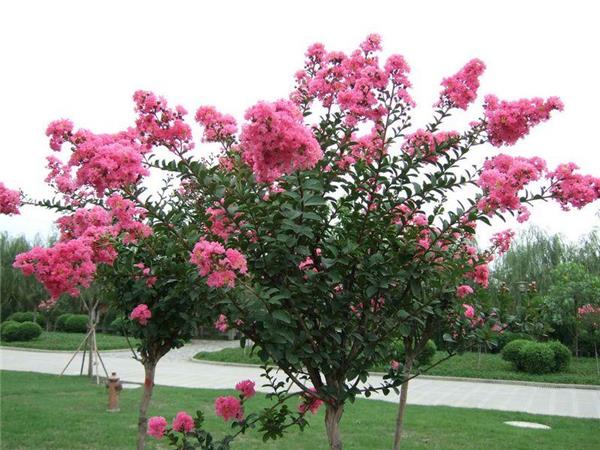
Planting crape myrtle
Because crape myrtle has strong root sprouting ability, division propagation can be carried out in October, planting the divisions in nursery beds or pots to grow; they generally bloom in 2 to 3 years. You can also cut mature fruit clusters in October to November and sow them in March of the following year, with seedlings emerging in about 2 to 3 weeks.
Crape myrtle requires loamy soil rich in organic matter and with good drainage. You can use a mixture of 5 parts leaf mold or sandy soil, 2 parts burned soil, and 1 part coal ball ash, thoroughly mixed.
In spring and winter, keep the potting soil moist. In summer and autumn, water once every morning and evening. During drought and high temperatures, appropriately increase the frequency of watering each day. Use river water, well water, rainwater, or tap water that has been stored for 2 to 3 days for watering.
For potted crape myrtle, replace the potting soil every 2 to 3 years. Use a mixture of 5 parts loose mountain soil, 3 parts garden soil, and 2 parts fine river sand to make the growing medium. When repotting, you can use organic fertilizers such as bone meal and soybean cake powder as a base fertilizer, but do not let the fertilizer come into direct contact with the roots, so as not to damage the roots and affect plant growth.
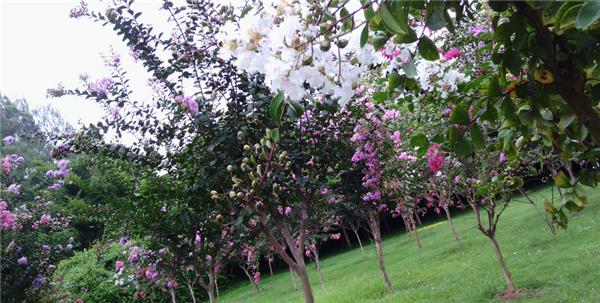
Propagation techniques
Crape myrtle propagation mainly includes seeding, cuttings, division, and other methods, but in actual production, seeding propagation is mostly used.
1. Seed propagation and seed collection: Because the fruit has already split before it matures, the seeds are easily lost, so they should be collected in time. Spread the collected seeds out to dry, thresh them, and remove impurities to obtain pure seeds. They can be sown promptly or dried and stored until spring of the following year for sowing. The germination rate reaches 80% to 85%.
Sowing: The sowing site should be chosen as sandy loam that is high and dry, fertile, and well-drained. Before spring sowing, soak the dry seeds in warm water at 40°C, then change to clean water and soak again. Once the seeds have absorbed enough water, they can be sown. The seeds are very small, so they can be mixed with an appropriate amount of fine sand and broadcast. If using drilling, the row spacing is 30 cm. After sowing, cover with a thin layer of soil, press lightly, and cover with grass. The suitable germination temperature is 18°C to 22°C. They sprout about 20 days after sowing.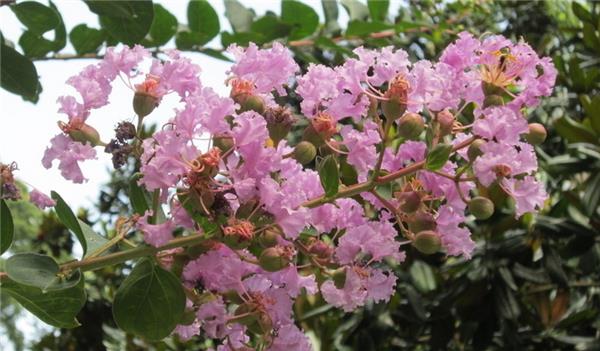
Seedling management: After emergence, gradually remove the covering and set up a shade shed for shading. When seedlings are 3 cm tall, thin them, with a final spacing of 10 to 15 cm. From June to August, they enter the rapid growth period. Because crape myrtle is an early-growth type, additional fertilizer should be applied 2 to 3 times in the early part of the rapid growth period. In the same year, seedlings can reach 50 to 80 cm in height.
2. Cutting propagation: Because crape myrtle is naturally pollinated, the flower colors of the offspring are rather mixed. In order to obtain pure flower colors, asexual propagation can be used.
Hardwood cuttings: Carry out in spring. Select one-year-old thick, well-developed branches and cut them into 15 cm lengths as cuttings. Insert them into the soil to 2/3 of their length. After inserting into the soil, keep them moist regularly. They can root in about 20 days after cutting, with a survival rate of 90%. With strengthened fertilizer and water management, seedlings can reach about 1 m in height in the same year.
Softwood propagation: This can be carried out during the rainy season, and attention should be paid to moisture retention and shading.
3. Division propagation: Crape myrtle has strong sprouting ability, and many sprouted shoots can grow near the root zone of the mother plant. Before buds sprout in spring, separate the sprouted shoots from the root zone of the mother plant and replant them with roots, forming independent individuals.
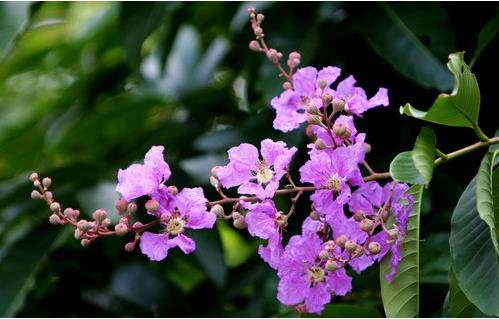
Shaping and pruning
The shaping and pruning of crape myrtle is mainly done during the dormant season, supplemented during the growing season.
Natural open-center form.
Before crape myrtle leaves the nursery, select and retain 3-4 large branches as main branches. Later, on the main branches, select and retain 1-2 branches with good angles and balanced growth as side branches. Each year when pruning, choose upper branches with larger angles as extension branches and moderately cut them back, in order to expand the tree crown. This tree form is easy to shape, has good light penetration, and can bloom in three dimensions. This tree form is suitable for planting in places with more space.