How to prune hibiscus? Detailed explanation of the correct pruning method
Zhujin peony, big red flower and other names are alternative names for hibiscus; hibiscus is an evergreen large shrub in the Malvaceae family. With the flower language of fresh romance and subtle beauty, hibiscus is as bright and beautiful as its name. Below is an explanation of hibiscus pruning methods, providing information for friends who want to grow it!
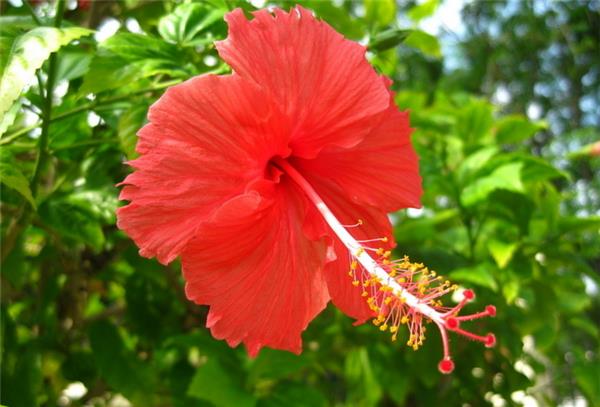
I. Pruning methods for hibiscus
Hibiscus branches have strong sprouting ability. Timely pruning can not only keep the tree shape neat, but also make it bloom more. Generally, after the flowers fade each year, thin out excessive water sprouts, diseased and pest-infested branches, weak twigs, crossing branches and overlapping branches to encourage new branch growth. Bloom more. For plants that have already bloomed for 2-3 years. A heavy pruning can be carried out every 1-2 years, keeping 2-3 buds at the base of each side branch. Cut off all the upper parts. Encourage new branch growth. This can make the hibiscus grow more vigorously and also produce more flowers with brighter colors.
Because hibiscus blooms on new shoots of the current year, only by constantly promoting vigorous growth can it produce more branches and keep blooming. For this reason. During cultivation, it is necessary to apply light fertilizer frequently to promote vigorous growth and produce more new branches. To achieve the goal of more blooms. Hibiscus is mainly propagated by cuttings. When the cutting seedling grows to about 20 cm high, pinch off the growing tip, which can encourage the axillary buds at the base to sprout. When the axillary buds sprout new branches, select and keep 3-4 new branches that are relatively uniform in growth and evenly distributed, and cut off the rest. In this way, a good plant can be cultivated.
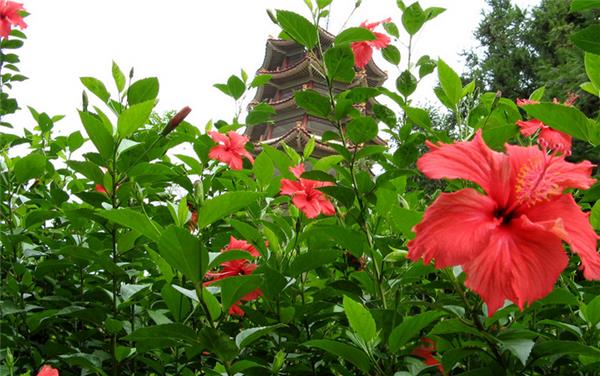
II. How to grow hibiscus
Repotting
Before moving it outdoors in April each year, it should be repotted. The soil should be loose, fertile sandy soil. When repotting, also replace with new culture soil, cut off some overly dense and curled fibrous roots, apply sufficient base fertilizer, and add a little phosphate fertilizer at the bottom of the pot.
Pruning
After moving it outdoors, carry out pruning. For each branch, except for keeping 2-3 buds at the base, cut off all the upper part. Pruning can encourage new branches to grow, make the growth more vigorous, and also make the plant shape more attractive. After pruning, appropriately control water and fertilizer.
Temperature
After Frost's Descent and before the Beginning of Winter, it must be moved indoors, because hibiscus is not tolerant of frost. The overwintering temperature should not be lower than 5°C, so as to avoid frost damage; it should not be higher than 15°C, so as to avoid affecting dormancy. When the weather is colder, it can be covered with paper or plastic film for warmth. After first moving indoors, open the windows for ventilation every day during the daytime, pay attention to changes in the dryness and moisture of the potting soil, and water appropriately. On the coldest days, watering helps prevent frost damage, but fertilizing should stop.
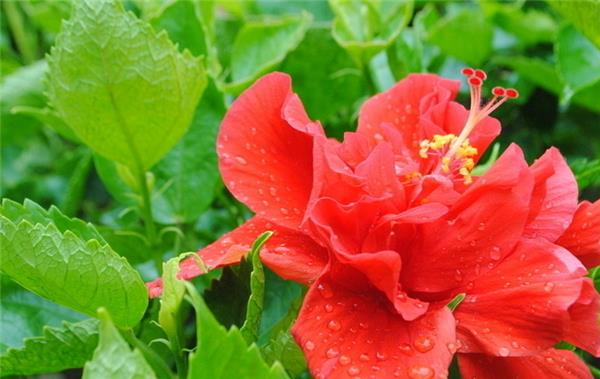
III. Morphological characteristics of hibiscus
The leaves resemble mulberry leaves, and there are also round leaves. Axillary trumpet-shaped flowers, with single and double petals, the largest flower diameter reaching 25 cm, evergreen large shrub or small tree. The stem is upright and much branched, and can reach 6 m in height. Leaves alternate, broadly ovate to narrowly ovate, 7-10 cm long, with 3 main veins, the apex abruptly pointed or gradually pointed, the leaf margin coarsely serrate or lobed, the base nearly entire, hairless or with a few sparse hairs on the veins beneath, shaped like mulberry leaves. Flowers large, with drooping or upright stalks, solitary in the upper leaf axils, divided into single-petaled and double-petaled; single-petaled
ones are funnel-shaped, double-petaled ones are not funnel-shaped, in colors such as red, yellow, pink, and white, blooming throughout the year, most abundantly in summer and autumn.
The hibiscus flower looks warm and bold on the outside, yet has a unique flower center. This is formed by many small stamens joined together and wrapping around the outside of the large pistil. The structure is quite delicate, just like a slender heart beneath a passionate appearance. Ming dynasty, Li Shizhen, "Compendium of Materia Medica - Wood III - Hibiscus": "Hibiscus is produced in the south, and is another variety of hibiscus syriacus. Its branches are weak, its leaves are dark green, slightly astringent like mulberry. Its flowers are red, yellow, and white; the red ones are especially prized and are called Zhujin." Ming dynasty, Xu Wei, one of the poems in "Hearing That Someone in the Village Bought a Hibiscus Flower": "I recall parting at Tangjiang fifty frosts ago, and I long remember the bright hibiscus of the southern flowers." Qing dynasty, Wu Zhenfang, "Miscellaneous Records of Lingnan," volume 2: "Hibiscus flowers are found everywhere in Guangdong. The leaves resemble mulberry but are slightly smaller, and there are three colors: bright red, light red, and yellow. The large ones open expansively like peonies, opening in the morning and falling at dusk, and after falling they bloom again, continuing without interruption from March to October."
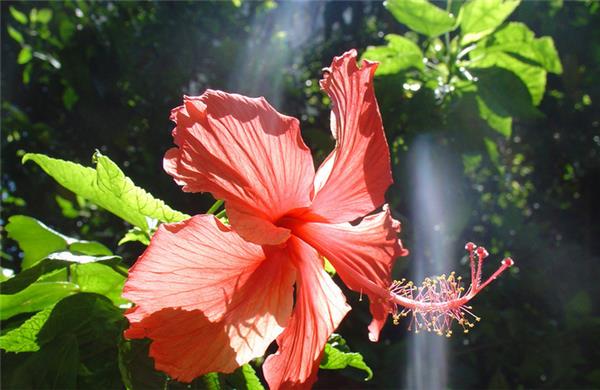
The above are the pruning methods for hibiscus and the growing methods for hibiscus. I believe everyone now knows how to grow hibiscus! Friends who like planting hibiscus, go buy hibiscus now, and you can plant it yourself.