Propagation Methods for Crape Myrtle and Wisteria
Crape myrtle is a tree species distributed across the Yangtze River basin, and it is also cultivated in South China, North China and Northwest China, with very strong adaptability. The crape myrtle tree is a peculiar variety among trees: its trunk is extremely smooth, so smooth that even a monkey cannot climb it. As the tree grows, the outer bark of the trunk falls away, leaving it smooth and barkless. If people gently stroke the trunk, its branches sway and leaves move, and the whole tree trembles, so people also call it the "ticklish tree." Now let us look at the propagation methods for crape myrtle.
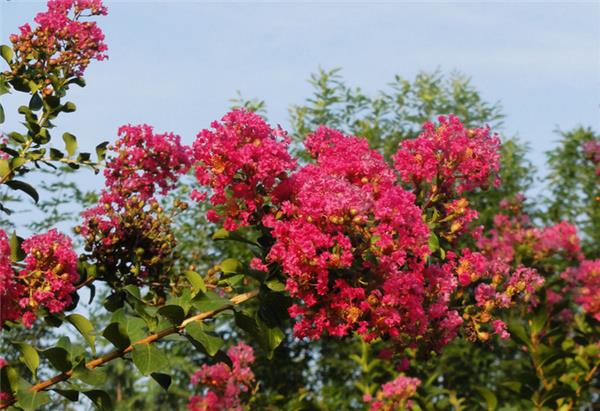
I. Propagation of Crape Myrtle
Introduction to cutting propagation methods for crape myrtle trees: both hardwood cuttings and softwood cuttings can be used.
Hardwood cuttings are generally taken from mid-to-late March to early April, before the branches sprout. Select thick, robust one-year-old branches and cut them into 15cm-long cuttings, then insert them into a seedbed of loose, well-drained sandy loam. The insertion depth should be such that the topmost bud of the cutting is exposed. After inserting, water thoroughly and cover with plastic film to retain moisture and warmth. Once the seedlings grow to 15-20 cm, the film can be removed and replaced with a shade net, with timely watering; the branches can grow to about 60-80 cm in the same year.
Softwood cuttings are taken in July-August, when new branches grow vigorously and are at their most vital. Select semi-lignified branches and cut them into 8-10cm-long cuttings, keeping 2-3 leaves at the upper end. The insertion depth is 3-4cm. After inserting, water thoroughly and set up a shade shed for shading. Roots generally form in about 20 days; remove the film, keep the shade net, and water timely. The branches can grow to about 60-80 cm in the same year, with a very good survival rate.
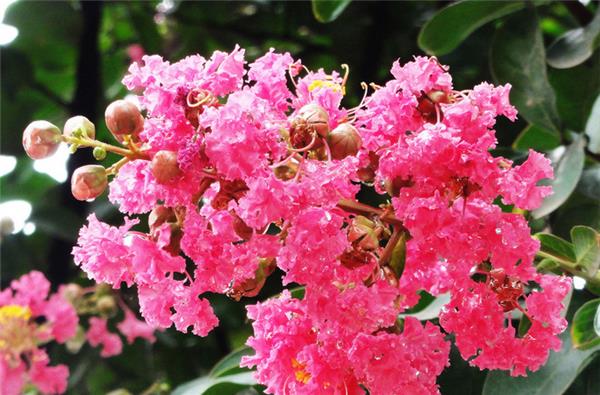
II. Cultivation Methods for Crape Myrtle:
Planting. Crape myrtle is a sun-loving tree species, so a sunny environment should be chosen for planting, and the soil should be moist and fertile while also having good drainage. The transplanting time for crape myrtle is from March to early April, with Qingming Festival being the best and autumn second best. When transplanting, the plant should be moved with its soil; keep the main trunk at 100 to 120 cm and cut off the upper part. After new shoots emerge, select and keep the 3 to 4 main branches with the most suitable angles to let them bloom.
Light and watering: Crape myrtle is a light-loving plant, so during the growing season it must be placed in outdoor sunlight. At the same time, crape myrtle has a high water requirement during the growing season and the soil needs to be kept moist. In spring and winter, keep the potting soil moist; in summer and autumn, water once in the morning and once in the evening. In high-temperature seasons, the number of waterings can be increased.
Regular fertilizing: Crape myrtle is a fertilizer-loving plant. A lack of fertilizer in potted crape myrtle will lead to thin, weak branches and yellowing color, causing the plant to grow weaker, bloom less or even not bloom at all; however, excessive fertilizing will cause excessive growth of branches and leaves. During the vigorous growing seasons of spring and summer, more fertilizer can be applied; after autumn begins, apply less; in winter during the dormant period, fertilizer may be omitted. Do not fertilize during the rainy season or at noon during summer high temperatures.
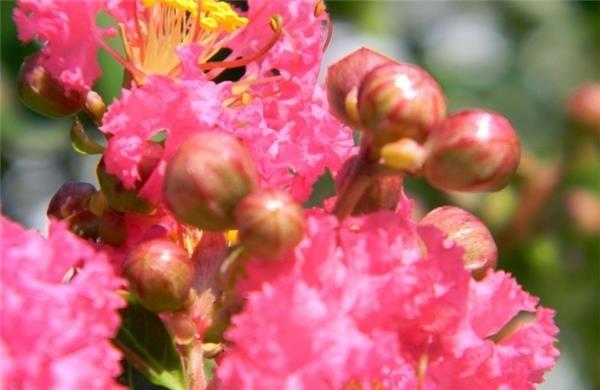
III. How to Make a Crape Myrtle Bonsai
(1) Seedling sources
Crape myrtle can be propagated by seed, or by division and cutting. Seed propagation is usually carried out in March each year, and the seedlings can reach 30-40 cm in the same year. Cutting propagation is a commonly used method for making small or miniature crape myrtle bonsai; it generally blooms in 2-3 years and takes shape quickly. The main trunk of crape myrtle is straight and brittle, and the cutting is generally inserted only 4-5 cm deep, unlike other seedlings that are inserted deeper. After cutting, pay attention to watering to keep the medium moist, but not waterlogged. In the year of cutting, after the crape myrtle sheds its leaves, cut off the entire main trunk from the soil surface. In the second year, pay attention to fertilizer and water management; in November, after the crape myrtle sheds its leaves, cut the main trunk again at 2-3 cm above the ground. Through pruning, the shortcoming of the straight trunk being difficult to shape can be overcome.
(2) Potting and shaping
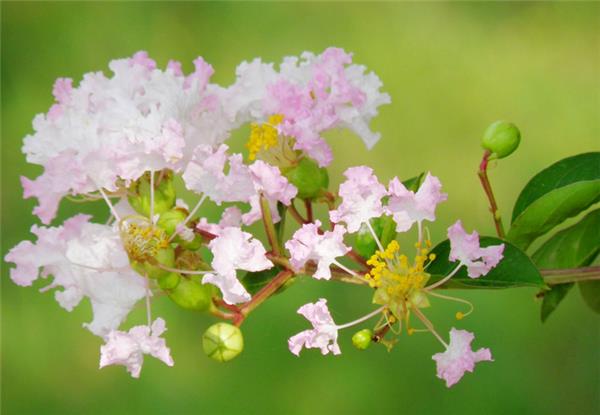
After crape myrtle is potted, it enters shade-shed management and can recover its vitality in 15 days. The trunk of crape myrtle is relatively thin, so when making bonsai from small seedlings, the method of twisting multiple trunks together is often used to thicken the main trunk. That is, use the branches sprouting from the base of the crape myrtle and wind them one by one in a spiral along the main trunk; after 1-2 years, the branches and main trunk can heal together and become a single whole, appearing aged and rustic. If small seedlings of different flower colors are planted together in one hole and tied together at the base so that the main trunks twine around each other, the same effect can also be formed after 2-3 years. The branches of crape myrtle are slender and numerous, and are not suitable for excessive twisting and shaping; generally, pruning and shaping methods can be used to make them more beautiful.
If used as indoor home decoration, wisteria is generally mostly potted or used as floral decorations. They are placed on balconies, corridors and other places. For potted wisteria, because its fertilizer and water can be controlled evenly, the conditions for its climbing or growth can be indirectly controlled. It can also make flowering in all four seasons possible. Wisteria decorations can be made into specimens, or wisteria made of plastic products can decorate home walls, cabinets, doors and windows, with a very good seasonal effect.
For potted wisteria, because its fertilizer and water can be controlled evenly, the conditions for its climbing or growth can be indirectly controlled. It can also make flowering in all four seasons possible. Wisteria decorations can be made into specimens, or wisteria made of plastic products can decorate home walls, cabinets, doors and windows, with a very good seasonal effect.