A complete guide to the planting methods of Canna Lilies, learn to grow Canna Lilies with ease
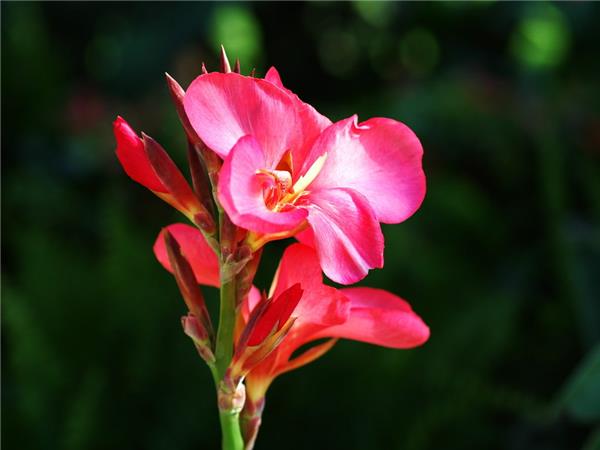
Canna Lily is a tropical broadleaf plant, with flower colors mainly in two types: yellow Canna Lily and red Canna Lily; in addition, improved varieties also show purple, pink, and multi-colored speckled patterns. Because Canna Lily blooms in the scorching heat of midsummer, bringing passersby a cool beauty, its brave spirit of fearing no fierce sun is praised by people, and its flower language is "a beautiful future." So how do you grow Canna Lilies?
How to grow Canna Lilies
First, seed selection. For potted Canna Lilies, it is suitable to choose dwarf varieties, which are relatively small in size and suitable for indoor cultivation. For potting soil, use a mixture of leaf mold, garden soil, peat soil, mountain soil, and other soils rich in organic matter, mix them evenly, and apply organic fertilizers such as bean cake and bone meal as a base fertilizer.
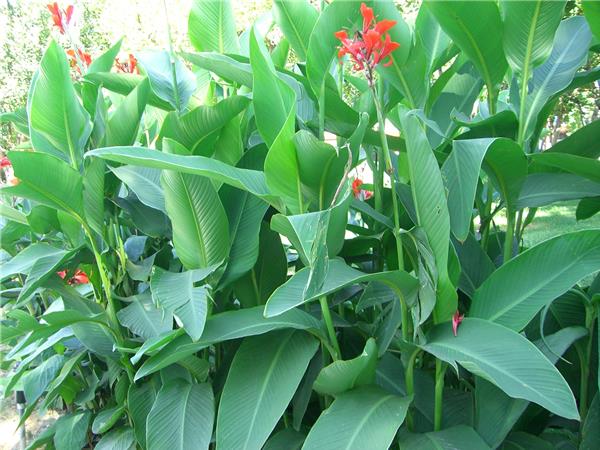
Second, division planting. Choose healthy rhizomes and divide and plant them in March-April. Cut them into several pieces according to the size of the rhizomes, with smooth cuts, and smear plant ash on the cuts. When dividing and planting, bury rhizome blocks with 2 or 3 stem buds into the potting soil, leaving the bud tips outside.
Finally, care. Carry out proper care according to the season and the growth habits of Canna Lilies. After division planting, the first watering should be thorough, and afterward keep the potting soil moist. When 5 leaves have grown, apply liquid fertilizer once every 10-15 days (fully decomposed dilute bean cake water with an appropriate amount of ferrous sulfate added, or a compound chemical fertilizer solution, with a concentration of about 0.3% as suitable). Stop fertilizing when flowering. During the flowering period, move the Canna Lily to a shaded place to prolong the flowering period. After the flowering period, cut off the flower stems to promote it to bloom again. In hot summer, water that is too cold and temperatures above 40°C will cause the leaf margins of Canna Lilies to scorch and turn yellow.
Planting
Plant in spring, with a clump spacing of 80-100 cm, and cover with soil about 10 cm thick. After the plants wither in late autumn, cut off the aboveground parts, dig out the rhizomes, dry them in the sun for 2-3 days, and bury them in sandy soil in a greenhouse with good ventilation. Do not water, and keep the room temperature above 5°C, so they can overwinter safely. In areas south of the Yangtze River, the rhizomes do not need to be dug out in winter; as long as soil is added and sealed well, they can still sprout again in the second spring.
Fertilizing
Before planting, sufficient base fertilizer is needed, and during the growth period, more topdressing is also needed, which can make the plants and flowers grow more brilliantly and beautifully.
Pest and disease control
Canna Lilies have strong adaptability, are relatively extensive in management, are not delicate, and also have very few pests and diseases. From May to August each year, pay attention to leaf-roller pests to avoid damage to their tender leaves and flower spikes. They can be controlled by spraying with 50% dichlorvos 800 times solution or 50% fenitrothion emulsion 1000 times solution. Field-planted Canna Lilies occasionally have cutworm occurrences, which can be controlled by manual capture, or by pouring 600-800 times trichlorfon solution onto the root soil.
Propagation
Canna Lilies are mainly propagated by division, and can also be propagated by sowing.
Division propagation is carried out in March-April. Dig out the old rhizomes, divide them into blocks, keep 2-3 buds on each rhizome block, with fibrous roots attached, and plant them into the soil at a depth of about 10 cm, keeping a plant spacing of 40-50 cm, and water thoroughly. When new shoots grow to 5-6 leaves, apply 1 application of decomposed fertilizer, and they can bloom in the same year. Canna Lilies are less often propagated by sowing, and this is only used when breeding new varieties or propagating in large quantities. Sowing is generally carried out in a greenhouse every March-April. Because its seed coat is hard, before sowing, the shell should be cut open with a knife, soaked in warm water at 25-30°C for 1 day, and then sown to make sprouting easier. If the temperature is kept at 22-25°C, sprouts will appear in 1 week, and after the seedlings grow 2-3 true leaves, transplant them.
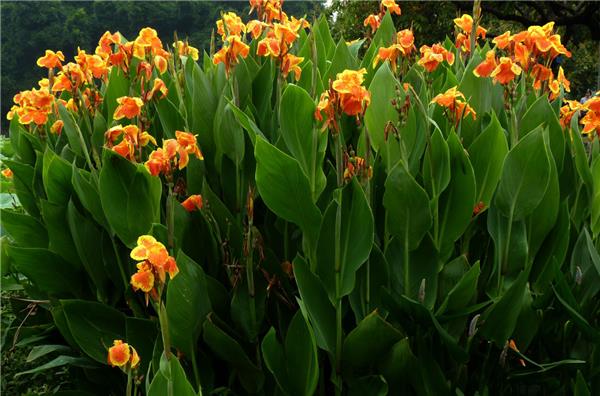
Aquatic Canna Lily plants are 1-2 m tall; leaves are long lanceolate, blue-green; racemes are terminal, many-flowered; stamens are petaloid; flower diameter is large, about 10 cm; flowers are yellow, red, or pink; in temperate regions the flowering period is from April to October, and in tropical and subtropical regions they bloom all year round; the aboveground parts die in winter in temperate regions, and the rhizomes enter a dormant period, while in tropical and subtropical regions they remain evergreen all year round.
The biggest difference between the aquatic Canna Lily and other species under the genus Canna in morphology and biological characteristics is that the rhizome is small, the internodes are elongated, and it is tolerant of flooding, being able to grow normally in water 20 cm deep.
Ecological habits
It is robust by nature, highly adaptable, light-loving, afraid of strong wind, and suitable for growing in moist and shallow-water places. It can grow well in fertile soil or sandy soil. The suitable growth temperature is 15-28°C, and below 10°C is not good for growth. In its place of origin it has no dormant period and grows and blooms year-round, while in cold northern regions it goes dormant in winter. The rhizomes need greenhouse protection to overwinter.
Cultivation management
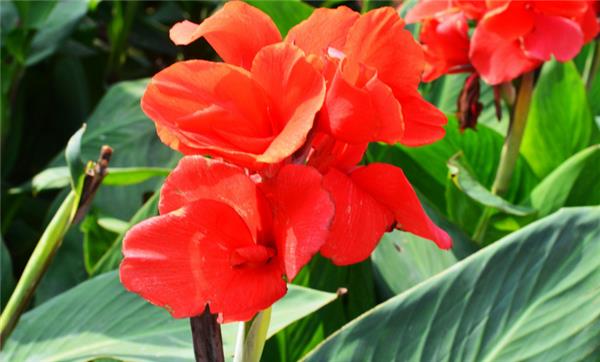
When potting, in spring the divided tubers can be planted directly into pots with fertile soil, with the growing points slightly exposed. After planting, irrigate thoroughly, place in a shaded place to recover for 5-7 days, and then move to a sheltered, sunny place for cultivation. For open-field planting, choose a pondside wet area or shallow-water area, dig holes and plant in clumps, bury the tubers in the soil, cover with 7-10 cm of soil, and after planting maintain moisture or shallow water.
Potted aquatic Canna Lilies should be placed in a warm, humid, and sunny environment. Promptly remove weeds in the pot and old leaves and dead leaves at the base, and keep the overall plant shape neat and attractive. For open-field planting in the south, they can overwinter outdoors. In warm areas, after 2-3 years the tubers need to be dug out and replanted in the same place after division.
After planting, irrigate thoroughly, place in a shaded place to recover for 5-7 days, and then move to a sheltered, sunny place for cultivation. For open-field planting, choose a pondside wet area or shallow-water area, dig holes and plant in clumps, bury the tubers in the soil, cover with 7-10 cm of soil, and after planting maintain moisture or shallow water.Potted aquatic Canna Lilies should be placed in a warm, humid, and sunny environment. Promptly remove weeds in the pot and old leaves and dead leaves at the base, and keep the overall plant shape neat and attractive. For open-field planting in the south, they can overwinter outdoors. In warm areas, after 2-3 years the tubers need to be dug out and replanted in the same place after division.