What is Lithops? Learn how to grow it
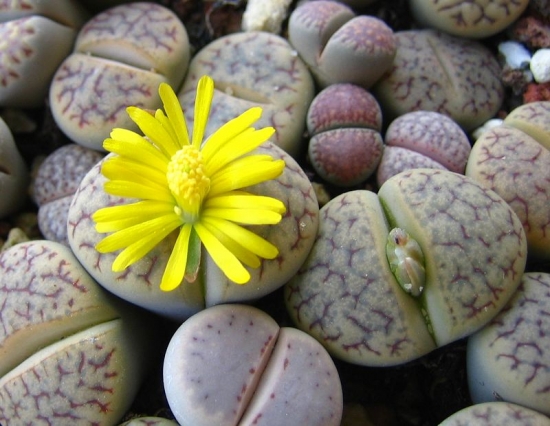
The colors of Lithops are not like those of other plants, lushly green and eye-catchingly bright; instead, they seem to be covered with a light layer of gray, looking not showy at all. If placed among larger stones, they are easily confused with the stones. However, this inconspicuous little fellow is very tenacious and very easy to grow.
I. What are Lithops
Lithops, also known as living stones and butt flowers, belong to the Aizoaceae family, and are the general term for species in the genus Lithops sp. (also called the stone plant genus), and are described as "living stones." Because of their unique shape and colorful appearance, they have become a very popular ornamental plant. They are native to southern Africa and grow and flower outside the rainy season. Among the gravel of their place of origin, Lithops are very hard to spot; this is a self-protective instinct formed to prevent small animals from preying on them, called "mimicry."
Lithops are native to southern and southwestern Africa, commonly found in crevices of rock beds and among gravel. They are described as "living stones." They grow and flower outside the rainy season. Among the gravel of their place of origin, Lithops are very hard to spot, and this is called "mimicry." Because of their unique shape and colorful appearance, they can be used as ornamental plants.
II. Propagation methods of Lithops
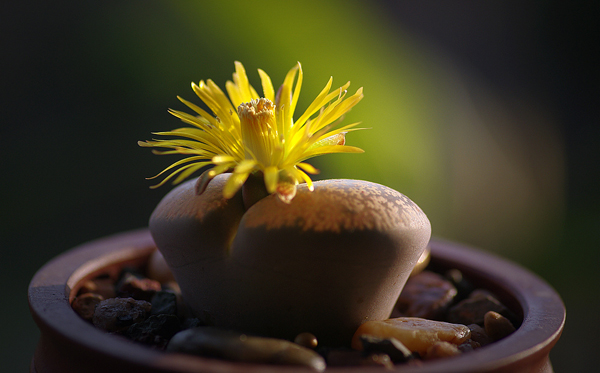
Sowing: After the seeds mature in late autumn, collect them immediately and sow them in pots, or sow again in mid-May of the following year. The seeds are tiny, so sow them indoors in pots; after sowing, cover with a thin layer of soil, and when the potting soil is dry, water by the soak-the-pot method. Never water directly, so as not to wash away the seeds. The sowing temperature is 22-24°C. About half a month after sowing, seedlings can emerge; after emergence, let the young seedlings gradually receive light.
Division: Each spring, Lithops grow new fleshy leaves from the gap in the middle, splitting the old leaves open, and the old leaves shrink and die. The new leaves grow rapidly and then shrink and split open again in summer. From the gap, 2-3 small new plants grow, and the young plants can be separated and planted.
III. How to grow Lithops
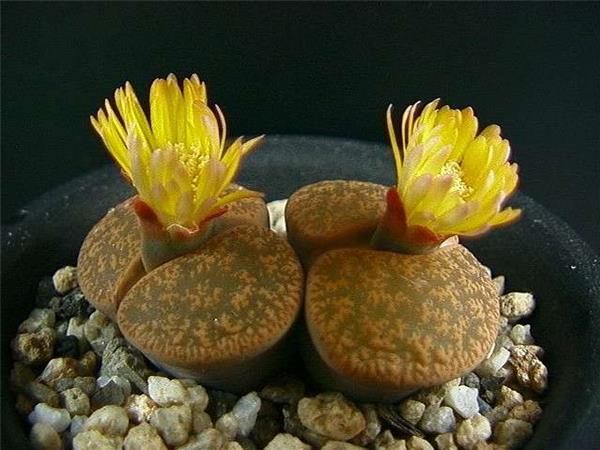
1. Soil: Lithops are not very strict about environmental conditions, and cultivation and management are relatively easy. The potting soil can be made by mixing 4 parts leaf mold, 3 parts calcareous material (shell powder, eggshell powder, old lime wall scraps, etc.), and 3 parts river sand.
2. Watering: Lithops need more water during the growing period, but must not be too wet, as algae easily grow and affect the normal growth of the spherical leaves.
3. Sunlight: In summer, keep Lithops in a semi-shaded place, or shade them by 50%, and the leaf color will be more beautiful. In spring and autumn, since the temperature is not very high, give them direct sunlight to help them carry out photosynthesis and accumulate nutrients. In winter, keep them indoors in a place with bright light.
4. Temperature: The most suitable growing temperature for Lithops is 15°C-25°C. They fear high temperature and stuffiness, and enter dormancy in the intense summer heat when the temperature is above 33°C. They avoid cold and frost, and the overwintering temperature needs to be kept above 10°C. In winter, when the temperature drops below 7°C, they also enter dormancy, and if the ambient temperature approaches 4°C, they will die from frost damage.
5. Fertilizing: Lithops need fertilizing once every half month, but the fertilizer solution must never stain the spherical leaves. After flowering in autumn, pause fertilizing.
6. Pests and diseases: Lithops mainly suffer from leaf spot disease and leaf rot disease, which can be sprayed with a 600-fold solution of 65% zineb wettable powder. Pests include ants and root-knot nematodes; use the soil-changing method to reduce nematode damage. To prevent ants, use the double-pot water-barrier method so that ants cannot crawl onto the tender, juicy spherical leaves.
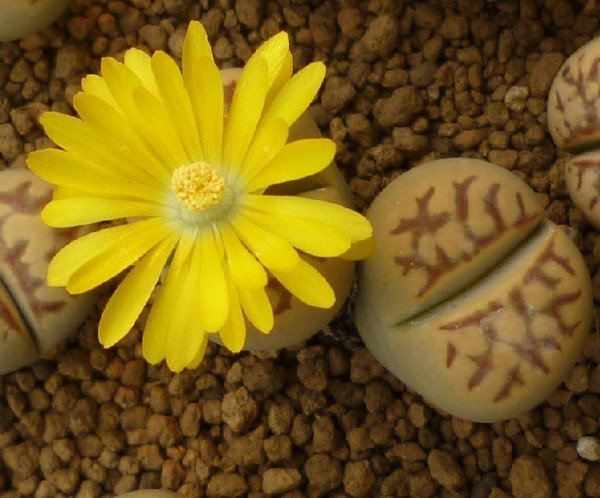
After learning about Lithops, have many friends already fallen in love with this inconspicuous little fellow? Although it does not have the delicate, charming floral beauty of peonies or Chinese roses, nor the noble, imposing leaves of bamboo palms or rubber trees, it still has its own unique characteristics and the striving spirit of hard growth. Growing a small Lithops by your side can also bring you great encouragement.