Syngonium Cultivation Methods and a Detailed Explanation of Its Toxicity
When it comes to ornamental plants today, many people prefer to grow large-leaved plants with high ornamental value, because these plants are relatively easy to care for. Among the many foliage plants, Syngonium is one of them. It is a perennial evergreen herbaceous plant in the Araceae family, native to tropical America. Today, let us learn together about Syngonium cultivation methods and whether Syngonium is poisonous.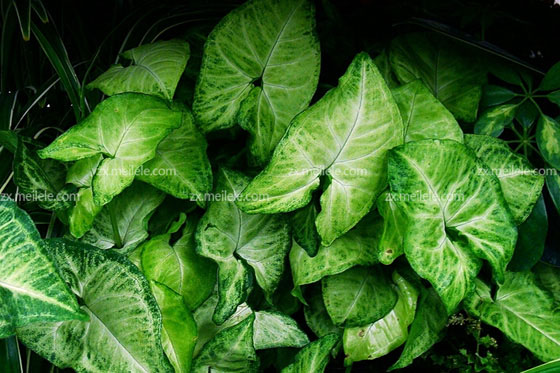
Introduction to Syngonium
Syngonium is a perennial trailing evergreen herbaceous plant, a foliage plant widely cultivated around the world. The nodes of the Syngonium stem bear aerial roots that climb and grow on other objects. The leaves are dimorphic: young leaves are single, arrow-shaped or hastate; mature leaves become palmately divided with 5-9 lobes, with the central lobe large, and small ear-shaped leaflets often growing on both sides of the basal lobes. Newly emerged leaves are light in color, while mature leaves are dark green with thicker texture. The spathe is light green or yellow. There are two types of Syngonium: one is the white butterfly Syngonium and the other is the green-gold Syngonium. The leaves of the white butterfly Syngonium grow in clusters, are shield-shaped, and resemble butterfly wings; the leaf surface is mostly yellowish-white with green patches and stripes along the edges, and the petioles are relatively long. The stem nodes are relatively short. The leaves of the green-gold Syngonium are tender green with yellowish-white markings in the center, the internodes are relatively long, and the stem nodes bear aerial roots.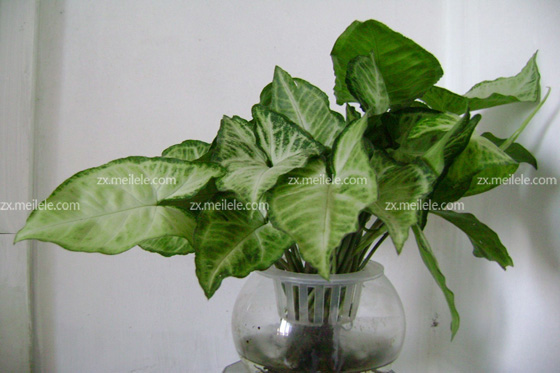
Introduction to Syngonium Cultivation Methods
1. Light: Syngonium has strong adaptability to light and prefers diffused light, but when the sunlight is too strong, its leaf edges will turn dry and yellow, while too dim light will make the leaves dull. In winter, there is no need to shade it from light. If kept in a position with insufficient light for a long time, the leaves will grow excessively and the markings will quickly fade.
2. Watering: Syngonium is a plant that likes moisture and fears drought. In summer, it should be watered adequately and the potting soil kept moist, which is beneficial to its stem growth. In winter, watering of Syngonium should be reduced, and its potting soil must not be too wet, otherwise it is prone to root rot and leaf blight in low-temperature environments.
3. Temperature: Syngonium is not cold-tolerant and likes a high-temperature, high-humidity environment. Its growing temperature is generally 20-30 degrees, and in winter it must not go below 15 degrees.
4. Fertilizing: Under bright light, Syngonium should be given a diluted liquid fertilizer once every two weeks, plus a 0.2% solution sprayed once a month. In winter, Syngonium should be fertilized.
5. Soil: Syngonium likes a slightly acidic soil that is high-temperature and high-humidity, loose and fertile, and well-drained. When potting, its growing medium can be made from a mix of leaf mold, peat soil and coarse sand. At the same time, Syngonium is also very suitable for soilless cultivation.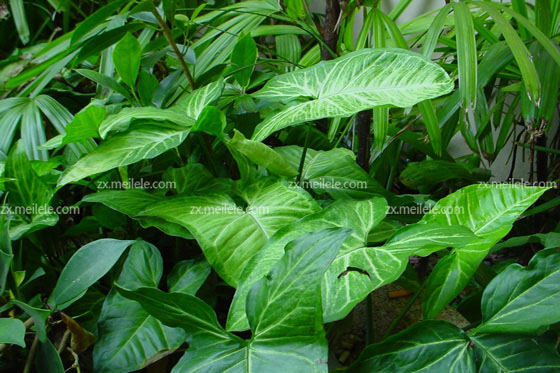
Is Syngonium Poisonous?
Syngonium, also known as arrow-leaf taro, is a plant in the genus Syngonium of the Araceae family. Araceae plants contain toxins, especially their sap, dripping water and rhizomes, which are all toxic. If ingested by mistake or if its sap is swallowed by mistake, it will cause discomfort in the throat and mouth, and in severe cases can even cause suffocation, leading to death from cardiac paralysis. Skin contact with its sap can cause itching or strong irritation, and eye contact with the sap can cause severe conjunctivitis or even blindness. Therefore, when growing it, contact with Syngonium should be minimized as much as possible, and families with young children had best not plant it.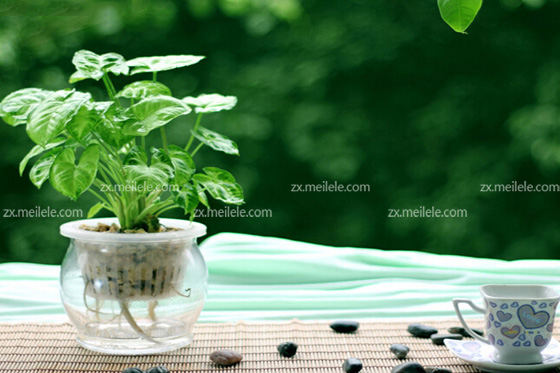
Summary: Because Syngonium is relatively easy to propagate, simple to cultivate, especially shade-tolerant and excellent in decorative effect, it is very widely used around the world. The above is the editor's introduction to Syngonium cultivation methods and whether Syngonium is poisonous. After reading the editor's introduction, I believe everyone has gained a certain understanding.